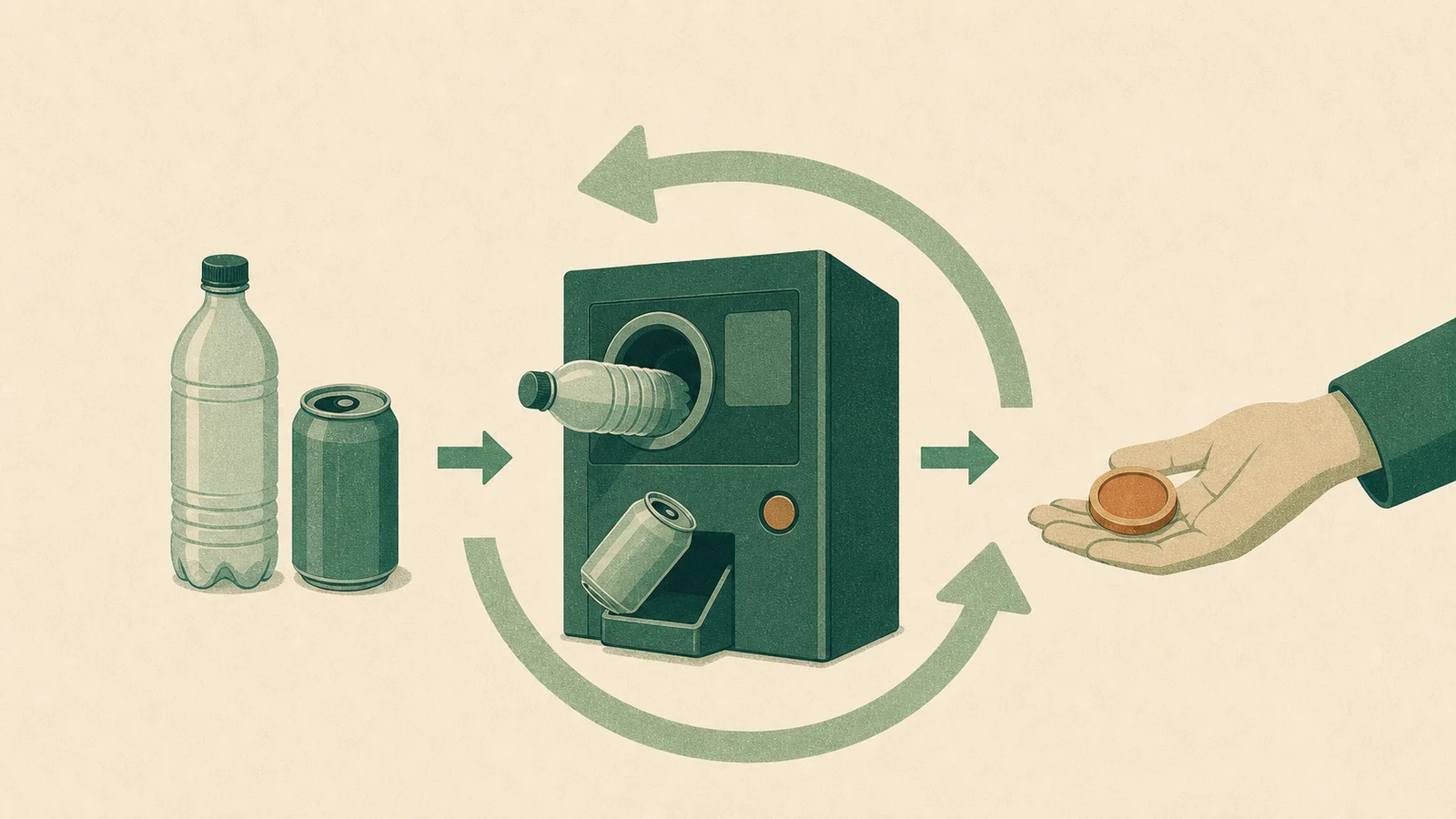
Since 1 January 2025, almost every single-use plastic bottle and every drinks can sold in Austria has carried an extra 25 cents — refunded when you bring the empty container back. A year and a half on, the initial confusion at the tills has largely settled into routine. Yet the same questions keep cropping up in everyday life: which bottles actually carry a deposit and which don't? Where do I return the empties? And what happens if the label is missing? This article explains the system step by step — and takes a sober first look at the results.
What the deposit is for — and where it comes from
Austria's single-use deposit is no national solo effort but part of an EU-wide push. The European Union's Single-Use Plastics Directive requires that at least 90 per cent of single-use plastic drinks bottles be collected separately by 2029. Internationally, a deposit is considered the most effective instrument for hitting such targets. Austria — following Germany, Scandinavia and the Baltic states before it — has chosen this route.
Two goals take priority. First, high-quality recycling: bottles returned as a single, clean material stream yield material pure enough to be turned into new bottles. Second, less littering — the careless discarding of packaging in nature. A can worth 25 cents ends up in the roadside ditch less often; that is the basic idea. The scheme is run by Recycling Pfand Österreich, a body set up specifically for the purpose, in which retailers and the beverage industry are jointly involved. The logic is much like trying to cut food waste at home: small everyday routines that add up to large volumes.
How much deposit, on which packaging
The deposit is a flat 25 cents per container, charged at the till on top of the product price. When you return the empty container, the 25 cents are paid back. The amount is independent of size: a 0.5-litre bottle carries exactly the same deposit as a 1.5-litre one.
The deposit applies in principle to single-use plastic bottles and metal cans with a fill volume between 0.1 and 3 litres. That covers the bulk of typical drinks: mineral water, soft drinks, iced tea, energy drinks, many juices and canned beer. These containers can be recognised by a uniform deposit logo, which, according to Recycling Pfand Österreich, must be printed on every deposit-bearing container.
What is not covered
It pays to look closely here, because the exemptions cause confusion. Milk and syrup are exempt — so anyone buying cow's milk in a plastic bottle pays no deposit. Plant-based milk alternatives such as oat or soy drinks, however, very much do fall under the deposit obligation. This distinction is not always intuitive and explains a fair share of the questions at the tills.
Also exempt from the deposit, according to the responsible bodies, are beverage cartons (the classic Tetra Pak packaging), glass bottles and metal bottles with plastic closures. Packaging for baby food and for liquid foods for special medical purposes is exempt too. Refillable glass bottles continue to run through the separate, older refillable-deposit system and are not part of the new scheme.
Rule of thumb for everyday life: deposit logo on the container means deposit paid — and deposit back. If there's no logo, the packaging belongs in the separate recycling collection, not in the reverse vending machine.
How returns work
The principle is simple: empties can be returned wherever such packaging is sold — supermarkets, discounters, drugstores, petrol stations and many smaller shops. Larger stores have reverse vending machines that scan the logo and barcode and credit the deposit onto a receipt. Smaller outlets without a machine take bottles and cans back manually and pay out the deposit directly.
One detail often overlooked in practice: with manual returns, a shop is only obliged to take back the types of packaging it actually stocks, and only in household quantities. Anyone looking to offload a large bag of mixed cans is better off heading for a machine. There is explicitly no take-back obligation for vending machines or for postal and parcel delivery services.
For a machine to accept a container, a few conditions must be met: the deposit logo and barcode must be legible, the container empty and uncrushed, and the label must be fully intact and readable. Squash a bottle flat or peel off the label and you risk the machine rejecting it. There is a special rule for hospitality: restaurants, cafés and snack stands where drinks are not usually taken away need neither charge a deposit nor take anything back.
The first results: target exceeded
After the first full year, the official verdict is positive. According to Recycling Pfand Österreich, the scheme achieved a collection rate of 81.5 per cent in its debut year — the deposit regulation had only required 80 per cent for 2025. In absolute figures: around two billion deposit-bearing drinks containers were put on the market in 2025, and roughly 1.4 billion bottles and cans had come back by year's end. The operator's rate factors in an average dwell time of around 51 days between sale and return — drinks bought in December often only come back in the new year.
The infrastructure is in place too: around 16,300 return points and more than 6,400 machines are in operation, according to the operator. On material quality, Recycling Pfand Österreich points to a packaging recyclability of 99.5 per cent and a recycled-content share in plastic bottles of over 60 per cent — well above what the EU currently mandates. The next milestone is a 90 per cent collection rate by 2027, which would see Austria meet the EU target two years ahead of schedule.
Where things still stick
For all the positive numbers, there are criticisms that shouldn't be swept under the carpet. Austrian media reports repeatedly mention broken or overflowing machines and queues, especially at peak times. Disability advocates point out that machines and labelling are hard to access for people with visual impairments. And drinks consumed in public spaces still frequently end up in the bin rather than the deposit loop — with the result that people redeem the deposit value by searching through rubbish bins. In border regions, retailers also reported a noticeable temporary dip in sales of canned beer.
On balance, the single-use deposit is one building block in a larger logic: it is meant to pull packaging out of residual waste and out of nature, and to feed it back into the loop as clean raw material. How it fits alongside the other levers becomes clear when you look at the circular economy in everyday life. And anyone who follows the deposit loop to its logical end inevitably arrives at the most obvious option of all — avoiding plastic in daily life in the first place, before a single-use bottle ever lands in the shopping trolley.