In Austria, every person generates around 34 kilograms of plastic packaging waste per year — roughly 300,000 tonnes in total, plus, according to industry figures, some 1.6 billion plastic bottles annually. These are much-quoted numbers, and they quickly trigger a reflex: sort even more carefully, make even more trips to the yellow recycling bin. But anyone who genuinely wants to reduce packaging waste has to start further upstream. The decisive question is not how to dispose of plastic correctly, but how to keep it out of the shopping trolley in the first place.
This article sorts the familiar tips by what actually makes a difference in daily life — and separates that from measures which feel good but move little. The yardstick is not activism, but the official waste hierarchy of the EU and Austria's packaging ordinance: avoid before reuse, reuse before recycle. That is also precisely the order in which it pays to think about your own consumption.
Why recycling is the weakest lever
Recycling has acquired an image in recent years as an all-purpose weapon against plastic waste. The reality is more sobering. Of the roughly one million tonnes of plastic waste Austria produces each year, several surveys suggest that only about a quarter is materially recycled — the vast majority is incinerated, often for energy recovery. For plastic packaging specifically, the recycling rate in 2021 stood at around 26 per cent, according to the Court of Audit (Rechnungshof) and environmental data. The EU requires that figure to double to 50 per cent by the end of 2025, with 55 per cent the target for 2030. Austria has so far lagged well behind these marks.
That does not mean sorting is pointless — quite the opposite: correctly separated packaging is the precondition for recycling to work at all. But recycling is, and remains, the end of the chain, not the beginning. Every plastic loses quality with each round of reprocessing, and a large share ends up in incineration despite the best intentions. Anyone who wants to avoid waste therefore gains most by not buying the packaging in the first place. This logic of the circular economy in everyday life sounds theoretical, but it has very concrete consequences for the weekly shop.
The biggest single lever: tap water instead of bottled water
If there is one point where the most plastic waste can be saved with minimal effort, it is drinking water. According to estimates, every person in Austria buys around 92 litres of water in plastic bottles each year — water that flows from the tap in outstanding quality in almost every household. The latest national drinking water report confirms it: over 98 per cent of the samples tested meet the strict requirements of the drinking water ordinance, and Austria draws its drinking water almost entirely from protected groundwater via wells and springs.
Switching from bottled to tap water saves not only packaging but also the lugging, the transport miles and a substantial cost factor. Supermarket mineral water is many times more expensive than tap water, with no demonstrable health benefit worth mentioning. Anyone who wants to know more about the actual differences will find a sober comparison in our fact check on mineral water versus tap water. For life on the go, a refillable bottle is all you need — a rare measure that is convincing both ecologically and financially at once.
Refillables over single-use: measurable, but slow going
When buying drinks, refillable deposit bottles are the most consistent lever. A returnable glass or PET bottle is refilled many times before it ever becomes recycling material. Lawmakers have recognised this: since the start of 2024, larger food retailers above 400 square metres have been progressively required to offer drinks in refillable containers as well — and since the end of 2025 this applies to all shops of that size. The aim is to lift the refillables share to at least 25 per cent by 2025 and 30 per cent by 2030. The first annual refillables report from the environment ministry shows, however, how far there is still to go: in 2024, just under 19 per cent of drinks sold came in refillable packaging.
For consumers this means the refillables shelves are now in place almost everywhere — but they have to be actively used. Beer, mineral water, soft drinks, juices and milk are available in deposit bottles in many shops. Reaching for those is a more effective decision than correctly disposing of a single-use bottle afterwards.
Refillables beat single-use because a bottle that comes back twenty times never has to be produced twenty times in the first place.
This is also where the single-use deposit scheme in force since 1 January 2025 comes in — though with a different logic. Since then, plastic bottles and cans carry a 25-cent deposit. In its first year, around 1.4 billion containers were returned according to Recycling Pfand Österreich, the deposit scheme operator, giving a collection rate of 81.5 per cent — above the statutory first-year target. The framing matters, though: the single-use deposit improves recycling, but it does not avoid any waste. It ensures that more single-use bottles end up cleanly in the loop rather than in residual-waste incineration. How the system works in detail, and what to watch out for when returning containers, is explained in our piece on Austria's single-use deposit scheme. None of this changes the fact that refillables remain the ecologically superior option.
Zero-waste shopping: sensible, but not necessary everywhere
Zero-waste shops are seen as the symbol of packaging-free shopping, and for certain products they really are practical: pasta, rice, nuts, pulses and in some cases washing and cleaning products can be dispensed there into containers you bring along. If you have such a shop nearby and stock up anyway, you avoid real quantities of packaging.
Realistically, though, the zero-waste shop does not replace the weekly shop for most households. More important — and lower-threshold — is packaging-conscious shopping in the ordinary supermarket or at the market. Fruit and vegetables are available loose almost everywhere; the thin plastic bags at the scales are dispensable if you bring reusable mesh bags. Bread and pastries go happily into a cloth bag. With processed goods, it pays to look at the material: glass and paper are usually easier to keep in the loop than composite packaging made of multiple layers. The environmental advice service Die Umweltberatung and the Austrian consumer association VKI have pointed out for years that simply avoiding portion packs and preferring larger sizes saves a noticeable amount of material.
What remains symbolism — and what counts
Not every well-meant gesture changes the waste balance. The single reused plastic bag is nice, but barely registers against 34 kilos of packaging waste per head. Heavily marketed "biodegradable" plastic alternatives often break down only under industrial conditions in practice, and can even disrupt the collection systems. And the feeling of solving the plastic problem through meticulous sorting is misleading as long as the overwhelming share gets incinerated anyway.
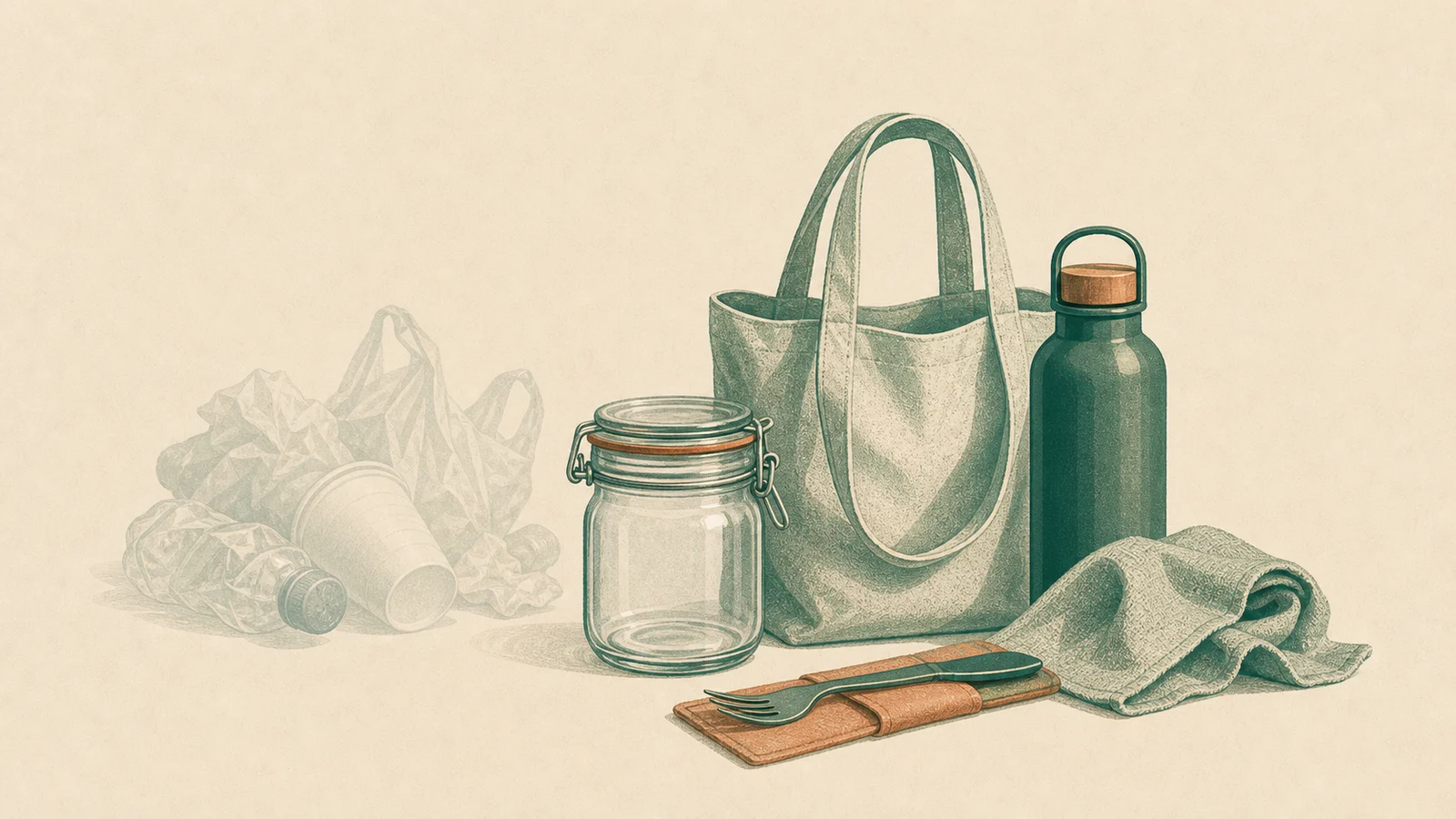
What counts is a short hierarchy that holds up in everyday life: tap water instead of bottled water, refillable instead of single-use, loose instead of portioned, larger sizes instead of many small ones — and only after that, the correct sorting of whatever could not be avoided. It is no coincidence that this order matches the statutory waste hierarchy. It is also the most honest answer to the question of where your own effort achieves the most. Avoiding packaging is less convenient than disposing of it — but it is the only lever that reduces waste where it really counts: before it exists.