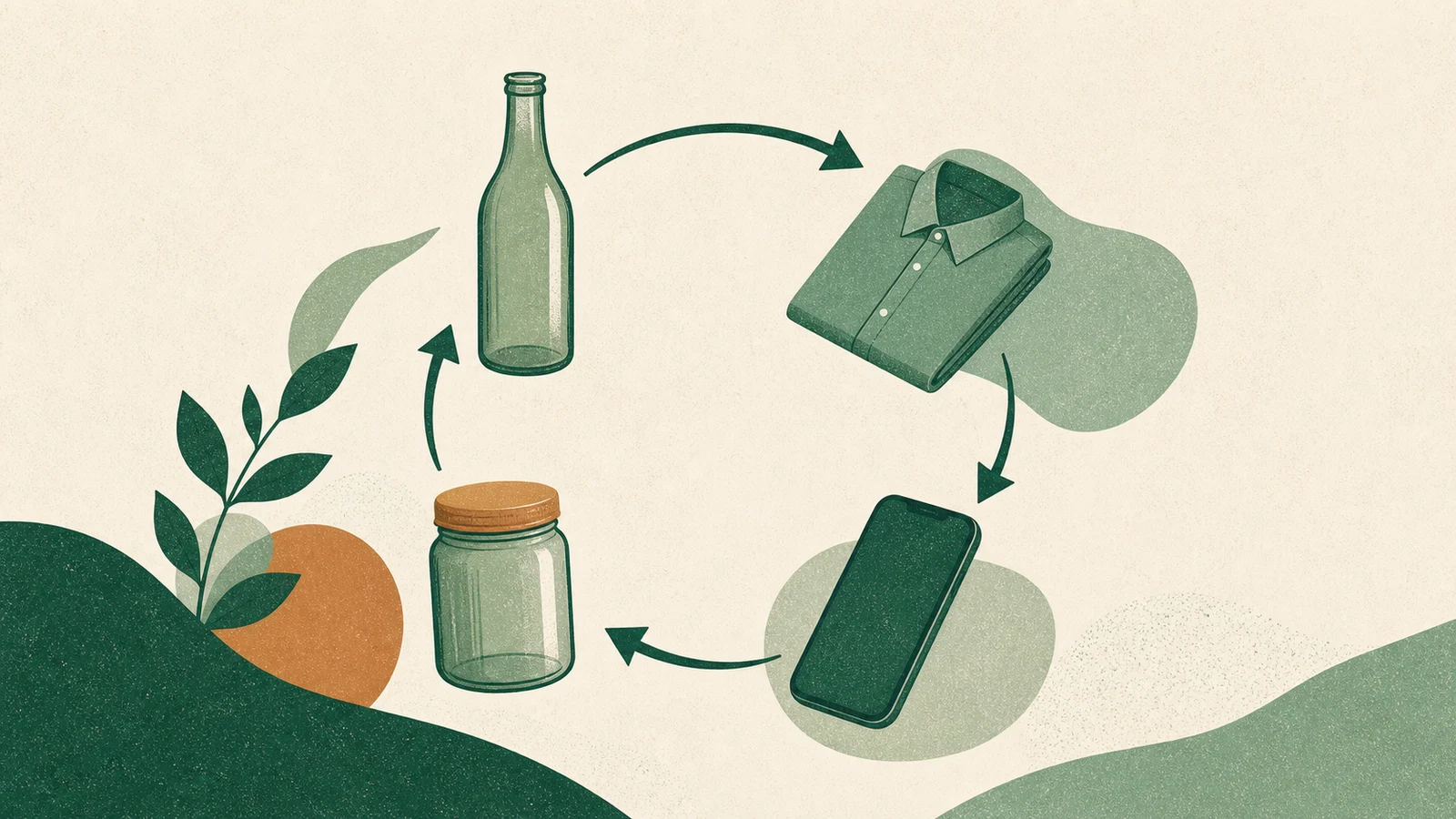
Nobody carrying the residual waste out to the bins in Austria feels like they are turning a great dial of the national economy. And yet the decisions made in kitchens, cellars and garages add up to considerable flows of material. According to the Umweltbundesamt, Austria's federal environment agency, around 600 kilograms of municipal waste are generated per person per year — a figure that sits towards the upper end of the European range. The idea of the circular economy starts precisely here: materials should stay in circulation for as long as possible, rather than being incinerated or landfilled after a single use. For everyday life, the interesting question is not so much whether to take part, but how much a single household actually moves — and where the line runs to the system level, where lawmakers, retailers and industry hold the real levers.
Waste sorting: a solid routine with room to improve
Separating waste has been ingrained in Austria for decades and works well by international standards. Glass, paper, metal, plastics and organic waste go into separate containers, and collection rates for several streams sit above the EU average. Altstoff Recycling Austria (ARA), the collection and recovery scheme that organises the bulk of packaging waste, regularly points to high capture rates for glass and paper. Even so, a stubborn problem remains visible in the residual waste: analyses by the Umweltbundesamt have shown for years that a substantial share of what ends up in the residual waste bin does not belong there. Organic waste and recyclable packaging account for a large part of it.
Since the beginning of 2023, a single rule has applied across Austria for plastic packaging: regardless of the material, it goes into the yellow bin or the yellow bag. This harmonisation ended years of patchwork in which every municipality had its own rules. For households, it means in practice that the yoghurt pot, the plastic bottle and the film wrap now all take the same route. The effect of waste sorting is real, but it has a blind spot: it intervenes at the end of the chain. What is never produced or packaged never needs to be sorted — and that is exactly where the bigger lever lies.
Refillables over single-use: the deposit as a system switch from 2025
Perhaps the most tangible intervention of recent years is the single-use deposit scheme that came into force on 1 January 2025. A deposit of 25 cents has since been charged on single-use plastic bottles and drinks cans, refundable on return to retailers. The aim is a markedly higher collection rate: the European Union requires that around 90 per cent of single-use beverage bottles be collected separately by 2025, and without a deposit that figure was out of reach in Austria.
For the individual household, the way drinks containers are handled has visibly changed. Bottles and cans are no longer tossed casually into the yellow bag but collected and taken back. In parallel, the classic refillable system is coming back into view — glass bottles for beer, milk or mineral water that, depending on the container, are refilled twenty to fifty times before being melted down. Anyone who shops regionally and buys refillables avoids material rather than merely recycling it. That is ecologically preferable, because recycling itself consumes energy and material quality degrades with every cycle. The deposit is a good example of how a political decision shifts the behaviour of millions of households at once — without each individual having to weigh up the ecology for themselves.
Repairing: from throwing away to using again
A second effective lever lies not in the bin but in the workshop. The longer an appliance, a garment or a piece of furniture stays in use, the fewer resources have to be spent on a replacement. With its repair bonus (Reparaturbonus), Austria has created an instrument that has drawn international attention: private individuals receive a subsidy towards the cost of repairing electrical and electronic devices — from dishwashers to smartphones to coffee machines. Thousands of businesses take part, and demand was at times so high that the funding had to be rationed.
Repair cafés and local initiatives
Alongside the state subsidy, a dense scene of volunteer-run repair cafés has taken root. In Vienna, Graz, Linz and Salzburg, volunteers meet regularly to dismantle, solder and revive broken devices together with visitors. The effect is twofold: waste is avoided, and knowledge is created about how things actually work — a competence that has been lost over recent decades. Repair does run up against limits that households cannot set for themselves, however. Glued-in batteries, unavailable spare parts and software that throttles older devices are design decisions made by manufacturers. The planned EU right to repair is meant to tighten the rules here, but until it takes full effect, much still hangs on the framework conditions.
Sharing and using instead of owning
The third building block changes the question of ownership. Not every appliance you need occasionally has to sit in your own cellar. Tool libraries, cargo-bike hire schemes and neighbourhood platforms make it possible to use things without owning them. Several Austrian cities run municipally supported cargo-bike sharing schemes, and libraries of things lend out drills, raclette grills or garden tools for a small fee or free of charge. It is often the same municipalities that are also bringing more green into the city — municipal commitment pays into both goals.
The ecological logic is simple: over its entire lifetime, a drill is actually used for only a few minutes on average. If a whole neighbourhood — a Grätzl, as the Viennese say — shares one device, it replaces dozens of new purchases. Second-hand platforms and flea markets belong in this category too — they extend the life of products without requiring new production. The household contribution here is real, but it only scales if the infrastructure exists. Sharing models need platforms, storage space and often municipal funding to grow beyond niche status.
Household versus system: an honest reckoning of proportions
For all the justified attention paid to individual behaviour, a sober assessment is worthwhile. The largest share of an economy's material consumption arises not in private households but in construction, industry and infrastructure. When the Umweltbundesamt reports hundreds of millions of tonnes of material input for Austria, the share a family influences through sorted waste and repaired appliances is comparatively small.
That is not an argument against doing your part — it is an argument for setting the right expectations. Households achieve two things. First, they directly reduce their own waste and resource consumption — measurably, but within limits. Second, and this is the underrated effect, changed consumer behaviour creates demand. Anyone who buys refillables, gets things repaired and shares sends the market a signal that there is paying custom for durable, circular products. The really big leaps, however, come from the system level: from ecodesign requirements that make repairability mandatory, from producer responsibility that shifts disposal costs onto manufacturers, and from deposit or refillable quotas that apply to everyone at once. The same logic applies to Austria's 2030 climate targets, which would be barely within reach without such structural course-setting. The deposit from 2025 illustrates this perfectly: a single change to the rules moves more bottles into the loop than all the voluntary efforts of past years combined.
What remains
The circular economy in everyday life is neither symbolic politics nor a cure-all. Waste sorting, refillables, repair and sharing are effective tools that make a measurable, if limited, contribution — and that steer demand in a resource-saving direction at the same time. Anyone who stays realistic, though, will recognise that the decisive levers lie at the system level, where laws and product design set the rules of the game for millions of households. The new deposit scheme, the repair bonus and the harmonised packaging collection are examples of how a political framework is what makes individual action broadly effective in the first place. For the individual household, the lesson is this: what you do counts — but above all, it pays to use, and to demand, the structures that turn many small decisions into a genuine material loop.