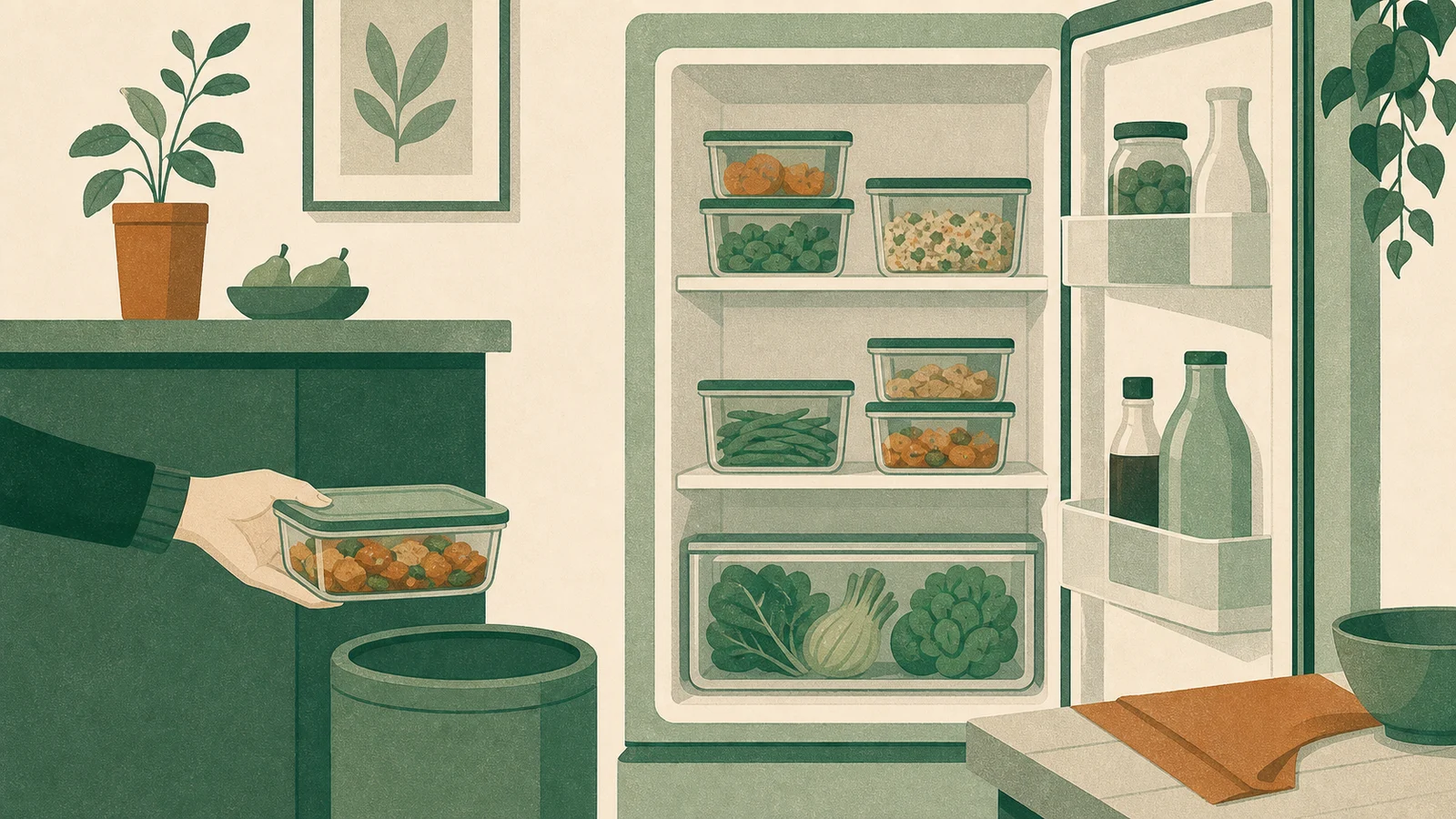
Every year, Austrian households send enormous quantities of perfectly edible food into the residual waste bin or the organic bin. The Umweltbundesamt, Austria's federal environment agency, estimates that around 100 kilograms of food and leftovers per person are thrown away avoidably each year — bread, fruit, vegetables, dairy products, cooked meals. Much of it could still have been used. This is not just a question of environmental footprint but of household budgets: the Chamber of Labour (Arbeiterkammer) calculates that an average household loses several hundred euros a year as a result. The good news is that most of these losses stem not from a lack of goodwill but from habits — how we shop, how we store food, how we read date labels. In other words, from levers that can be adjusted at home.
How big the problem really is in Austria
Across the entire value chain — from farming through processing and retail to restaurants and private kitchens — Austria generates around one million tonnes of avoidable food waste per year, according to estimates by WWF Austria. And the single largest contributor is not supermarkets or restaurants but households themselves. Studies by the University of Natural Resources and Life Sciences (BOKU) in Vienna, which has been analysing residual waste bins for years, repeatedly arrive at the same picture: a considerable share of what ends up in household rubbish is still in its original packaging or barely opened.
These figures vary depending on the survey method, and reputable sources themselves point out that the data has its blind spots. The trend, however, is stable: household food waste is a volume problem made up of many small decisions. The national strategy takes the same view, aligning itself with an EU target of significantly reducing food waste by 2030. That target is part of a broader EU push against waste, which also includes the new right to repair. At home, though, what matters is less the headline figure than the concrete question: where, in my own kitchen, is food going to waste?
A best-before date is not an expiry date
A substantial share of the waste rests on a misunderstanding. The best-before date — the wording on the packaging is "mindestens haltbar bis", "best before" — is a manufacturer's guarantee that a product, stored correctly, will retain its specific qualities such as taste, texture or colour until that day. It is emphatically not the date on which the food suddenly becomes inedible. Yoghurt, pasta, rice, flour, tinned goods, chocolate or honey are often perfectly fine to eat weeks or months past the printed date. Honey, for one, keeps virtually indefinitely.
Clearly distinct from this is the use-by date, labelled "zu verbrauchen bis". It appears on highly perishable products such as minced meat, fresh poultry or certain fish products. Here the issue is food safety, and once the date has passed, the product genuinely should not be eaten. The simple rule of thumb: with "best before", trust your own senses. Smell it, look at it, taste a small amount, and you will reliably know whether something is still good. This shift in thinking alone — reading the date as guidance rather than as a command — would, environmental organisations estimate, prevent a noticeable share of household food waste.
Proper storage extends shelf life
Many foods spoil sooner than necessary simply because they are kept in the wrong place. The fridge is not a uniform box: it is coldest at the bottom, above the vegetable drawer, which is where meat, fish and cold cuts belong. Dairy products sit well in the middle, while the door — the warmest zone — is the right home for butter, sauces and drinks. A fridge temperature of around five degrees slows spoilage significantly without wasting energy.
Not everything belongs in the cold. Tomatoes lose their aroma in the fridge and turn mealy; potatoes, onions and garlic stay fresh longest stored somewhere dark, cool and dry — ideally separated from one another. Bread keeps for days in a clay or ceramic bread crock, whereas in the fridge it goes stale faster. Another underrated lever is the freezer: bread, cooked portions, leftover vegetables or herbs can be frozen, rescuing what would otherwise have spoiled. And shopping in honest quantities — with a list, and a realistic look at what the week actually holds — prevents waste at the source, before anything even reaches the fridge.
Turning leftovers into cooking
So-called leftover cooking is not a makeshift solution but an old, once self-evident practice that many households have lost. Stale bread becomes dumplings, breadcrumbs or a bread bake. Vegetables starting to wilt turn into a soup or a stir-fry. Yesterday's leftovers can be rebuilt into a gratin, a frittata or a stew. What matters is less the recipe than the mindset of first checking what is already there before buying anything new — a principle that works just as well when buying clothes consciously.
A system long standard in the food retail trade helps at home too: first in, first out. Whatever was bought first moves to the front and gets used first. Anyone who takes a quick weekly look into the fridge and the pantry and deliberately plans one meal around what needs using up soon will reduce their waste with no extra effort. This is where the biggest effect lies: not in doing without, but in consistently using up what has already been bought.
Apps and initiatives as a complement
Beyond the home kitchen, plenty has happened in recent years. The app Too Good To Go — as widespread in Vienna, Graz, Linz, Salzburg and Innsbruck as in smaller towns — brokers surprise bags from bakeries, supermarkets, restaurants and hotels that would otherwise have food left over at the end of the day. Customers pay a reduced price and collect the goods shortly before closing time. This does not solve the structural problem, but it makes the handling of surplus food visible and easy to take part in.
Alongside it there is the food-sharing movement with its publicly accessible "Fairteiler" community fridges, through which private individuals and businesses pass on edible food, as well as the social supermarkets (SOMA), which sell flawless goods at heavily discounted prices to people on low incomes. Food banks and charitable organisations play a similar role. These schemes are a sensible complement, but they do not replace prevention at home — because the most effective food waste remains the waste that never happens in the first place.
What remains
Household food waste is not a moral failing but a problem of routine, one that a few sober adjustments can shrink. Read the best-before date as guidance rather than a deadline, stock the fridge sensibly, glance at your supplies before shopping and use up leftovers consistently, and you save money and rubbish at the same time — without sacrifice and without great effort. The roughly one hundred kilograms per person that the Umweltbundesamt flags as avoidable each year are not a constant of nature but the sum of many small decisions. Which is exactly why they can be changed where they arise: at home, in your own kitchen.