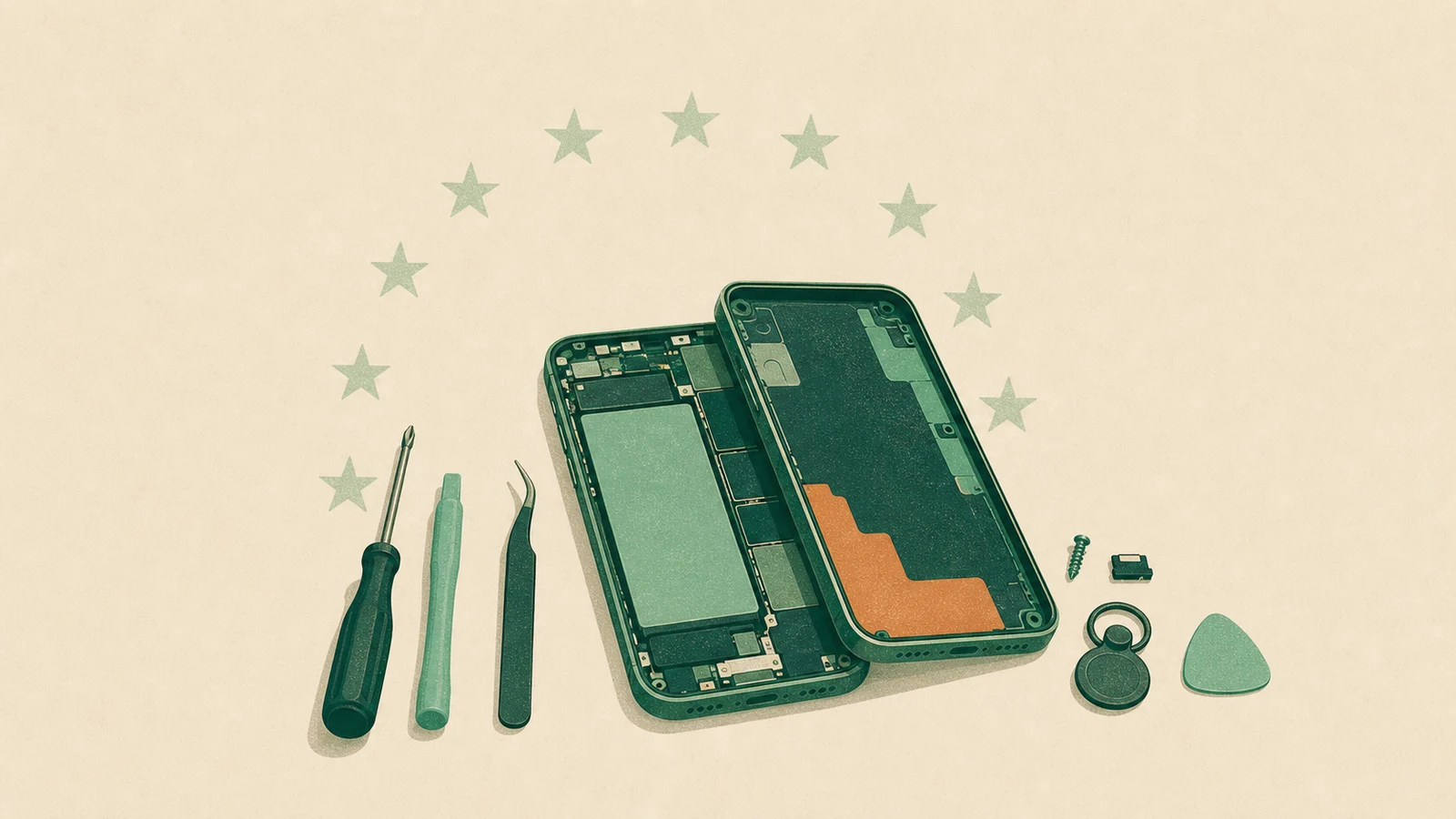
A washing machine that gives up the ghost after five years. A smartphone whose battery fades just after the warranty runs out. Until now, the story usually ended the same way: throw it away, buy new. Anyone who wanted to repair instead often foundered on missing spare parts, opaque pricing, or simply the fact that no manufacturer felt responsible. From summer 2026, that is set to change. The EU directive on the "right to repair" is being written into Austrian law — and, as far as can currently be foreseen, takes effect from 31 July 2026.
Behind the unwieldy name Directive (EU) 2024/1799 sits a genuinely ambitious goal: repairing should become easier, more transparent and more attractive, so that working appliances stay in use longer and fewer end up as electronic waste. The underlying idea mirrors buying clothes consciously: what lasts longer needs replacing less often. For Austrian households this matters, because the country's existing repair subsidy has already nurtured something of a repair culture. But what does the new right deliver in concrete terms — and where are the catches?
From EU decision to Austrian law
The directive has been in force at European level since the end of July 2024. As is usual with EU directives, member states must first translate it into their own legislation. In Austria that job falls to the so-called Goods Repair Directive Implementation Act, known by its German abbreviation WaRUG. According to the Ministry of Justice, it amends several existing laws at once, above all the Consumer Protection Act (Konsumentenschutzgesetz) and the Consumer Warranty Act (Verbrauchergewährleistungsgesetz).
The key date on which the new rules are due to apply is 31 July 2026 — which is also the deadline by which the EU requires implementation. As things stand, the new obligations apply to contracts concluded from that date onwards. An important caveat: at the time of writing, the bill was still making its way through parliament. Individual details may therefore still shift before it enters into force. The broad strokes, however, are settled, because they are dictated by the EU directive.
Two building sites: the warranty period, and repairs after it
To understand what is new, a distinction helps. The first building site concerns the statutory warranty — the period (in Austria, generally two years from handover) during which sellers must answer for defects. Here the new law creates a clear incentive to choose repair over replacement: if you opt for a repair within the warranty period, the warranty is extended, according to the draft law, by one additional year on a one-off basis. Whoever repairs rather than replaces will in future be not worse off, but protected for longer.
The second — and genuinely new — building site lies beyond the warranty. Until now, once the guarantee had expired, a manufacturer was under virtually no legal obligation to repair a defective device at all. That is precisely what is being turned on its head: for certain product groups, manufacturers must in future repair on request — even years after purchase, and regardless of whether the device was originally sold by them or through a retailer.
Which devices are covered — and which are not
It is worth looking closely here, because the right to repair is not a universal entitlement for every kitchen gadget. It is tied to the EU's ecodesign requirements. As things currently stand, it chiefly covers large household appliances and electronics: washing machines and washer-dryers, dishwashers, fridges and freezers, vacuum cleaners, electronic displays such as televisions and monitors, plus smartphones and tablets. Servers and certain commercial equipment are also included.
For many everyday products — coffee machines, toasters, headphones and the like — there is, for now, no corresponding repair obligation. The list is, however, deliberately designed to be dynamic: as new ecodesign regulations are added, the circle of products subject to mandatory repair grows too. Smartphones, for instance, have been subject to their own ecodesign requirements since mid-2025, obliging manufacturers to keep batteries, displays and other components available as spare parts for years.
Repair becomes a right — but only for those device categories the legislator expressly puts on the list.
What manufacturers must now deliver
For the right to work in practice, the directive imposes several concrete obligations on manufacturers. They must make spare parts and the necessary tools available at a reasonable price — and not only to their own workshops, but in principle also to independent repair businesses and to technically capable consumers.
Particularly striking is the ban on so-called repair obstruction. Under the new rules, manufacturers may no longer deploy software locks or technical tricks that make repair harder — for instance, a device recognising a non-original spare part and then refusing to function fully. Nor may they use contracts or technology to block the use of second-hand, compatible or even 3D-printed spare parts. That opens the door to cheaper repair routes beyond the brand's own workshop.
The European repair platform and the repair form
Two further building blocks are meant to bring more clarity. The first is a Europe-wide online repair platform, where consumers should be able to find repair businesses in their area or local initiatives such as repair cafés. Instead of 27 national silos, a single EU platform with country-specific sections is planned. One expectation worth managing: under the directive, this platform is not due until mid-2027 — roughly a year later than the other rules. Using it is free for consumers, and participation is voluntary for businesses.
The second building block is the European repair information form. It lets a business set out at a glance what is at stake: the type of defect, the proposed repair, the price or — where this cannot yet be fixed exactly — the calculation method including a maximum price, and the expected duration. The decisive advantage for households: if a business opts to use this form and you accept the terms, the stated conditions are binding for at least 30 calendar days. You can compare offers at your leisure without the price changing overnight. This form, too, is voluntary — a business is not obliged to use it.
How it interacts with Austria's repair subsidy
For Austrian households, the new right dovetails with an already established subsidy. The former Reparaturbonus repair grant was converted at the start of 2026 into the "Geräte-Retter-Prämie" (appliance rescuer premium), which, according to the available information, has been running since 12 January 2026. It still covers half the cost of a repair — but with a lower cap: instead of up to 200 euros, a maximum of 130 euros per repair is now reimbursed. For the years 2026 to 2028, around 30 million euros per year were originally earmarked; newly added to the scheme are, among other things, care and medical products such as wheelchairs or blood pressure monitors.
In practical terms: the EU right ensures that a repair is possible at all and that spare parts are available — while the national premium additionally lowers the price you ultimately pay yourself. Together, the two can make the difference between a repair paying off or not. Repairing thus joins choices like reducing everyday plastic among the consumer decisions with a measurable rather than merely symbolic effect. That said, demand has recently been high, and the scheme's continuation beyond 2026 is the subject of ongoing budget negotiations — anyone hoping to benefit should not take the pot for granted.
What households should watch out for
Welcome as the changes are, an honest assessment includes a few caveats. The most important criticism: what exactly counts as a "reasonable price" for spare parts, or a reasonable repair timeframe, remains vague in the legal text. Where the line lies will likely only emerge in practice — and possibly in court. Anyone commissioning a repair should therefore compare prices and, if in doubt, obtain a second quote.
Second, the right to repair applies only to the device categories listed. It is of no help, for now, with a broken toaster or a cheap pair of headphones. Premature discarding, incidentally, is not just an appliance problem — with best-before dates on food, too, plenty ends up in the bin far too early. Third, much of the framework is voluntary — both the platform and the repair form. Consumers should therefore actively ask for these tools rather than wait for them to be offered automatically.
On balance, the new right shifts the starting position noticeably in favour of repair. It turns what was often a frustrating exercise in supplication into a genuine entitlement — at least for durable appliances, where a repair is most likely to be worthwhile anyway. For Austrian households already familiar with the repair subsidy, it is a logical next step. But the greatest benefit will go to those who know the fine print: which devices are covered, how the form binds, and how right and premium can be combined.