39.7 degrees at Hohe Warte in Vienna, recorded at the end of June — the old June record from 1950 was pulverised by a full 3.6 degrees. According to the heat report from GeoSphere Austria, the national weather service, 157 of 277 weather stations set new monthly records in June 2026, and the lowlands strung together 10 to 14 heat days in a row. On the night of 29 June, the temperature at the Jubiläumswarte never dropped below 27.3 degrees — the warmest night ever measured in Austria. Anyone who spent those weeks in a Viennese attic flat or an unshaded Altbau in Graz has long since googled the question: buy an air conditioner, yes or no? And if so, which one? The answer depends less on how badly you feel the heat than on three sober factors: electricity consumption, purchase price and — often overlooked — the refrigerant inside the unit.
What running one actually costs
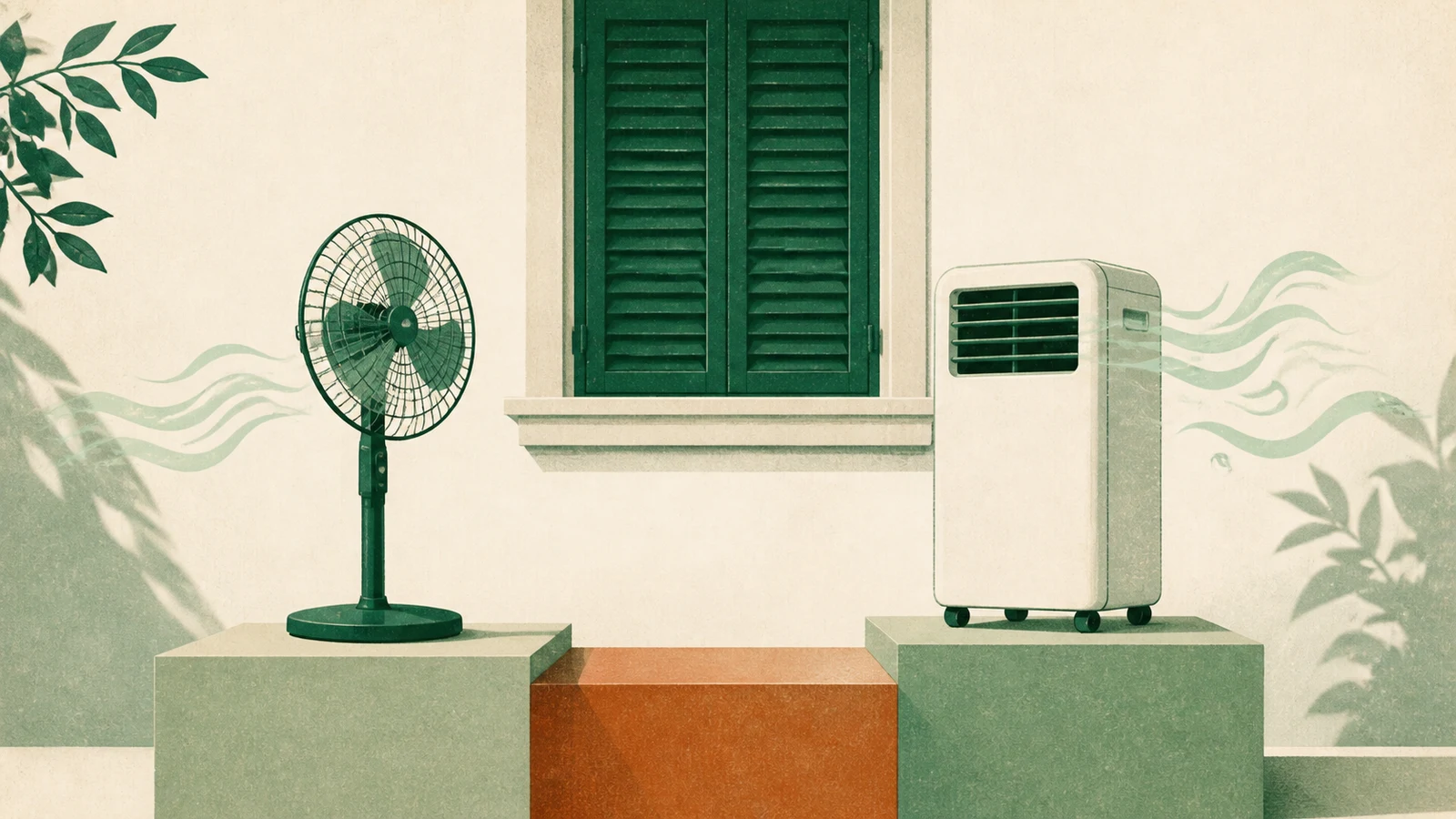
The differences in running costs are enormous, and they start with physics: a fan does not cool the air, it only moves it. The breeze makes sweat evaporate faster, which feels like a few degrees' relief. In return, a typical pedestal fan draws around 50 watts — a twentieth of what an air conditioner pulls. Even if you run it eight hours a day for an entire summer, you end up at roughly 40 kilowatt hours. At the current Austrian electricity price of around 29 cents per kilowatt hour on average — that is what comparison portals report for spring 2026, with the all-in price ranging from 23 to 35 cents depending on supplier and grid area — that comes to about twelve euros per season. With moderate use, the portal Stromliste reckons with as little as 4 to 10 euros per summer. Why it is still worth checking your own tariff is something our analysis of electricity prices in Austria in 2026 makes clear.
The portable monobloc air conditioner — the DIY-store classic with its exhaust hose wedged into a tilted window — is a different story altogether. It does actually cool, but inefficiently: warm air streams in continuously through the window gap, so the unit works against itself. A power draw of 1,000 watts and more is standard, meaning every hour of operation costs upwards of around 30 cents. For a 25-square-metre bedroom, 60 summer days, four hours a day, Stromliste calculates 80 to 160 euros in electricity costs per season. Anyone cooling eight hours a day in a summer like this one quickly lands above 200 euros — for a single room.
The permanently installed split system with an outdoor unit is the most efficient option: according to industry comparisons, it uses 30 to 50 per cent less electricity than a monobloc of the same cooling capacity. A modern A+++ unit comes to 40 to 80 euros per summer in the same scenario. The decisive figure when buying is the SEER value, which indicates cooling efficiency — specialist portals recommend values above 8.5.
The maths over several summers
When it comes to the purchase price, the picture flips. A decent portable unit usually costs several hundred euros, with basic models available for considerably less. A split system with 2.5 kilowatts of cooling capacity will set you back 1,500 to 4,500 euros in Austria in 2026, installation included — plus ongoing maintenance: a survey by the Lower Austrian Chamber of Labour (Arbeiterkammer) put a minor service alone, including a leak test and cleaning of the condenser, at 104 to 233 euros.
Add up purchase and running costs, and the monobloc still comes out as the cheaper overall solution over the first few years: the split system's premium of often well over a thousand euros takes many years to claw back through electricity savings alone — its arguments are efficiency, quiet running and lifespan, not quick payback. And all of this presupposes you are allowed to install one in the first place; that is exactly where things often fail in rented flats, more on which in a moment. For everyone else, the consumer advocates' simple rule of thumb applies: the cheaper the appliance is to buy, the more expensive it becomes to run.
That this calculation now concerns ever more households is shown by the ownership figures: according to the Environment Agency Austria (Umweltbundesamt), around 40,000 Austrian households owned an air conditioner in 2004; by 2018 the figure had reached 180,000. A Marketagent survey commissioned by Daikin in spring 2026 finds that roughly one in five owner-occupier households now has a unit and almost one in six is planning to buy one. Cooling is thus becoming a significant line item in household electricity — and belongs in any assessment of where the biggest electricity-saving levers in the home lie.
Refrigerants: the overlooked climate problem
Fighting the heat with an appliance that fuels global warming is a consistency problem — and that is precisely what lurks inside many air conditioners. The currently widespread refrigerant R32 has a global warming potential (GWP) of around 675: one kilogram, if it escapes, has the climate impact of 675 kilograms of CO2. Older units running on R410A sit far above even that. The alternative has long existed: propane, known in refrigeration engineering as R290, is a natural refrigerant with a GWP of about 3.
The EU is tightening the screws here. The revised F-gas Regulation 2024/573 stipulates that from 2027, new monobloc units may only contain refrigerants with a GWP below 150 — which effectively rules out R32 for this class of appliance. For small split systems the rules tighten in stages: from 2027 a GWP limit of 750 applies there first, and from 2029 units below twelve kilowatts of capacity also fall under the 150 threshold — at which point R32 is finished there too. Anyone buying now should therefore ask specifically for R290 units: they are already on the market, technically mature, and spare you an appliance that is regulatorily obsolete the day you buy it.
Buying an air conditioner with a classic F-gas refrigerant in 2026 means cooling yourself against the heat with a substance that makes it worse in the long run.
What the Chamber of Labour advises
The consumer protection experts at the Chamber of Labour (Arbeiterkammer) have a clear line on the purchasing decision — and a few warnings worth knowing. The legal side first: tenants may run portable units at any time without permission. A permanently mounted split system, by contrast, counts according to the AK as a material alteration to a rented flat and must be reported to the landlord in writing; for flats fully covered by the Tenancy Act (Mietrechtsgesetz), consent is deemed granted if the landlord does not object within two months. In Vienna, outdoor units often additionally require notification to the building authority.
The safety warning from the Lower Austrian AK is stark: portable air conditioners must never be run at the same time as a gas boiler. The unit creates negative pressure in the room and can draw odourless carbon monoxide from the flue into the flat — in the worst case a lethal combination, especially when you are cooling with the windows shut while hot water is being heated. Then there are the everyday recommendations: match the unit's capacity to the room size before buying, clean the filters regularly, take maintenance seriously, because bacteria and mould settle in neglected appliances. And the consumer advocates are equally clear about what they consider the better solution: external shading, proper ventilation and a fan — in that order.
Cooling without an appliance: shading beats technology
The most effective cooling is the heat that never gets in. Vienna's environmental advice service (Umweltberatung) puts it unequivocally: external shading achieves the best effect, while interior curtains and pleated blinds are the least effective, because by then the heat has already passed through the window. Specialist bodies put the difference at a multiple, depending on the system — Vienna's environmental ombuds office (Wiener Umweltanwaltschaft) even cites a factor of seven to ten for externally mounted slats compared with interior blinds. In concrete terms, for the summer that means:
- Fit roller shutters, external venetian blinds or awnings on the outside wherever it is structurally and legally possible — in a rented flat, ask the landlord if in doubt; in a jointly owned building, consult the other owners
- Keep windows and shading closed during the day, especially on the south and west sides
- Cross-ventilate at night and in the early morning, when the outdoor air is cooler than the indoor air — although in June 2026 it was admittedly sometimes too warm even for that
- Switch off internal heat sources: the oven, old halogen lamps and appliances running around the clock all add to the heat
The principle behind it is the same as in winter, only in reverse: the building envelope and your own ventilation habits determine how much technology you need in the first place — anyone familiar with the logic will recognise it in our guide to heating and ventilating properly.
That leaves the honest bottom line. For most flats in Austria, the combination of rigorous shading, night-time ventilation and a fan costing 50 to 150 euros is enough — with electricity costs of about one pub dinner per summer. For anyone living in an attic flat, coping with health conditions or getting small children through tropical nights, an efficient split system with R290 refrigerant is the cleanest technical solution — expensive to buy, but frugal to run. The portable monobloc unit, the one that sells fastest in heatwaves, is of all things the least convincing option: loud, inefficient and, over time, the most expensive way to cool a room. June 2026 has shown that the question is no longer whether such summers are coming. Only how cleverly we prepare for them.