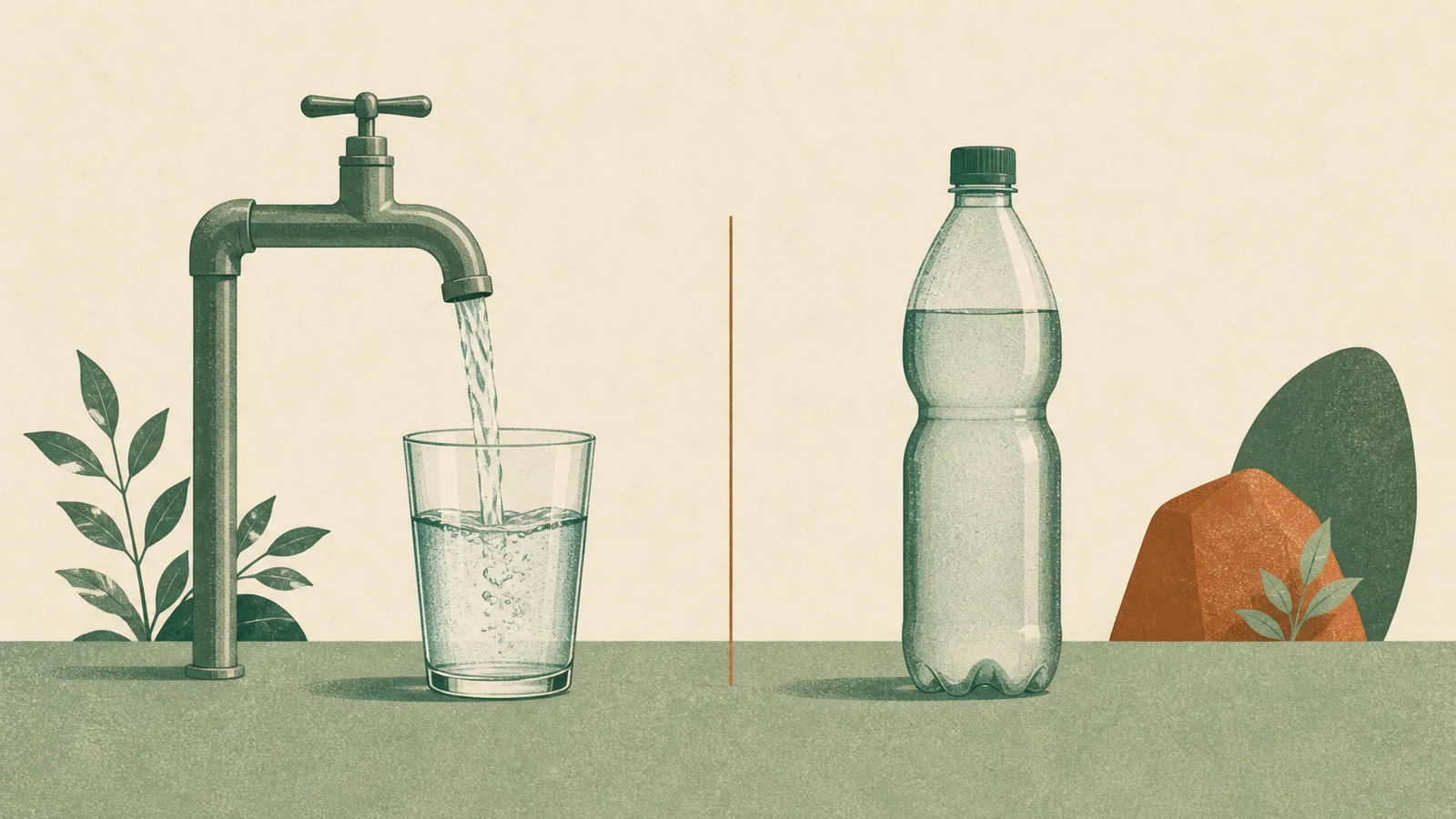
Turn on a tap in Austria and you get one of the most tightly regulated foodstuffs in the country – at a price that undercuts any supermarket bottle by orders of magnitude. And yet crates of mineral water sit in many households, and at the checkout the bottle lands in the trolley almost without a second thought. Is that a matter of taste, of habit, or actually a sensible decision? Here is a sober comparison along the lines that really matter: quality, cost, environmental footprint – and the myths that stubbornly refuse to die.
Quality: what actually comes out of the tap
An exceptionally high share of Austrian tap water comes from groundwater and spring water that often needs no treatment at all, or only minimal treatment. Vienna famously draws its water through two high-alpine spring pipelines from the Limestone Alps in Styria and Lower Austria – Wien Wasser, the city's water utility, has stressed for years that this water reaches households without any chemical treatment. But Graz, Linz, Salzburg and Innsbruck also rely largely on regional groundwater and alpine springs.
Legally, drinking water in Austria is treated as a foodstuff. The requirements of the Drinking Water Ordinance are strict, and compliance is monitored continuously – by the water suppliers themselves, by official bodies and by laboratories of AGES, the Austrian Agency for Health and Food Safety. Testing covers microbiological parameters as well as nitrate, heavy metals and pesticide residues. In its reports, AGES regularly points out that Austrian drinking water quality performs very well by European standards and that exceedances of limit values remain the exception.
As with organic, AMA or Fairtrade labels, it pays to look closely at who vouches for what. A common misunderstanding concerns the last few metres: the supplier is responsible for water quality up to the handover point, usually the water meter in the building. What happens after that depends on the building's plumbing. In older buildings, old lead pipes or water left standing in rarely used lines can be an issue. If you have been away for a while, it is best to let the water run briefly until it turns noticeably cooler – that means fresh water is coming through the pipe.
The price gap is not a typo
This is where the comparison gets stark. Depending on the municipality, a litre of tap water in Austrian cities costs somewhere between roughly half a cent and a few cents – often still in the low single-digit cent range per litre even including wastewater charges. Supermarket mineral water, even the cheap own-brand kind, costs a multiple of that, and branded water can be several hundred times more expensive per litre than its counterpart from the wall.
The Chamber of Labour (Arbeiterkammer) regularly runs the numbers on everyday costs like these and arrives at a noticeable annual sum for an average household that covers its entire drinking needs with bought water – money that is saved almost entirely by switching to the tap. For a family of four, the difference easily adds up to several hundred euros over the year. Even if you insist on fizz, a carbonator works out considerably cheaper in the long run than buying by the crate. How much the choice of appliance shapes everyday costs like these is something our cost check on cooling shows as well.
Plastic, CO2 and the journey to the bottle
The biggest ecological difference arises not in the glass but before it: in packaging and transport. Mineral water has to be bottled, packed, trucked to retailers over sometimes long distances and finally carried home. Tap water makes that journey through the pipe network, with no single-use packaging and no vehicle.
The Environment Agency Austria (Umweltbundesamt) and transport organisations such as the mobility association VCÖ have long pointed out that the climate footprint of bottled water is many times that of tap water – driven above all by packaging production and transport. Tap water comes out better by orders of magnitude in these comparisons virtually every time, regardless of whether the bottle is glass or PET.
The packaging material deserves a more nuanced look. Returnable glass, filled regionally in short loops, performs markedly better ecologically than single-use PET transported over long distances. Since the start of 2025, Austria has had a single-use deposit on plastic bottles and cans, designed to raise return rates and improve recycling. Recycling, however, does not change the fact that every bottle produced ties up material and energy in the first place. By a wide margin, the most resource-efficient drink remains the one that needs no packaging of its own.
When mineral water still makes sense
This fact check is not out to trash mineral water – there are understandable reasons for reaching for the bottle. Some people simply prize the taste of particular springs, or the sparkle that only comes bottled unless you own a carbonator. Mineral waters with a defined content of calcium, magnesium or hydrogen carbonate can, depending on their composition, contribute to mineral intake, which matters in certain dietary situations.
Practical reasons count too: anyone living in a very old building with questionable plumbing who has doubts about their own pipes can have the water analysed – through AGES or accredited laboratories, for instance – and switch to bottled water until the matter is settled. On the go, during sport or wherever no reliable tap is at hand, the bottle is the obvious choice anyway. So this is not about either/or, but about a conscious decision rather than pure habit – the same principle that separates secondhand fashion from the pure impulse buy.
Three myths, briefly checked
Plenty of assumptions circulate around water that do not survive closer scrutiny.
- "Tap water is full of chlorine." Thanks to its origin in protected groundwater and spring sources, drinking water in Austria is usually not disinfected at all, or only in exceptional cases. A persistent chlorine taste of the kind found in some other countries is untypical here.
- "Mineral water is fundamentally healthier." Both contain minerals, and the levels vary widely from source to source – bottled water included. There is no blanket health advantage; what matters is your overall diet.
- "Limescale in water is harmful." Limescale is nothing more than dissolved calcium and magnesium. Hard water can clog up your coffee machine and kettle, but it is harmless to health and even supplies minerals.
As for the much-invoked difference in taste: in blind tastings, good tap water regularly performs surprisingly well. Much of what we think we can taste is temperature, carbonation and expectation – not the substance itself.
The bottom line
For ordinary thirst at home, almost everything in Austria speaks for the tap: strictly monitored quality, a fraction of the cost and an incomparably better environmental footprint, because packaging and transport fall away. Mineral water remains a legitimate choice where taste, fizz, a specific mineral profile or a particular situation tips the balance – ideally as a conscious decision and, where possible, in regional returnable glass. Weigh the two soberly against each other and it quickly becomes clear that Vienna's high-alpine spring water and its counterparts from Graz, Linz, Salzburg or Innsbruck offer a remarkably good starting point. Not using them is, above all, one thing: a habit that deserves a second look.