Austria's EAG investment grant in 2026: €150 per kWp up to 10 kWp, €150 per kWh for storage, three funding calls, and why a storage bonus is planned from 2027.
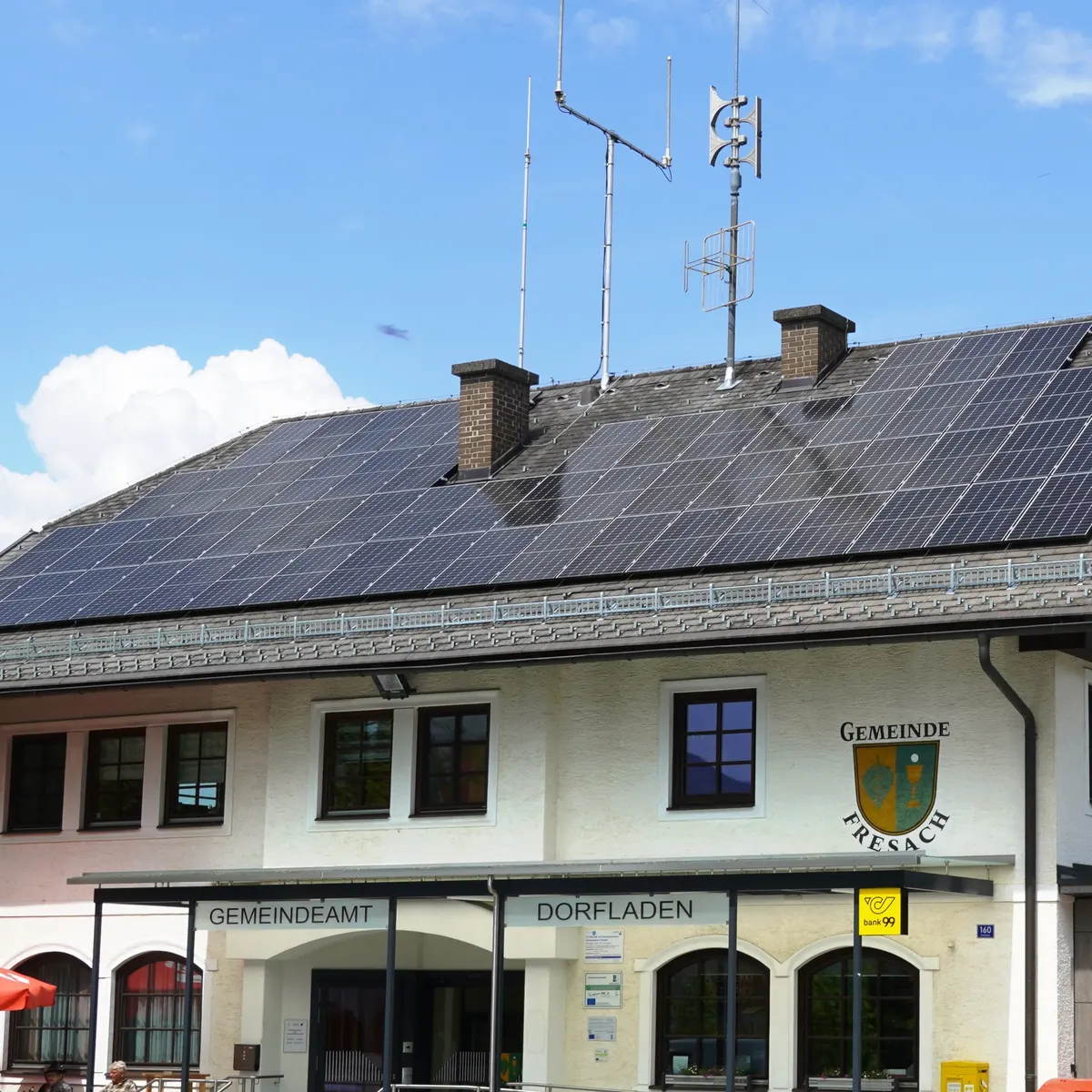
PV system with battery storage on the municipal office in Fresach, Carinthia, May 2023.
Photo: Naturpuur, CC BY 4.0, cropped
Austria's federal government funds photovoltaic systems in 2026 with the EAG investment grant: a one-off amount per kilowatt peak, €150 for small systems up to 10 kWp, and €150 per kilowatt hour for a battery bought at the same time. Applications are only possible in fixed windows, the funding calls. The third and last call of the year runs until 22 October 2026, and demand far exceeds the money available. From 2027 the economy ministry wants to replace the classic PV grant with a bonus for storage systems; this has not been passed yet. This article reflects the situation on 17 October 2026.
How the federal grant works in 2026
The legal basis is the EAG investment grant regulation for electricity (EAG-Investitionszuschüsseverordnung-Strom), last amended by Federal Law Gazette II No. 12/2026. The grant is administered by the EAG-Abwicklungsstelle, and applications go through its portal. The main rules according to the WKO funding overview:
- New PV systems and extensions of existing systems are eligible.
- The system must not be in operation when the first application is submitted; construction may already have started.
- A battery is only funded together with an application for a PV system, never on its own.
- The grant is a fixed amount per kWp or per kWh, not a percentage of the costs.
Since 1 April 2025, new contracts for PV systems are again subject to the standard VAT rate of 20 per cent; the temporary zero rate was ended early (Ministry of Finance, VAT rate for PV modules). That makes the investment grant the main federal support in 2026.
The 2026 grant rates
| Category | System size | Rate |
|---|---|---|
| A | up to 10 kWp | €150 per kWp, fixed |
| B | over 10 to 20 kWp | €140 per kWp, fixed |
| C | over 20 to 100 kWp | at most €130 per kWp |
| D | over 100 to 1,000 kWp | at most €120 per kWp |
| Storage | only with a new or extended PV system | €150 per kWh, fixed |
Source: WKO, EAG investment grant 2026, based on regulation BGBl. II No. 12/2026.
A worked example with these rates: an 8 kWp system in category A receives 8 times 150, so €1,200. Add a 10 kWh battery and that is another €1,500, €2,700 in total. If you install European-made components, a Made-in-Europe supplement has applied since 23 June 2025: 10 per cent each for modules, inverters and storage, up to 30 per cent on top of the granted rate.
In categories A and B, the time of submission decides who gets funding. For larger systems, applications are ranked by the funding requested; whoever asks for less per kWp comes first.
The three funding calls in 2026
| Funding call | Period | Budget cat. A | Cat. B | Cat. C | Cat. D |
|---|---|---|---|---|---|
| 1st call | 23 April to 11 May | €5m | €5m | €15m | €15m |
| 2nd call | 16 to 30 June | €2m | €2m | €4m | €4m |
| 3rd call | 8 to 22 October | €2m | €2m | €2m | €2m |
Source: WKO, EAG investment grant 2026. For the third call, the economy ministry topped up the regular €8 million with unused funds from earlier calls to €38.5 million in total (BMWET, 7 October 2026).
The third call began on 8 October at 5 p.m. with the ticket draw. A ticket is not yet an application: it only fixes the submission time that counts for the ranking. The actual application follows in the portal, by 22 October (WKO Carinthia, 28 September 2026).
Why the money is gone in seconds
The ministry's figures show how scarce the funds are. In the second call of 2026, the money was committed after 33 seconds; just under 28,000 applications competed for funding for only around 3,000 projects (BMWET, 6 October 2026). The rush for the third call was even bigger:
- 3rd call, after 1 minute19,600
- 3rd call, after 5 minutes40,800
- 3rd call, after 10 minutes43,300
- 2nd call, after 10 minutes24,900
Source: BMWET press release of 9 October 2026. Rounded figures; a ticket is not yet a submitted application.
For households this means: a ticket in the first seconds is a precondition, not a promise. Without an early ticket, do not count on the federal grant.
What is meant to change from 2027
On 6 October 2026 the economy ministry announced a new model (BMWET):
- The classic PV investment grant is to be replaced by a storage-system bonus.
- Storage on new PV systems and retrofits to existing systems are to be funded.
- The condition is an intelligent energy management system that runs the battery in a way that serves the grid and the system.
- A new battery on a new PV system is to require a European-made inverter; for retrofits there is to be a separate Made-in-Europe bonus.
- Instead of funding calls, applications are to be possible on a rolling basis after completion, with the final invoice, modelled on the craftsman bonus (Handwerkerbonus).
- Transition: projects with intelligent storage that received no EAG funding in 2026 and are invoiced or commissioned from 1 November 2026 are to be able to apply under the new system in 2027.
None of this has been passed. The required change to the law needs a two-thirds majority in parliament; the size of the bonus, the conditions and the technical criteria are still being negotiated, according to the ministry, and will be set in the annual investment grant regulation.
What this means for your plans
If you drew an early ticket in the third call, complete your application by 22 October. If you miss out and are planning a battery anyway, keep an eye on the announced transition rule: invoicing or commissioning from 1 November 2026. As the law for it is still missing, this is an announcement, not a commitment. Under the ministry's plans, a system without storage will no longer have its own federal grant from 2027.
Some federal states also fund PV systems under their own rules; Carinthia, for example, has announced that applications for systems built in 2026 will open in October, to be submitted after commissioning (WKO Carinthia). Whether a battery pays off at all is worked out in our piece on adding a battery to your solar system. Why power from your own system is sometimes worth nothing on the exchange at midday is explained in the article on negative electricity prices, and if you have no roof of your own, you can join an energy community or start with balcony solar.