Anyone planning or already running a photovoltaic system in 2026 will sooner or later face the same question: is a battery storage system worth adding — or is it an expensive way to buy peace of mind? The answer depends less on the technology than on a single metric: self-consumption. We run the numbers, soberly and without any sales pressure.
One important note up front: this article is about batteries for classic rooftop PV systems on owner-occupied homes. If you live in a rented flat, you'll find the rather different logic in our piece on balcony solar for tenants — there, a battery plays virtually no role.
Why a battery is all about self-consumption
A PV system produces the most electricity at midday — precisely when many households consume the least. The surplus flows into the grid. You are paid a feed-in tariff for it, but it is meagre: the monthly fluctuating OeMAG rate mostly ranged between roughly 5 and 9 cents per kilowatt-hour in 2026, and stood at just under 6.8 cents in May. At the same time, according to the energy regulator E-Control and standard tariff comparisons, an Austrian household pays on average 21 to 25 cents per kilowatt-hour in 2026 when drawing electricity from the grid.
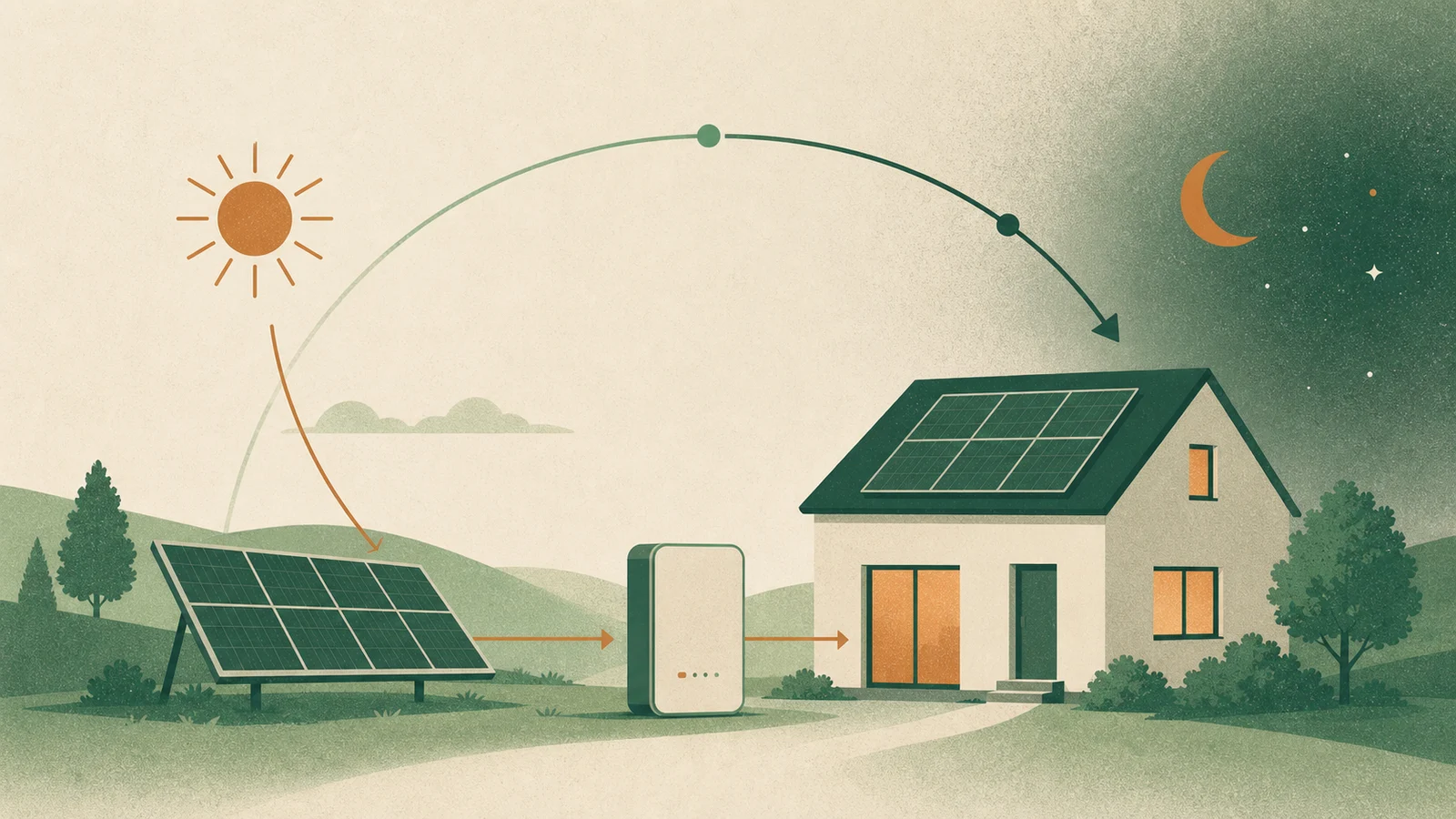
That gap is where all the leverage lies. Every self-generated kilowatt-hour you also consume yourself saves you the full purchase price. Every kilowatt-hour you feed in earns only a fraction of that. In 2026, self-consumption is roughly three to four times as valuable as feeding in. A battery does nothing more than shift the midday surplus into the evening and night — turning feed-in into self-consumption.
Without a battery, a typical household's self-consumption rate is, in practice, around 30 per cent. With an appropriately sized battery, it rises to 60 to 80 per cent. Those additional 30 to 50 percentage points are the economic core of the whole calculation — not self-sufficiency as such.
What a battery costs in 2026
The good news first: batteries have become significantly cheaper. According to industry figures, prices for lithium storage systems have fallen by around a third since 2023. The market is now clearly dominated by lithium iron phosphate (LFP) batteries, which are considered safe and long-lasting and are rated for 6,000 to 8,000 charge cycles — roughly equivalent to 15 to 20 years of use.
For pure storage capacity, prices in 2026 sit at roughly 400 to 450 euros per kilowatt-hour for smaller systems, and in some cases under 390 euros for larger ones. These figures cover the storage module including power electronics. In practice, retrofitting also means paying for installation, cabling and, where necessary, a new hybrid inverter. Realistically, an installed 10 kWh battery therefore ends up closer to the 8,000 to 11,000 euro range including fitting.
One point that is often overlooked in 2026: Austria's zero VAT rate for private PV systems expired on 1 April 2025. New purchases are once again subject to the standard VAT rate of 20 per cent. Anyone still holding an old zero-rate contract only benefited if delivery or installation took place by the end of 2025. For all new projects in 2026, the tax is fully priced in again — which makes the subsidy all the more important.
The EAG subsidy for 2026 in detail
In 2026, the federal government continues to subsidise electricity storage through the EAG investment grant (under Austria's Renewables Expansion Act). According to the EAG administration office, the subsidy rate is 150 euros per kilowatt-hour of usable capacity. The rules of the game matter:
- A battery is subsidised only in combination with a newly built or expanded PV system. Purely retrofitting a battery without expanding your PV is not covered by the federal scheme.
- Funding is capped at 50 kWh of usable capacity, and the battery must provide at least 0.5 kWh per kWp of PV output.
- Since mid-2025, the "Made in Europe" bonus adds up to ten per cent on top of the battery subsidy rate if a European-made battery is installed (modules and inverters are treated separately, each also with up to ten per cent).
- Applications are submitted together with the PV system via the EAG portal. The 2026 funding calls run in several windows; in the small capacity categories, first come, first served applies — so the budget is limited.
For a 10 kWh battery, the base rate of 150 euros/kWh means around 1,500 euros in subsidy, slightly more with the Europe bonus. On top of that come provincial subsidies depending on where you live — these vary widely and should be checked directly with your federal province before buying. The funding landscape broadly resembles other energy programmes such as the 2026 heat pump subsidy, but differs in amount and application route.
A battery doesn't pay for itself through self-sufficiency, but through every kilowatt-hour it shifts from poorly paid feed-in into expensive self-consumption.
The payback calculation — soberly done
Let's work through a realistic example. A 10 kWh battery costs around 9,500 euros installed. After the EAG grant and an average provincial subsidy, roughly 7,000 to 7,500 euros of net investment remain.
The benefit: for an average household, such a battery shifts roughly 2,500 to 3,500 kilowatt-hours per year from feed-in to self-consumption. Per shifted kilowatt-hour, the gain equals the difference between the purchase price (around 23 cents) and the feed-in tariff (around 7 cents) — about 16 cents. That works out to an annual benefit of roughly 400 to 560 euros.
Divide the net investment by that annual benefit and you land on a payback period of about 13 to 18 years. That is dangerously close to the battery's expected lifespan. With significantly higher electricity prices, above-average evening consumption or particularly cheap battery prices, the calculation slips into the 10-to-13-year range — and then it becomes clearly economical. With low consumption and an expensive installation, however, it can also run beyond the lifespan, and then the battery is a comfort project, not an investment.
This spread is not a calculation error but the honest reality. A battery's economics are far more sensitive to your own consumption profile than those of the PV system itself.
When a battery makes sense — and when it doesn't
Clear rules of thumb follow from the arithmetic. Leaning yes, if:
- your annual electricity consumption is high (above 4,500 to 5,000 kWh), ideally with a lot of it in the evening;
- an electric car, a heat pump or both are coming anyway and will push consumption up;
- the battery is installed together with a new PV system, so the EAG subsidy applies in full;
- you value a degree of independence from electricity price swings and don't judge every kilowatt-hour purely by its return.
Leaning no, if:
- your consumption is low and happens during the day — the valuable PV power is then used directly anyway, and the battery would have little to do;
- the battery would be retrofitted without expanding the PV system, disqualifying it from the federal subsidy;
- the investment would be financed with a loan at meaningful interest rates, which further eats into an already tight annual benefit.
An important note on sizing: bigger is not better. An oversized battery never fills up in winter and never empties in summer — the expensive top kilowatt-hours then never earn their keep. As a rough guide, aim for a battery capacity close to your daily electricity consumption, often in the range of 0.5 to 1 kWh per kWp of PV output.
Conclusion
In 2026, a battery storage system is cheaper and more mature than just a few years ago — but it's no sure thing. If you consume a lot of electricity, use it mainly in the evening and capture the EAG subsidy when building a new PV system, you can achieve payback within the battery's lifespan. If you consume little, and mostly during the day, you should honestly accept that the battery is then more about comfort than returns. The crucial homework before any quote remains the same: know your own consumption profile — and only then talk about battery size. Incidentally, cutting your electricity use first shifts this calculation noticeably; the biggest levers are set out in our piece on saving electricity at home.