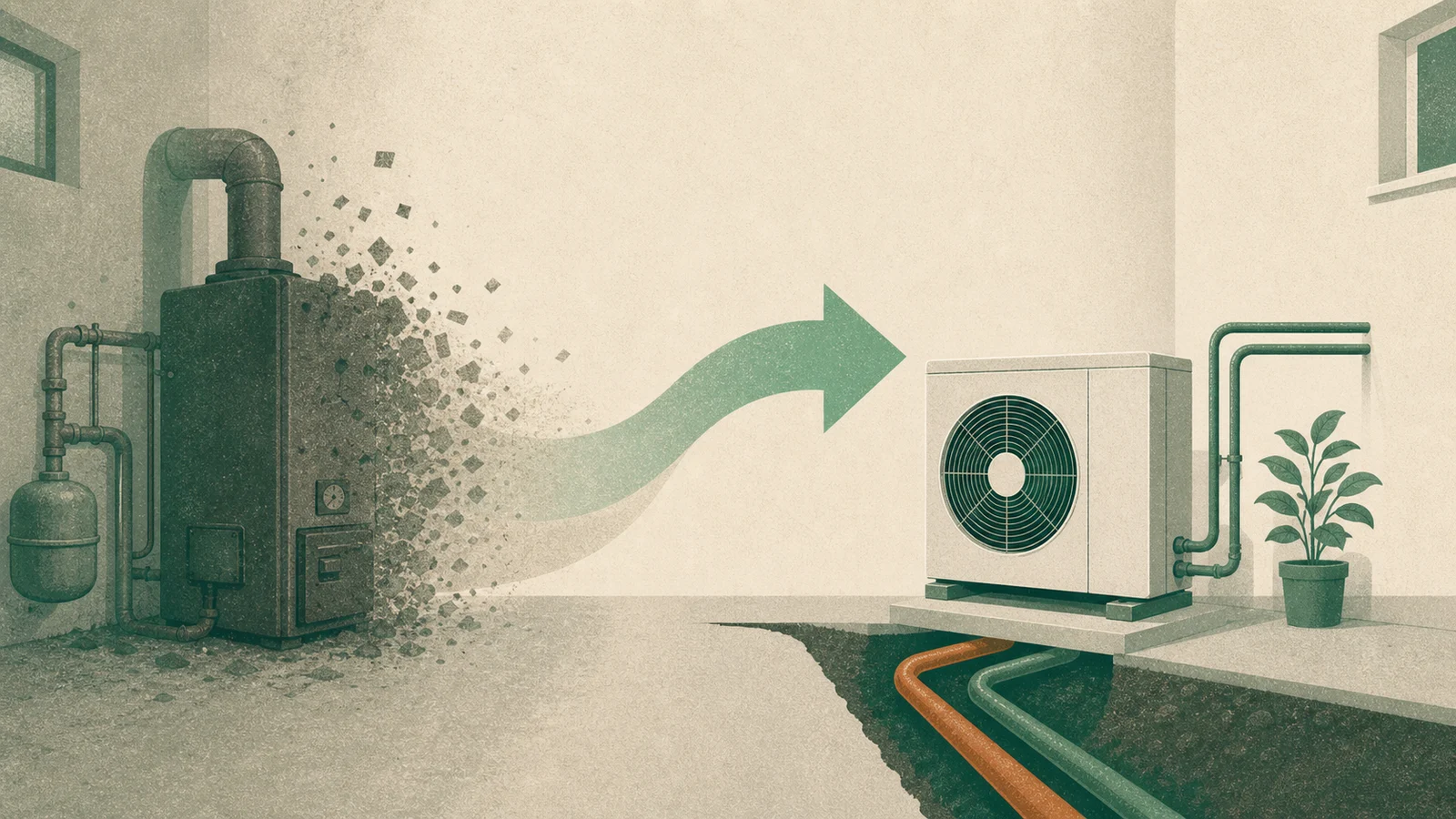
The old gas boiler still works, the oil furnace in the cellar has run faithfully for twenty years — and yet many households in Austria are asking themselves the same question in 2026: when is it worth switching, and to what? The answer is rarely simple, because it depends on where you live, the state of the building, the budget available and, not least, the pace of subsidy policy. This overview weighs up the three realistic options — heat pump, district heating and pellet boiler — explains the legal framework and names the pitfalls people most often stumble over in practice.
The legal framework: what already applies — and what's coming
Let's clear up a common misconception first: there is no blanket ban in Austria in 2026 that banishes working gas or oil heating systems from cellars overnight. Anyone running an intact system may, in principle, keep it going. Where things have tightened is at the margins.
Under the Renewable Heat Act (Erneuerbare-Wärme-Gesetz, EWG), passed by the National Council in December 2023 with a constitutional majority, fossil-fuel heating systems have been banned from new buildings since February 2024. In existing buildings, too, policymakers are using generous grants to push households away from fossil heating: if an old oil or coal boiler breaks down, switching to a renewable system is the explicitly subsidised norm — whether a like-for-like replacement with a new fossil-fuel unit is still permissible in an individual case depends on the applicable provincial and building regulations, and should be clarified in advance. The backdrop is Austria's target of climate neutrality by 2040, which anchors the entire heating transition.
What matters in practice: on the finer points of implementation — such as mandatory replacement deadlines for particularly old systems — federal law and the respective provincial and building regulations interlock, and the details vary from province to province. If you are unsure whether your own system is affected, the safest move is to check with your municipality or the relevant provincial office beforehand. Nor has the longer-term path for gas heating been politically settled once and for all; here it pays to watch how things develop rather than betting on a fixed end date.
The three options compared
The heat pump is the obvious choice for most detached houses. It works most efficiently when the house is well insulated and heated at low flow temperatures — ideally via underfloor heating or generously sized radiators. In renovated buildings it can usually be installed without trouble; in unrenovated older stock, an honest upfront assessment is needed to check whether the system will deliver enough output on cold days without the electricity bill exploding. How a heat pump performs in older buildings, and what to watch out for, is covered in detail in our piece on heat pumps in older buildings.
District heating is the most convenient solution wherever a network runs down the street — above all in Vienna, Graz, Linz and other urban centres. No boiler, no tank, no chimney, little maintenance: you simply draw heat from the network. The catch is availability. Whether a connection is possible is decided by location, not by preference. And the running costs depend heavily on the particular supplier and its energy mix.
The pellet boiler is the classic route for households that want to stay with a water-based heating system running at higher flow temperatures — for instance in older buildings with traditional radiators, where a heat pump reaches its limits. Pellets are a domestic fuel, largely available regionally. In return, you need space for the store and the boiler, plus regular maintenance and ash removal.
What it costs — purchase and running costs
When it comes to investment, purchase price and running costs must be considered separately, or you end up with a distorted picture.
For an air-to-water heat pump in an older building, figures of roughly €16,000 to €28,000 before subsidies circulate, depending on the source and the building — the wide range is explained by the associated work often required, such as new radiators or an upgraded electricity connection. A pellet boiler sits in broadly the same bracket, at around €17,000 to €28,000. A district heating connection is often the cheapest in pure connection costs and, depending on the work involved, can start in the low four figures. All of these numbers are ballpark values; a reliable price only emerges after an on-site visit.
If you only look at the purchase price, you are comparing the wrong number. Over fifteen years, it is the running costs that help decide which system was cheaper in the end.
With running costs, the picture often flips. A heat pump — assuming efficient operation and a suitable heat-pump electricity tariff — produces annual heating costs in the low four figures according to common comparisons, and thus usually significantly less than an old gas boiler. Pellets move in a similar corridor on fuel price, depending on market conditions. District heating can work out more expensive in day-to-day operation depending on the tariff and supplier — that varies greatly by provider and should be checked directly with the supplier before deciding. Anyone who pairs a heat pump with a photovoltaic system and a battery can push running costs down further; whether that adds up in an individual case is something we examine in our article on whether a solar battery pays off in 2026.
The subsidy landscape in 2026: what's on offer
The good news for switchers: the heating replacement is still generously subsidised in 2026. The former "Raus aus Öl und Gas" ("Out of Oil and Gas") programme rolled over at the end of 2025 into the "Sanierungsoffensive 2026" (renovation offensive), administered by Kommunalkredit Public Consulting (KPC) on behalf of the federal government. At its heart is the so-called boiler swap.
Under the current funding conditions, federal grants of up to €7,500 are available for switching to a heat pump; the rate for pellet boilers is higher at up to €8,500, and somewhat lower for a district heating connection at up to €6,500. The exact maximum amounts and the share of eligible costs should be checked on the official platform before applying, as the details can change.
On top of the federal subsidy come the provincial schemes, which in many cases can be combined — though with a cap: federal and provincial funding together must not exceed a certain share of the eligible costs. In Vienna, for example, combinations in the region of around €15,000 are possible when switching from gas to a heat pump, according to the available figures. Lower Austria additionally offers annuity subsidies for loan-financed renovations. For a deeper look at the grants available for heat pumps, see our guide to heat pump subsidies in Austria 2026.
A chapter of its own is "Sauber Heizen für Alle" ("Clean Heating for All"): this programme targets lower-income households and can, under certain conditions, cover the heating switch up to its full cost. The income thresholds are tiered — for single-person households, the limit was most recently just under €1,870 net per month, with correspondingly higher limits for families. According to the current information, registrations are possible until the end of 2026, as long as the budget lasts.
Pitfalls that cost real money in practice
The first and most expensive mistake is getting the order of events wrong. Many subsidies must be registered or applied for before the contract is signed or the system is ordered. Buy first and apply later, and you risk walking away empty-handed.
The second issue is speed. The funds of the Sanierungsoffensive are finite and allocated on a first come, first served basis; it has been reported that by mid-2026 the overwhelming majority of the pot had already been used up. Waiting can therefore mean there is nothing left by the end of the year.
Third, it pays to take a sober look at your own building. A heat pump in a poorly insulated older house with small radiators can become expensive to run if the flow temperature stays too high. It often makes sense to think about the heating switch and thermal renovation together, rather than merely swapping out the appliance.
And finally: get several quotes, insist on a proper heat-load calculation, and price in the ancillary costs — removing the old tank, adapting the radiators, electrical work — from the outset. The list price of the system is rarely the final bill.
Conclusion
Anyone in Austria who wants to move away from oil or gas in 2026 has three viable paths: a heat pump in renovated (or renovatable) buildings, district heating wherever the network reaches, and pellets as a robust solution for houses with high flow temperatures. The subsidy landscape in 2026 is unusually generous, but finite — those planning a switch should apply early, make full use of the combination of federal and provincial funding and, on a tight budget, look into "Sauber Heizen für Alle". The most important rule remains simple: calculate and take advice first, order second.