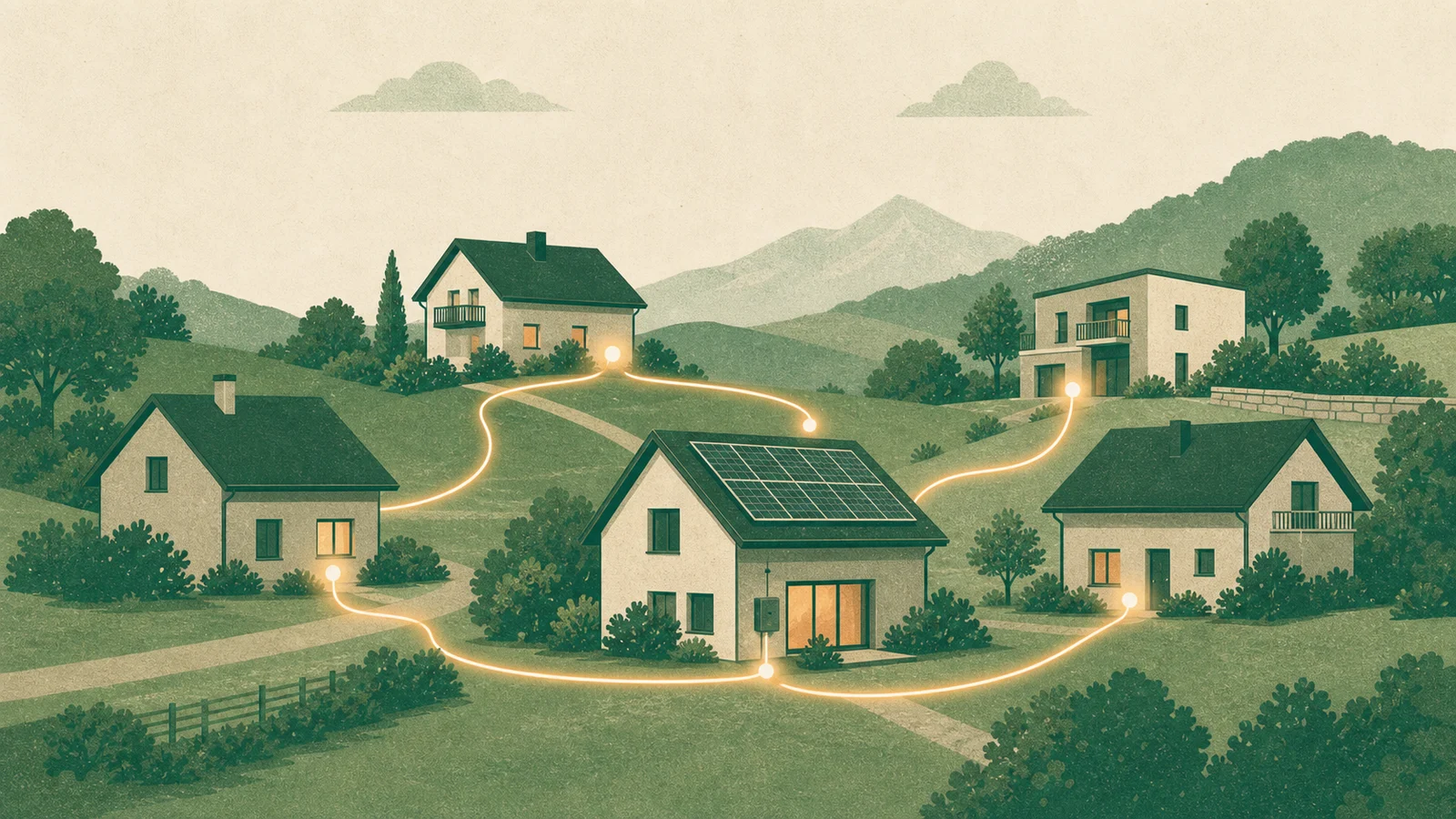
Anyone in Austria with a photovoltaic array on the roof knows the dilemma: at midday the panels produce more electricity than the household can use, and the surplus flows into the public grid for a few cents — on sunny middays sometimes even at negative exchange prices. In the evening, once the sun is gone, the same household buys power back at several times that price. Energy communities target precisely this gap. They allow neighbours, associations, businesses or entire municipalities to distribute self-generated electricity among themselves — with a legal footing since the Renewable Energy Expansion Act (Erneuerbaren-Ausbau-Gesetz) of 2021. What long sounded like pioneer spirit has since become a real building block of Austria's energy transition, with several thousand communities founded and interest growing steadily.
What makes an energy community
At its core, an energy community is an association of at least two participants who jointly generate, store, consume or sell electricity from renewable sources. Instead of feeding every surplus anonymously into the grid, the power flows first to the members. Only what remains goes to the energy supplier.
The decisive difference from conventional electricity trading lies in the purpose. Under the provisions of the Renewable Energy Expansion Act, an energy community may not be primarily profit-oriented. The priority is ecological, economic or social benefit for the members and the region. The community needs its own legal form — often an association, a cooperative or a limited company — and a contract with the responsible grid operator. Billing runs through the smart electricity meters that have been rolled out across the country in recent years. These smart meters report every quarter of an hour who has generated and consumed how much, so that the electricity produced can be allocated to the members on paper.
EEG and BEG: two models, one goal
The law recognises two basic types, which are often confused in practice but differ markedly.
The renewable energy community — EEG for short, after its German name — is geographically bound. Its members must be connected via the same low-voltage or medium-voltage grid: put simply, within the same transformer station or the same substation. That keeps an EEG local — a block of flats, a housing estate, a village district, a municipality. It is exactly this proximity that brings the biggest financial advantage, because the shared electricity is barely transported through the grid physically.
The citizen energy community, or BEG, is not tied to geographical boundaries. Members can be scattered across the whole of Austria, as long as they sit within the same operator's grid area. That opens the door to larger projects, for instance when a group of investors jointly finances a bigger installation. The price for this: a BEG does not enjoy the same grid-fee reductions as an EEG, because the electricity may travel long distances through the network. A BEG may also work exclusively with electrical energy, whereas an EEG, according to the explanatory notes to the law, could in principle also incorporate heat or other forms of energy.
For most of the neighbourhood projects at issue here, the EEG is the right model. It connects the people who actually know each other and live close together.
The grid-fee discount as the core incentive
The economic lever of an energy community is less the raw electricity price than the grid fee. Anyone drawing electricity through an EEG pays reduced grid usage charges on the shared portion. Where the connection runs through the same transformer station — the lowest grid level, in the jargon — the discount is at its highest; if the connection spans several levels, it drops accordingly. The exact rates are set by the energy regulator E-Control and adjusted periodically.
On top of that come levies which are partly waived or reduced for locally shared electricity. All told, the purchase price of the shared electricity can be pushed noticeably below that of the regular tariff, while the participant feeding in receives more than the usual surplus remuneration. Both sides benefit — one buys more cheaply, the other sells at a better rate. How large the advantage turns out to be in practice depends heavily on the internal price agreed jointly. The members negotiate this themselves; the law prescribes no level here.
Important to know: the reduction applies only to electricity that is actually shared communally. Whatever a household draws from the grid beyond that continues at the normal tariff. An energy community therefore does not replace the electricity contract — it supplements it.
How founding one works
The path to your own energy community has become more manageable than many assume. The central point of contact is the Austrian Coordination Office for Energy Communities (Österreichische Koordinationsstelle für Energiegemeinschaften), which provides guides, model contracts and calculator tools and helps with questions. Anyone going through the process moves roughly along the following steps:
- Clarify the group and the generation: Who is taking part, where are the installations, and does everyone sit in the right grid area? An enquiry to the grid operator will reveal whether the planned participants are connected in an EEG-compatible way at all.
- Choose a legal form and found the entity: an association, a cooperative or a limited company, depending on size and ambition. For small neighbourhood projects, the association is usually the leanest option.
- Sign a contract with the grid operator and switch the members' smart meters to release their data to the community. Only then can the quarter-hourly allocation of electricity begin.
After that comes day-to-day operation: generation and consumption are managed through a billing platform, internal prices are set and the data is analysed. Some energy suppliers and municipalities now offer complete packages that take over this administrative part, which lowers the hurdle particularly for older or less tech-minded participants.
Examples from practice
Energy communities are no longer a theoretical construct. In Vienna, apartment complexes and housing cooperatives have begun distributing electricity from rooftop photovoltaics beyond the building community itself, so that tenants without their own roof benefit too. In Graz and Styria, where PV expansion and municipal initiatives came together early, rural municipalities rank among the most active founders — there, farmers with large roof areas often team up with neighbouring households.
Vorarlberg and Tyrol are regarded as pioneers of municipality-wide projects in which schools, town halls and private households cooperate under one umbrella. In Upper Austria and around Linz, meanwhile, energy suppliers are driving the topic forward with standardised offerings. In total, according to the Coordination Office, several thousand communities have been founded since the law came into force — a momentum few observers had expected at this pace.
What the successful projects usually have in common is a local driving force: a committed individual, a municipal council or an existing association that takes on the organisation. Where this caretaker figure is missing, interest often fizzles out, because coordinating technology, law and neighbourhood demands patience.
What remains
Energy communities do not solve one single big problem, but they shift several small levers at once. They make locally generated electricity usable where it is produced, they lower costs for participants, they relieve — in theory — the wider grid, and they actively involve people in the energy transition who would otherwise merely pay electricity bills. The legal framework of the Renewable Energy Expansion Act has turned a niche into an accessible model, and the grid-fee reductions provide a genuine financial reason to get involved.
Anyone toying with the idea should assess two things realistically: the financial advantage is noticeable but rarely spectacular, and founding a community demands organisational work that somebody has to take on. For neighbours who are betting on photovoltaics anyway, an energy community is nonetheless one of the most obvious ways to get more out of their own roof — and to turn electricity into something you quite literally share with the people next door.