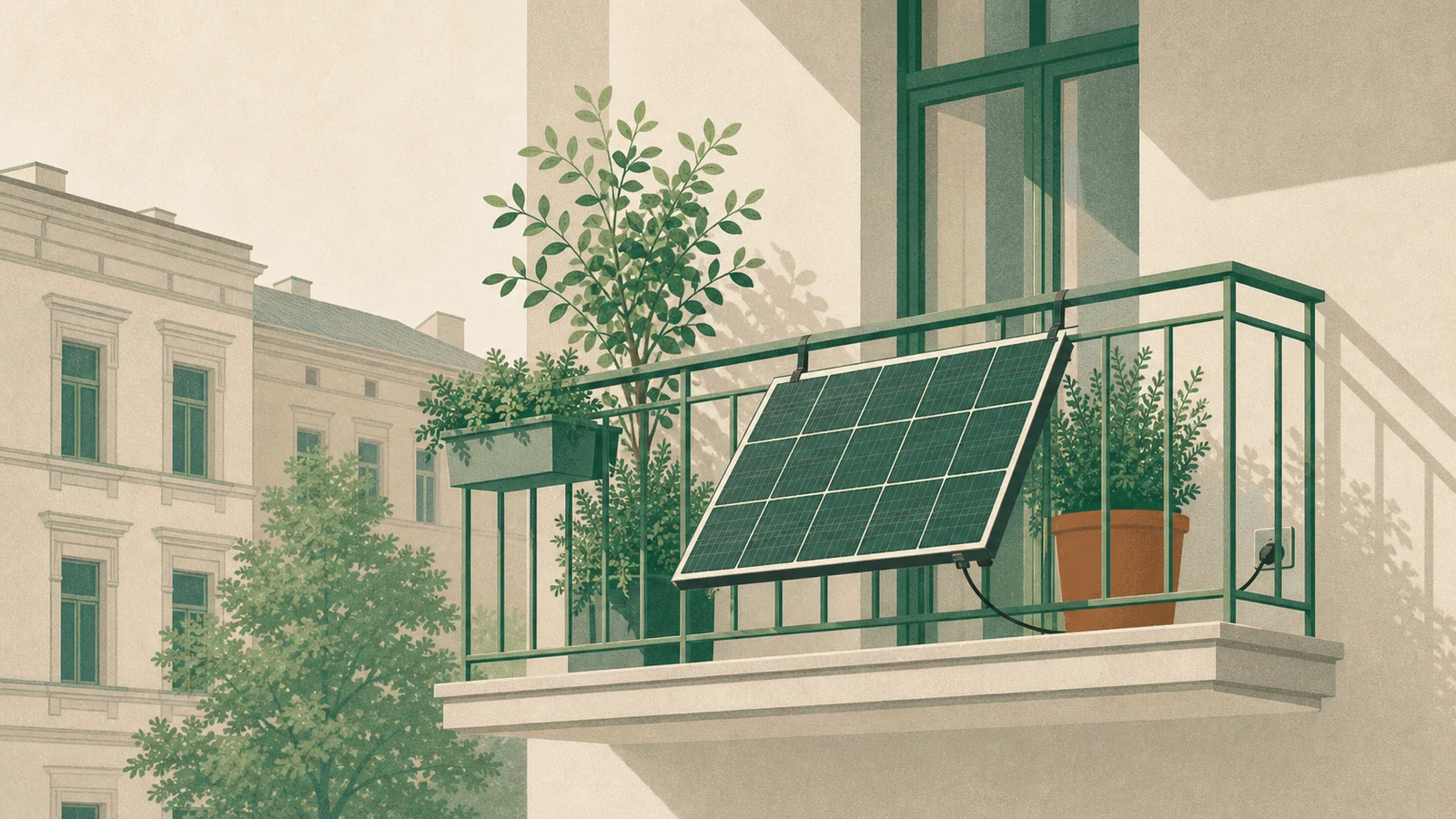
A solar panel hanging from the balcony railing, plugged into an ordinary socket, feeding electricity straight into your own household: what long passed for a technical gimmick has become a serious option for renters in Austria. Plug-in photovoltaics — "kleine Erzeugungsanlage" (small generation unit) in official parlance, balcony power plant in everyday speech — promises a way into producing your own electricity without a roof, without owning property and without a five-figure investment. But between the online retailers' advertising and Austrian law lie a few hurdles you are better off knowing before you buy. Anyone living in a rented flat in Vienna, Graz or Linz needs to sort out two things above all: registration with the grid operator, and consent from the landlord or the owners' association.
How a balcony power plant works
Technically, it is a modest affair. One or two PV modules generate direct current, an inverter converts it into standard household alternating current, and a plug connection carries the electricity into the flat's wiring. It is consumed wherever appliances happen to be running — the fridge, the router, devices on standby. If the system feeds in more than is needed at that moment, the surplus flows into the public grid — a grid already under growing strain from the rising power demand of data centres. A battery is not part of the standard setup, which is why the benefit comes mainly from the base load that runs around the clock.
The key difference from a classic rooftop installation: no electrician is needed to wire it into the circuit. The device is plugged in like a household appliance. That very simplicity is the reason for the boom — and, at the same time, the reason grid operators and landlords get a say.
Registering with the grid operator: mandatory, but straightforward
In Austria, even a plug-in solar system must be reported to the local grid operator. The responsible party is not your electricity supplier but the local network company — Wiener Netze in Vienna, Energienetze Steiermark in Styria, Netz Oberösterreich in Upper Austria. The energy regulator E-Control has established the legal framework and backed uniform requirements, so the procedure is now considerably leaner than it was just a few years ago.
For small, plug-and-play systems, a simple notification is generally enough — no elaborate approval process. Many grid operators provide an online form for the purpose. Registration still matters, though: the grid operator checks whether the existing meter is suitable. Older mechanical Ferraris meters can run backwards when electricity is fed in — that is not permitted and is remedied by swapping in a modern meter. In most Austrian households, smart meters are already installed or being rolled out, which takes the sting out of this point.
Skipping registration risks more than formal trouble. An unregistered system can become an insurance headache if something goes wrong.
The power limit: 800 watts as the new benchmark
For a long time, Austria applied a de minimis threshold of 600 watts of inverter output for the simplified procedure. At European level and in several neighbouring countries, 800 watts has since established itself as the standard, and practice here increasingly follows that figure. What counts is the inverter's output power, not the wattage printed on the modules — the installed panels may well add up to more peak capacity, because they rarely reach it in everyday use.
Anyone who exceeds the scope of a micro-system falls out of the simplified procedure and may need a full registration involving a qualified electrician. For the typical rented flat with one or two modules on the balcony, however, the 800-watt mark is almost always sufficient. The industry association PV Austria points out that the exact requirements can vary slightly from one grid operator to another — a quick look at the operator's website before buying spares you surprises later.
Consent from the landlord and the owners' association
This is where things get trickier for renters than the technology itself. A module mounted on the outer façade or the balcony railing changes the external appearance of the building and may encroach on the common parts of the property. In a rented flat, this fundamentally requires the landlord's consent; in an owner-occupied flat, that of the owners' association (Wohnungseigentümergemeinschaft, WEG).
Austrian condominium law has been modernised in recent years to make climate-friendly measures easier. For certain alterations, a relaxed consent rule now applies: if the other owners do not respond within a set deadline, their silence can count as consent. That lowers the bar considerably, but it does not replace the clean route of a written request. The Chamber of Labour (Arbeiterkammer) generally advises renters to obtain written approval for any structural change, so as not to face accusations of unauthorised alterations when they move out.
For those unwilling to take any risk, there is a pragmatic alternative: modules laid flat on the balcony floor, propped on a stand on the terrace, or fixed to the inside of the railing barely alter the façade and often need no drilling into the building fabric. The yield is somewhat lower than at the optimal tilt, but the approval burden drops significantly.
What the system earns — and when it pays off
The economic benefit depends on location, orientation and consumption habits. A system facing south and free of shade delivers more than an east-facing railing in a courtyard. Realistically, a typical two-module balcony power plant in Austrian conditions generates several hundred kilowatt-hours per year. What matters is how much of that you consume yourself, because the surplus fed into the grid is remunerated only modestly — if at all. The real advantage lies in the electricity you no longer have to buy.
With electricity prices recently elevated and a simple plug-in system costing a few hundred euros, industry experts put the payback period typically at a few years — the range runs from roughly four to eight years depending on the self-consumption rate. With modules lasting around twenty years, that leaves a surplus afterwards. Honest expectations matter: a balcony power plant covers part of the base load; it makes nobody energy-independent. Those who are out of the house all day with barely any consumption benefit less than a home-office household.
Then there is the subsidy landscape. Individual federal provinces and municipalities have in the past offered grants for plug-in solar, but the programmes are time-limited and quickly exhausted. The subsidy framework for larger efficiency measures such as thermal renovation is considerably more durable. A look at current provincial subsidies can improve the maths, but it should not be the basis of the purchase decision.
The bottom line
Plug-in solar is a real option for renters in Austria to cover part of their own electricity consumption — without a roof and without a major investment. Three points decide whether it runs smoothly: notifying the local grid operator and having a suitable meter, staying within the power limit of generally 800 watts at the inverter, and obtaining written consent from the landlord or owners' association as soon as the installation touches the façade or the building's appearance. Anyone who sorts out these steps before buying, and stays realistic about the yield, gets a low-maintenance system that pays for itself over the years. Those looking to take their energy savings further will find the next lever in heating — for instance with a heat pump in an older building. The specific requirements differ from grid operator to grid operator — a quick check against the information from the energy regulator E-Control and the industry association PV Austria before ordering is the best insurance against later disappointment.