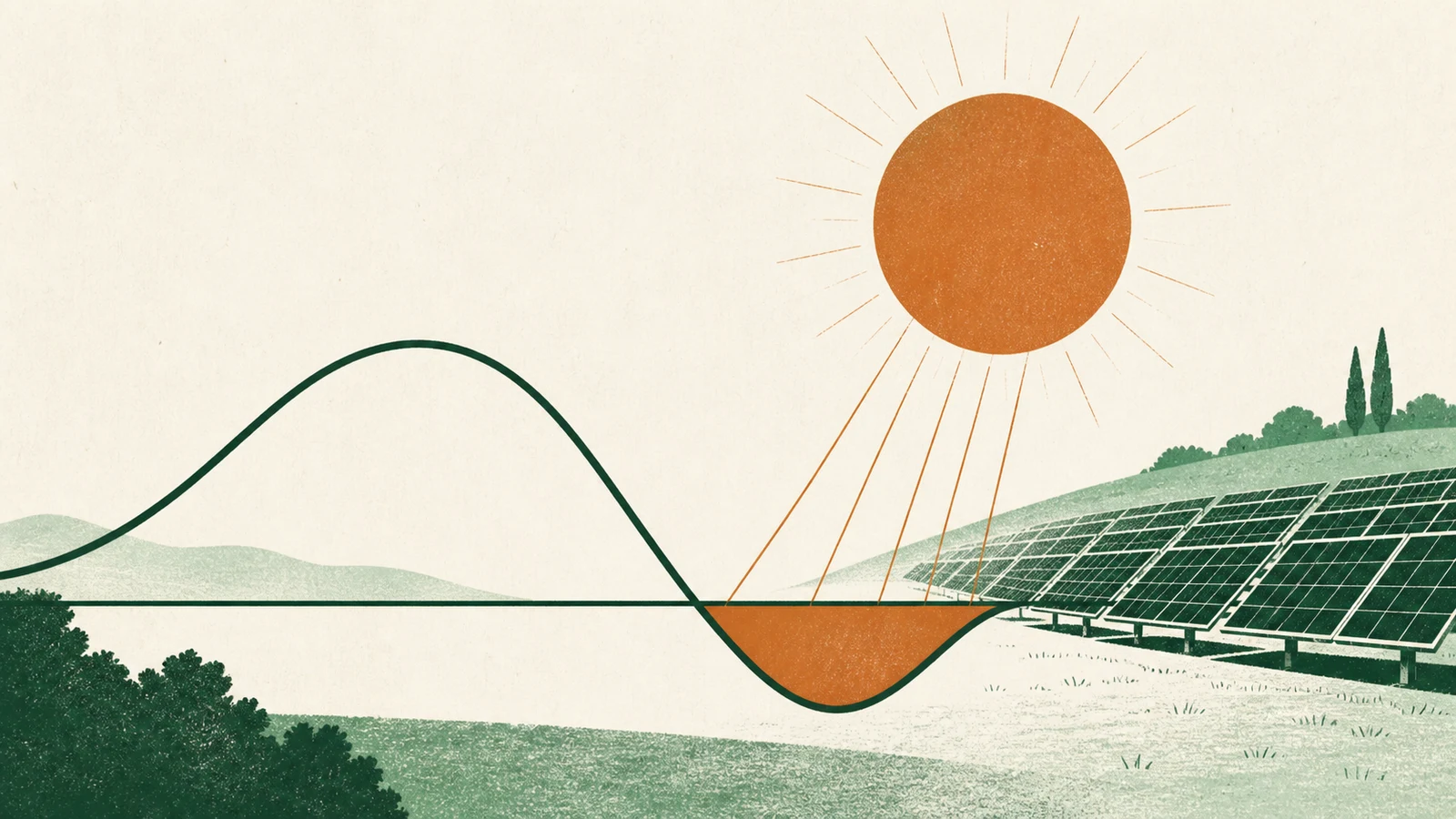
At 1.30pm on 1 May 2026, something happened on the electricity exchange that Austria had never seen before: the price of a megawatt-hour of power fell to minus €498.65 in day-ahead trading on EPEX Spot — practically the technical floor the market allowed at the time. Anyone feeding electricity into the grid during that quarter-hour would, in theory, have had to pay almost 50 cents per kilowatt-hour just to have someone take it off their hands. The cause was not a malfunction but an entirely foreseeable combination: a public holiday, little industry on the grid, and brilliant sunshine across much of the country. Photovoltaics were producing flat out, demand was in the doldrums, and the market could only find equilibrium through extreme negative prices.
The episode was spectacular, but it was no one-off. It is the most visible symptom of a development shaping the Austrian electricity market this summer like no other issue — one with very concrete consequences for the hundreds of thousands of households with solar panels on their roofs.
Why a price can fall below zero at all
Negative electricity prices seem absurd at first glance, but they follow a simple logic. Electricity still cannot be stored at scale except to a limited degree; generation and consumption must balance every single second. When photovoltaics produce massively on a sunny early-summer midday while run-of-river hydropower plants on the Danube and the Inn keep running and demand is depressed by a public holiday, there is simply more electricity than anyone needs. Some power plants nonetheless cannot or will not switch off — because ramping down and back up would cost more than a few hours of negative prices, or because subsidy regimes made feeding in attractive even when the market was long since saturated. Then producers pay to get rid of their electricity.
The frequency of these hours has multiplied within just a few years. According to a market commentary by the energy regulator E-Control, Austria already recorded around 300 hours of negative day-ahead prices in 2024 — more than twice as many as in the years before. In 2025, the 300 mark — counted as hours with zero or negative prices — had already been reached by early August, according to the industry association Oesterreichs Energie. In the tightly coupled German market zone, the trade publication pv magazine reported a record 573 negative hours for 2025. And for 2026, market observers expect a further increase in their analyses, with some scenarios projecting 800 hours below zero or more. The fact that this May delivered around 26 per cent more sunshine hours than the climate average — ranking among the five sunniest Mays on record, according to GeoSphere Austria, the national weather service — has only fuelled the trend. The exchange itself has responded: after the extreme reading of 1 May, EPEX Spot lowered the permissible price floor in day-ahead trading from minus €500 to minus €600 per megawatt-hour. It is clearly bracing for prices to go even lower.
For households without their own installation, all this is at first a footnote with at most indirect effects — for instance on the question of how electricity prices will develop overall in 2026. For the owners of the roughly 500,000 PV installations now operating in the country, it is considerably more than that.
The OeMAG tariff is stuck at the legal floor
Those who feel the price slump most directly are the households selling their surplus power to OeMAG, the clearing and settlement agency for green electricity. Its feed-in tariff has been set monthly and retroactively since January 2024, pegged to the quarterly market price that E-Control calculates under Section 41 of the Green Electricity Act. That reference value stands at 11.97 cents per kilowatt-hour in the second quarter of 2026, according to E-Control, up from 9.25 cents in the first quarter. Sounds decent — except ever less of it actually reaches the people feeding in.
The OeMAG tariff actually paid out in June 2026 was 6.772 cents per kilowatt-hour. That is exactly the legal floor: 60 per cent of the quarterly market price, minus a balancing-energy deduction of 0.408 cents that OeMAG applies to photovoltaics this year. Without this statutory floor, the tariff would arithmetically have fallen even further, because exchange prices are at their lowest precisely when PV systems deliver the most — at midday, in the sunshine. Specialist portals such as the Smart Meter Portal speak of the so-called cannibalisation effect: the more solar power pushes into the grid at the same time, the less each individual kilowatt-hour is worth.
The subsidy landscape, too, now reckons with negative prices. Anyone receiving a market premium under the Renewables Expansion Act (EAG) comes away empty-handed under Section 15 of that law as soon as the day-ahead price is negative for at least six consecutive hours — a rule that bites ever more often in sunny months. And the new Electricity Industry Act (ElWG), which parliament passed on 11 December 2025 as part of the "Cheaper Electricity Act" package, tightens the screw further: new feed-in contracts may include peak capping, under which PV feed-in is throttled to 70 per cent of installed capacity when grid overload threatens. Installations above 20 kilowatts will have to pay a grid contribution for feeding in for the first time from 2027; smaller rooftop systems remain exempt, according to the industry association Photovoltaic Austria.
The market's message is unambiguous: electricity that everyone produces at the same time is worth little. The reward goes to those who deliver it — or consume it — when it is actually needed.
Batteries move from luxury to logic
What does this mean in practice? First of all: the old rule of thumb — feed in as much as possible — has had its day. Anyone planning or running a system today almost always does better by keeping as much solar power as possible in their own home. Every self-consumed kilowatt-hour replaces grid electricity that costs households 20 to 30 cents depending on the tariff — while the exported one currently earns those 6.77 cents at OeMAG, and in dynamic marketing models sometimes nothing at all at midday.
That shifts the economics markedly in favour of battery storage. A battery moves the midday surplus into the evening — out of the hours of zero and negative prices and into those when electricity is worth something again. How the sums work out in concrete terms, which sizes make sense and where the limits lie is something we have crunched in a separate analysis: Is a home solar battery worth it in 2026? In short: the combination of fallen battery prices and shrunken feed-in revenues makes the battery, in many configurations, the economically obvious standard for the first time — rather than an eco-accessory.
Those without a battery can still do plenty to adapt to the new price landscape:
- Deliberately shift big consumers — the hot-water boiler, washing machine, dishwasher or the EV's wallbox — into the midday hours, whether manually or via simple timers and energy management systems
- When planning a system, consider an east-west orientation, which spreads generation more evenly across the day instead of bunching it into the midday peak
- Compare feed-in contracts: alongside OeMAG, many regional utilities and independent buyers offer fixed or market-linked tariffs whose conditions are currently changing fast
Flexible tariffs: the same curve, with the sign flipped
What hurts those feeding in can delight those consuming. Dynamic electricity tariffs that pass on the exchange price hour by hour turn the midday dips into a savings window. The provider aWATTar, a pioneer in this segment since 2015, charges the EPEX spot price plus a fixed markup; smartENERGY and Verbund, among others, also have dynamic models on offer. The prerequisite is a smart meter with quarter-hourly or hourly metering activated, which you have to enable with your grid operator via opt-in.
One illusion, however, should be buried straight away: even in negative hours, you virtually never get money for nothing. Grid charges, levies and VAT are due on every kilowatt-hour regardless. Calculations by comparison portals show that even at an exchange price of minus 5 cents, around 10 cents per kilowatt-hour still end up on the bill — considerably less than the usual 20 to 30 cents, but no subsidy for consuming electricity. The model is attractive above all for households that can shift substantial loads, first and foremost EV drivers with a controllable wallbox or owners of heat pumps with a buffer tank.
And in the longer term? Negative prices are not an industrial accident but a transitional stage. They show that the expansion of generation has outrun the transformation of the rest of the system — grids, storage and flexible demand are lagging behind. The ElWG lays some of the groundwork here, notably peer-to-peer electricity trading, which is set to allow direct sales to neighbours from October 2026. Something similar already works today through energy communities, in which households share their solar power regionally — often on terms above the OeMAG tariff. The more electricity is consumed locally instead of crowding onto the exchange en masse at midday, the less often the market will have to seek forced relief through negative prices. Until then, the new ground rule of this summer applies to PV households: it is not the kilowatt-hour produced that counts, but the one delivered at the right time.