Two phrases, two entirely different messages — and yet they regularly end up in the same rubbish bin. "Best before" and "use by" appear in small print on yoghurt pots, minced meat and packets of ham. Anyone who doesn't know the difference throws away food every year that would still be perfectly good to eat. And in Austria this is no fringe issue: according to calculations by the University of Natural Resources and Life Sciences, Vienna (BOKU) and WWF Austria, more than 1.2 million tonnes of avoidable food waste are generated here every year across the entire supply chain. More than half of it comes from private households.
Nor is this only about a guilty conscience. According to the WWF, the average Austrian household throws away food worth around €100 a month — roughly 14 kilograms that end up in the residual waste bin instead of on the plate. Much of that could be avoided if it were clear what the two date labels actually mean.
Best-before: a quality promise, not an expiry date
The best-before date — Mindesthaltbarkeitsdatum, or MHD, in German — is the most widely misunderstood date on a food package. It indicates until when an unopened product, stored properly, will retain at least its characteristic qualities: taste, smell, colour, texture. The key word is "at least". The manufacturer guarantees quality up to that day — it does not claim the food spoils abruptly afterwards. As with the many quality seals on food, it pays to look closely at what the label actually promises.
This is precisely the misunderstanding that fills the bins. The information platform "Österreich isst informiert", an initiative of the domestic food industry under the umbrella of the Austrian Economic Chamber (Wirtschaftskammer Österreich), points out that most foods remain perfectly edible long after the best-before date has passed — provided the packaging is undamaged and the product has been stored correctly. Dry and preserved goods such as pasta, rice, flour, sugar, salt, honey or tinned food often keep for months or even years beyond the printed date.
Many manufacturers deliberately set the best-before date conservatively to stay on the safe side. The result: products are discarded long before they have spoiled. According to "Österreich isst informiert", almost 58 kilograms of still-edible food per household end up in the bin in Austria every year — often simply because a date has passed.
The use-by date: where the leeway ends
The use-by date, recognisable by the wording "zu verbrauchen bis" ("use by"), is a different matter. It appears on highly perishable foods that can pose a direct health risk after a short time. This is not about taste but about microbiology. Once this date has passed, the product should no longer be eaten — even if it still looks and smells fine.
Under EU rules, the use-by date is mandatory for, among other things, fresh poultry and raw milk sold at retail. Beyond that, it is commonly found on minced meat, fresh fish, smoked fish, deli salads and pre-cut leaf salads. What makes these products treacherous: germs such as listeria can continue to multiply slowly even at fridge temperatures of 2 to 4 degrees. You cannot see or smell them. With smoked or cured salmon in particular, food safety authorities warn against pushing the use-by date to the limit, because the bacteria accumulate over time.
The risk is especially relevant for pregnant women, older people, small children and anyone with a weakened immune system. The simple rule of thumb: with a best-before date, trust your senses; with a use-by date, trust the date.
With a best-before date, your senses decide. With a use-by date, the date decides.
Look, smell, taste: the sensory check
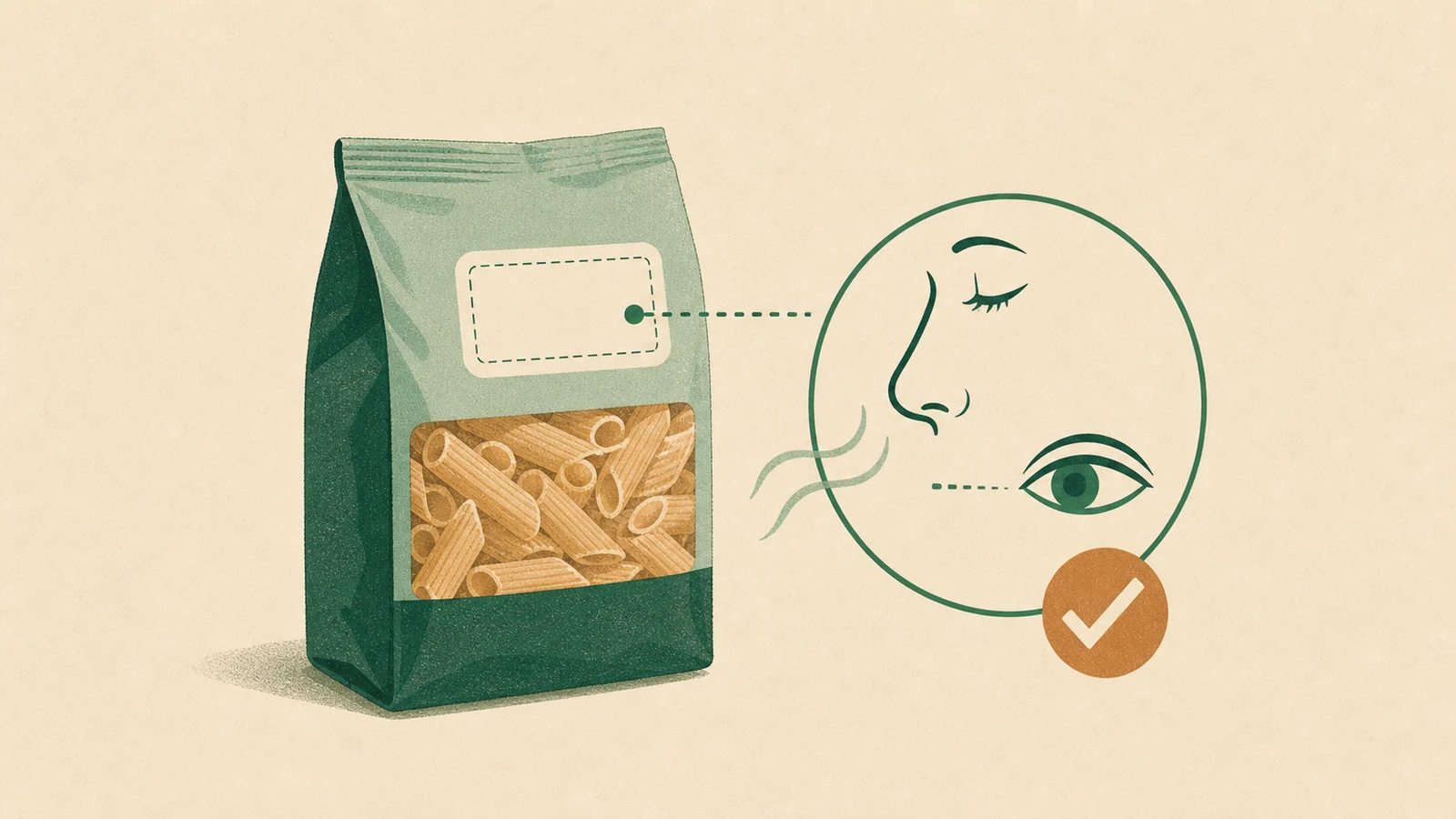
If the best-before date has passed, a quick test with your own senses is worthwhile before anything goes in the bin — the so-called sensory check. It works in three steps and takes less than 30 seconds.
Look: Is the packaging bloated or damaged? Does the product have an unusual colour? Are there any traces of mould? A bulging yoghurt pot or tin is a clear warning sign and should be discarded.
Smell: Does the food smell musty, sour, fermented or otherwise off? An unpleasant odour is often the most reliable indicator of spoilage.
Taste: If the appearance and smell are unremarkable, a small taste test helps. If something tastes bitter, sour or strangely bland, out it goes.
Austrian consumer protection and nutrition bodies explicitly recommend this method too. The order matters: look first, then smell, and only if nothing seems amiss, taste. And crucially: the sensory check applies exclusively to products with a best-before date, never to those with a use-by date.
How long do typical products really last?
Concrete reference points help sharpen your instincts. According to consumer protection experts at the Chamber of Labour (Arbeiterkammer), yoghurt kept continuously refrigerated often lasts around a week to ten days beyond the best-before date — as long as the lid and pot are intact and nothing is bulging. Eggs stored in the fridge can frequently still be used two to four weeks past the date, but should then only be eaten thoroughly heated — that is, cooked or baked; the water-glass test reveals whether an egg is still fresh: if it sinks to the bottom, it is fresh; if it floats, it should go. Hard cheese with mould only on the outside can be generously cut away, whereas soft cheese and yoghurt with mould belong in the bin entirely.
For the risky candidates, the opposite of generosity applies. Minced meat, fresh poultry, raw fish and pre-cut salads are best eaten on the day of purchase or by the use-by date at the latest. To be on the safe side, heat meat and fish through thoroughly — this kills most germs, but it is no substitute for checking the date.
From date to routine: less bin, more plate
Handling these two date labels consciously is one of the most effective levers against food waste in your own household — and one of the few that saves money at the same time. Rescuing expired but unspoiled products instead of binning them by reflex noticeably reduces both the amount of waste and the monthly food bill. The principle resembles the subsidised approach of repairing instead of discarding electrical appliances: what still works deserves a second chance.
A few habits make it easier: organise your supplies on a "first in, first out" basis, moving older items to the front. Use the fridge properly — meat and fish in the coldest compartment at the bottom, dairy products in the middle. And before shopping, take a look in the fridge and pantry to avoid buying duplicates. If you want to dig deeper into practical strategies, you will find concrete approaches in our piece on how to reduce food waste in everyday life.
In the end, it comes down to a simple distinction anyone can keep in mind: "best before" is a recommendation — here, eyes, nose and palate decide. "Use by" is a boundary — one best left uncrossed. Keep these two phrases apart and you will save money, protect your health and ensure that far less perfectly good food ends up in the residual waste bin.