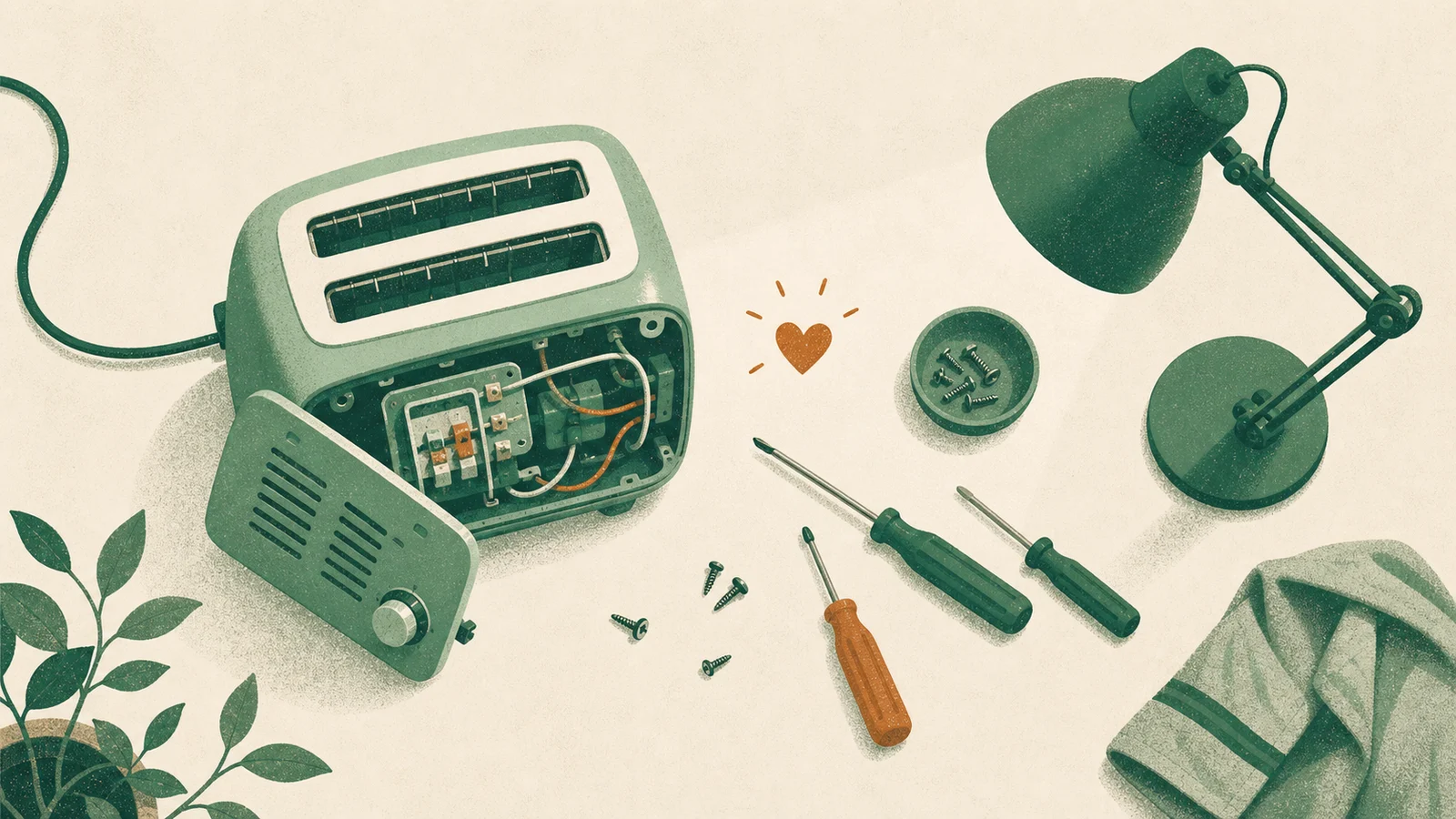
On a Saturday morning in a Viennese community centre, toasters, coffee machines, a DVD player and several bicycles pile up on long tables. Beside them sit people with screwdrivers, soldering irons and multimeters – most of them volunteers. What is happening here is called a repair café, and it has long since ceased to be a niche phenomenon. In nearly every larger Austrian city and in many smaller municipalities, people now meet regularly to get broken appliances working again together rather than throwing them away. The trend coincides with a political climate in which repair is being seriously promoted for the first time in decades – through state subsidies, specialised businesses and new EU rules.
How a repair café works
The principle is deliberately simple. Anyone with a faulty appliance brings it along on a set date and sits down with a volunteer repair helper to track down the fault. As a rule, nothing is charged; some initiatives ask for a voluntary donation, others are funded by municipalities, associations or small grants. Spare parts, where they are needed at all, are paid for by the visitors themselves.
The crucial difference from a conventional workshop is that repairs are not done for the customer but with them. Someone who turns up with a blender that has stopped working should, ideally, come away understanding what went wrong – a worn belt, a dry solder joint, a jammed switch. This educational component is intentional. The idea, which emerged from the Dutch movement around 2009 and spread quickly across central Europe, is aimed not just at individual repaired appliances but at a shift in mentality: away from the assumption that anything broken gets replaced, towards the question of whether a repair is worth it. It is the same shift in awareness that puts the question of origin front and centre when people buy local food from short supply chains.
Not everything can be saved. Devices with glued-shut casings, permanently built-in batteries or components for which spare parts no longer exist quickly hit their limits. Success rates vary by initiative and type of device; experience shows they are considerably higher for simple mechanical and electrical faults than for modern consumer electronics. It is precisely this experience that also makes repair cafés a place to learn about product design – and about why some devices are built in a way that barely allows for repair at all.
The repair bonus as a lever
Perhaps the strongest impulse for Austria's repair scene came from the state repair bonus. Administered through the Federal Ministry for Climate Action (BMK), it covers part of the cost when electrical or electronic devices are repaired at a participating business. Private individuals can download a voucher and redeem it at a specialist repairer; the scheme funds a share of the repair bill up to a maximum amount per voucher.
The response was remarkable. According to the Climate Ministry, several hundred thousand repairs have been processed through the bonus since its launch in 2022, with a funding budget running into the hundreds of millions. At times the rush was so great that the platform hit its limits and the payout arrangements had to be adjusted – an indication that people are willing to pay for repairs once the price gap to buying new shrinks.
That is precisely the economic crux. A repair rarely fails on technical grounds; it usually fails on the arithmetic: when an hour of workshop labour costs almost as much as a new appliance from the discount shop, the decision goes against repairing. The bonus shifts that ratio. Die Umweltberatung, an environmental advice service active in Vienna and several federal states, has long pointed out that the lifespan of many household appliances can be extended considerably by a single repair – and that in most cases this pays off both ecologically and financially. Anyone who keeps an appliance in use for longer also, almost incidentally, reduces their everyday carbon footprint.
R.U.S.Z. and the professional repair economy
Repair cafés and subsidy vouchers only work if there are also businesses capable of doing repairs. A pioneer of this scene is the Repair and Service Centre R.U.S.Z. in Vienna. The social enterprise has been repairing large household appliances – washing machines, dishwashers, tumble dryers – since the 1990s, and combines this with labour market integration: people who struggle to gain a foothold in the regular job market are trained in the repair trade.
Over the years, R.U.S.Z. has played a dual role. On the one hand as a workshop that actually gets appliances working again, on the other as a persistent lobbyist against so-called planned obsolescence – the suspicion that products are deliberately engineered to fail once the warranty expires. This milieu also gave rise to initiatives such as the Reparaturführer network, a repair directory that helps consumers find reliable repair businesses near them. Structures like these are decisive: a subsidy voucher is of little use if nobody within reach is willing to open up the broken device.
Electronic waste: the scale of the problem
Why all the debate? The answer lies in the volumes. Electrical and electronic equipment is among the fastest-growing waste streams of all. According to the Umweltbundesamt, Austria's federal environment agency, a substantial mountain of waste electrical equipment accumulates in Austria per person per year – estimates for developed industrial countries run to double-digit kilogram figures per capita. A large share of it ends up not in proper recycling but in drawers, in residual waste or on opaque export routes.
That is problematic for two reasons. First, many devices contain valuable raw materials – copper, aluminium, rare metals – whose extraction is energy- and environment-intensive. When a smartphone goes in the bin, the material bound up in it is lost or has to be laboriously recovered. Second, electronics contain pollutants that can leach into soil and water if disposed of improperly. In this logic, repair is the most effective form of waste prevention: the best recycling is the device that never becomes waste in the first place. Die Umweltberatung regularly puts it this way: reuse ranks above recycling in the waste hierarchy – and that priority is still not lived out enough in everyday life.
The right to repair
Overlaying the national measures, for some time now, has been a European framework that is structurally changing the repair question. Under the banner of the right to repair, the European Union has passed rules that place greater obligations on manufacturers. For certain product groups – including large household appliances and, increasingly, consumer electronics – spare parts must remain available for a defined period, and access to repair information is being made easier.
In addition, the EU is relying on ecodesign, which intervenes at the construction stage: devices should be built so that components can be swapped with standard tools rather than being glued or welded shut. There are also plans for better labelling of repairability, so that consumers can already tell at the point of purchase how long a product is likely to last. The Chamber of Labour (Arbeiterkammer) and consumer protection organisations broadly welcome this direction, but point out that everything depends on the concrete implementation and on affordable spare-part prices – because a spare part that is theoretically available at the price of half a new appliance helps nobody.
For Austria, this means several levels interlocking: national funding through the repair bonus, a mature infrastructure of workshops and repair cafés, and a European legal framework that addresses manufacturers. Only in combination do they take effect. A subsidy runs into the void if there are no spare parts; a right to repair remains abstract as long as repairing costs more than buying new.
What remains
Repair cafés are neither a solution for all electronic waste nor a cure-all for throwaway culture. A volunteer-run Saturday morning is no substitute for an industrial circular economy. But their significance goes beyond the number of repaired toasters. They make visible that many devices could be repaired – and create an awareness that feeds back into political demands and consumer behaviour.
The decisive question will be whether the various instruments keep working together over the long term. The repair bonus has shown that demand is there once the price is right. Businesses like R.U.S.Z. prove that repair can be a viable business and social model. And the EU's right to repair, for the first time, targets those who decide a product's lifespan at the drawing board: the manufacturers. Repairing instead of discarding is thus less a moral gesture than an economic and ecological calculation – one that, given the right framework conditions, increasingly adds up.