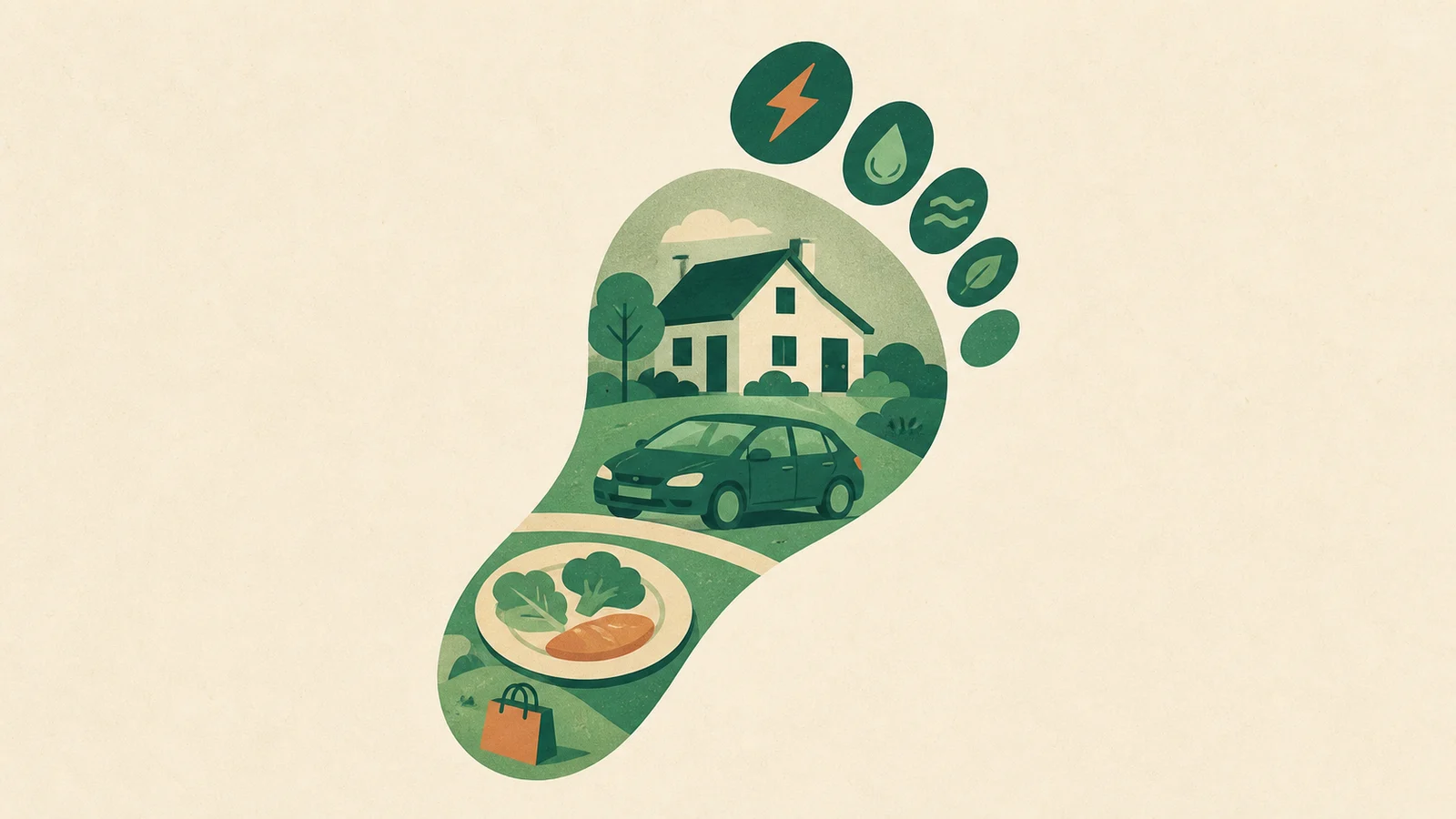
Few terms from the climate debate are as ubiquitous — and as widely misunderstood — as the personal carbon footprint. Plenty of people dutifully refuse the plastic bag at the supermarket checkout, then fly off on holiday twice a year without ever registering the contradiction. That is not a moral failing but a problem of perception: we feel the small gesture every day, while the big items sit invisibly in the boiler room, the car and on our plates.
Anyone serious about shrinking their footprint therefore has to face an uncomfortable question: which measures genuinely make a difference — and which merely feel good? This piece ranks the levers by their actual impact. Sober, not preachy.
How big is the Austrian footprint in the first place?
First, the scale. According to the federal Environment Agency (Umweltbundesamt), Austria emitted around 66.6 million tonnes of CO₂ equivalent in 2024 — a drop of roughly three per cent on the previous year and a good 16 per cent below the 1990 figure. That number measures what is emitted within the country's borders.
The more honest figure, however, is higher. Once you add in the emissions embedded in imported goods — from smartphones to avocados — the consumption-based footprint sits around 40 to 50 per cent above the production-based figures, according to the Environment Agency. Per capita, that puts Austria well above the EU average — in a country that is already feeling the effects of climate change quite tangibly.
For everyday life, a different number is more useful. Environmental education organisations and carbon calculators for Austria work on the assumption that each person generates around 7.5 tonnes of CO₂ per year through their personal consumption — the share they can actually steer, influence and change. This is precisely where the levers come in.
And those 7.5 tonnes are not spread evenly. Roughly 40 per cent goes to mobility, about 30 per cent to food and around 20 per cent to housing — meaning only the running energy demand, not the construction of the building itself. The rest falls to consumption and miscellaneous. That breakdown alone tells you where it pays to look closely.
Lever 1: heating — the invisible giant in the basement
Let us start where many people look last: the heating system. According to industry and government figures, around ten per cent of all CO₂ emissions in Austria come from heating and hot-water systems — roughly eight million tonnes a year. Of just under four million primary residences, around one million are still heated with natural gas, plus the oil-fired systems on top.
For an individual household, that means the switch from a fossil-fuel heating system to a heat pump or a district-heating connection is by far the most effective single decision that can be made in an owner-occupied home. We are talking tonnes per year here, not kilograms. Since November 2025, the federal government has been subsidising the replacement of fossil systems under the new renovation drive (Sanierungsoffensive) with up to 30 per cent of the investment costs, capped at €7,500 for a heat pump — so the financial hurdle has shrunk considerably.
Those who cannot make the heating decision themselves — tenants, for instance — still have room to act: lowering the room temperature by one degree saves a noticeable amount of energy, as do a hydraulically balanced system and insulated heating pipes. And a second major household lever lies in electricity. If you want to know where the biggest consumers hide, our piece on saving electricity at home walks through the specifics — from the immersion heater to the ageing fridge.
Swapping an oil boiler for a heat pump shifts more in a single year than a lifetime of refused plastic bags.
Lever 2: mobility — and the special case of flying
The biggest chunk of the personal footprint is mobility. The car dominates here because it is used daily: switching to public transport, the bicycle or an electric car running on green electricity therefore pays off across the entire year.
Flying plays a role of its own. A single long-haul return flight can generate around 1.9 tonnes of CO₂ per person — more than a quarter of the entire personal annual budget, in a matter of hours. That makes the aeroplane by far the most climate-damaging way to travel; compared with the train, it is worse by a multiple. For many households, a simple truth follows: one long-haul flight avoided per year beats even the most disciplined waste sorting. That does not mean never flying again — but it does mean treating the flight for what it is: the single most expensive line in your personal climate ledger.
In daily life, what counts above all is regularity. Anyone who shifts the daily commute from the car to public transport or the bike accumulates a bigger effect over a year than any one-off action — all the more so as cities like Vienna, Graz and Linz are making the switch steadily more appealing with more urban greenery.
Lever 3: diet — where meat makes the difference
Around 30 per cent of the personal footprint sits in what we eat, and within that category one factor dominates: animal products. According to nutrition studies, Austria consumes around 63 kilograms of meat per person per year — roughly three times what the Austrian Society for Nutrition (Österreichische Gesellschaft für Ernährung) recommends.
The numbers behind this are unambiguous. According to the studies cited, an omnivorous diet generates around 1,467 kilograms of CO₂ equivalent per person per year, a vegan one only about 439 kilograms — a difference of roughly 70 per cent. Even a vegetarian diet cuts diet-related emissions by about 48 per cent, and simply reducing meat consumption by two thirds gets you to around 28 per cent less.
The good news: this lever requires no investment, no subsidy and no tradesperson. Less beef, more plant-based food, less waste — it is that rare lever that takes effect from the very next meal and is often cheaper into the bargain. Regional and seasonal produce amplifies the effect, even if, in the end, origin matters less than the question of what lands on the plate in the first place.
What really counts — and what remains symbolism
Which leaves the honest reckoning. The plastic bag you refused saves only a few kilograms of CO₂ over a year — a single long-haul flight equals the tally of hundreds of thousands of bags. That does not make avoiding plastic pointless: there are sound ecological and health reasons for it, and it sends an important signal to politicians and retailers. But as a lever against your own climate balance, it is a small one.
The real problem is not the bag but the confusion. Anyone who mistakes the small gesture for the big deed soothes their conscience while leaving the genuine items — heating, car, flight, meat — untouched. Everyday climate action only becomes effective when the order is right: tonnes first, kilograms second.
In concrete terms, for most households that means: settle the heating question once, ration flying deliberately, cut meat consumption noticeably and shift the daily commute away from the car. Four decisions that together move more than an entire catalogue of symbolic gestures. Those who want to dig deeper will find the remaining dials in our overview of cutting your carbon footprint — but the most important insight is already here: it pays to pull the big levers rather than wear yourself out on the small ones.