On the night of 29 June, the temperature at the Jubiläumswarte in the west of Vienna never dropped below 27.3 degrees. That was the low, mind you: it got no cooler than that all night. According to GeoSphere Austria, the national weather service, it is the highest overnight minimum ever recorded in Austria since records began. The day before, on 28 June, the Hohe Warte weather station had registered 39.7 degrees, shattering two marks at once: Vienna's June record of 36.1 degrees from 1950 and the city's all-time record of 38.5 degrees from August 2013.
The heatwave, which began on 18 June and only ended in the east of the country on 1 July, was — according to GeoSphere Austria's analysis — the most severe since measurements began in Vienna, Innsbruck and Bregenz, and on a par with the 2015 heatwave in Linz; in Vienna, the records stretch back to 1872. New June highs were set at 157 of the country's 277 weather stations, and 66 stations even recorded new all-time annual highs. Below 800 metres above sea level, depending on the region, there were ten to 14 consecutive hot days — days of at least 30 degrees. The summer of 2026 has only just begun, and it is already confronting Austria's cities with the question they have been trying to answer for years: how do you live in a city that no longer cools down?
A June for the record books
What worries meteorologists most is not so much any single peak reading as the duration. The strongest heatwaves now last, according to GeoSphere Austria, an average of seven days longer than around 1960 — an increase of roughly 140 per cent. The margin by which the new records fell is unusual, too: on average, the June highs of 2026 exceeded the previous best marks by 1.4 degrees, and at 46 stations by two degrees or more. On the night of 29 June, 94 weather stations recorded a tropical night, in which the temperature never fell below 20 degrees.
The long-term trend points in the same direction. At Vienna's Hohe Warte, the number of hot days in the 1961–1990 climate period averaged 9.6 per year; in the 1991–2020 period, that figure more than doubled to around 21. How the warming is affecting the country as a whole, from glacier retreat to crop failures, is something we have compiled in our analysis of the consequences of climate change in Austria. For cities, however, there is an additional factor that has only an indirect connection to the global climate: they heat up more than their surroundings.
Why the city doesn't cool down
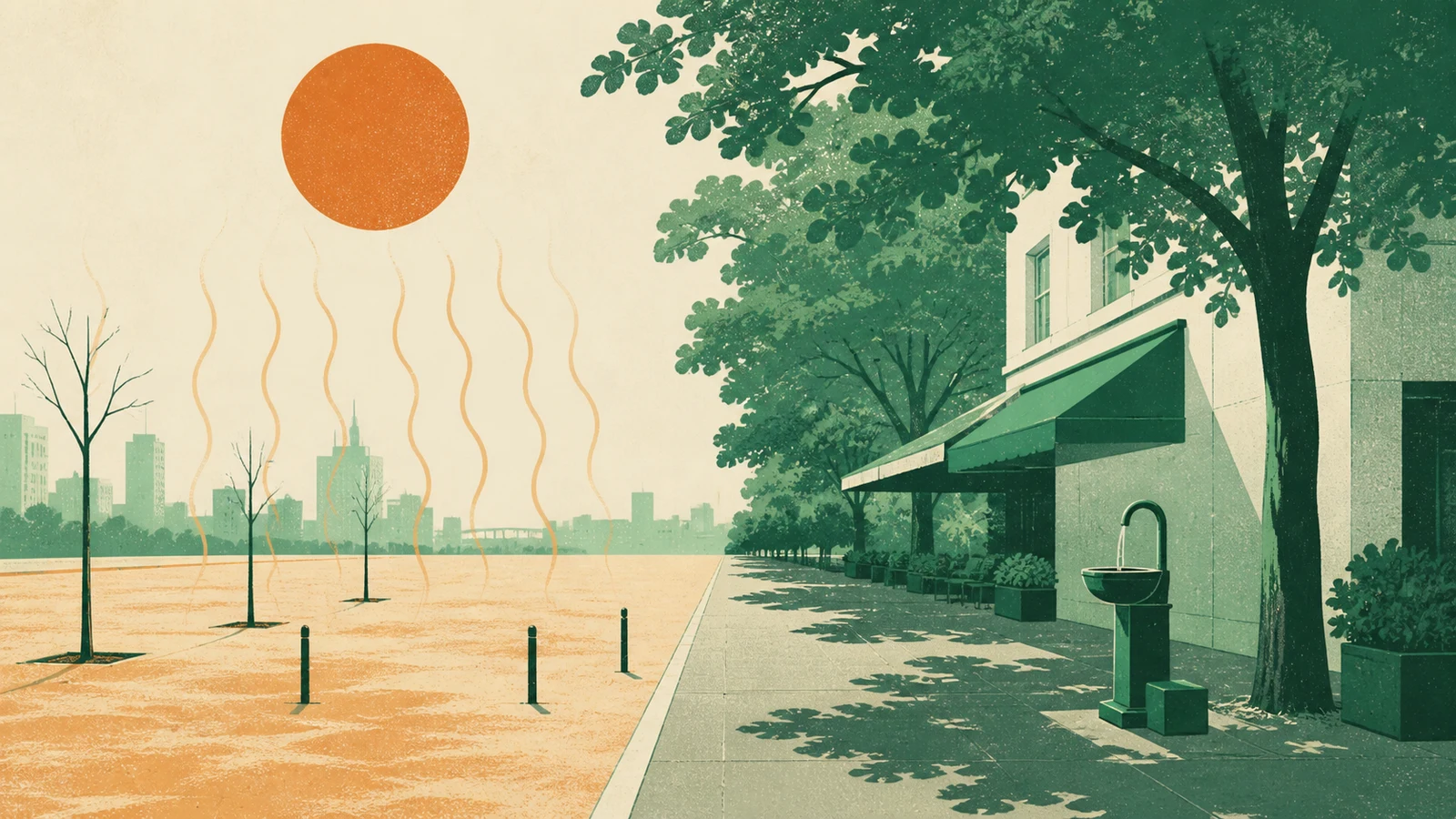
The difference can be read directly off the map in Vienna. In 2024, the Innere Stadt weather station in the city centre counted 52 hot days; the Hohe Warte, on the green edge of the city, only 45. Asphalt, concrete and dense construction store heat during the day and release it again at night, while the evaporation that soil and plants would provide is missing. Experts call this the urban heat island effect, and every additional square metre of sealed surface intensifies it.
This is precisely where Austria's structural problem lies. According to the latest monitoring data from ÖROK, the Austrian spatial planning conference, and the federal environment agency (Umweltbundesamt), an average of 6.5 hectares of land per day were newly taken up between 2022 and 2025, with more than half of that land sealed over. The WWF, which uses a broader definition, puts land consumption for 2025 at as much as 7.7 hectares per day. Sealed ground cannot absorb water and cannot cool; it turns summer heat into a health risk.
Just how serious that risk is can be seen in the figures from AGES, Austria's agency for health and food safety: its heat mortality monitoring records 449 heat-related deaths in Austria for the summer of 2025, and for the record year of 2024, calculated using the new internationally comparable method, 989. Most of the victims are elderly people, the chronically ill and those who cannot afford a cool home. That makes heat the deadliest weather-related consequence of climate change in the country, well ahead of flooding or storms.
What Vienna is actually doing
Vienna presented a comprehensive heat action plan back in 2022, combining short-term protective measures for vulnerable groups with long-term urban redesign. Its most visible element this year is the Cool Zones (Coole Zonen): 34 freely accessible, cooled spaces across 20 districts, housed in libraries, pensioners' clubs, municipal offices and social facilities. According to the City of Vienna, they have been open since 1 June, and since the end of June they can be found, complete with opening hours, on the city's online map.
Added to this is a water infrastructure reaching its largest scale yet in the summer of 2026: around 1,800 public drinking fountains, 123 misting showers and mist columns in parks, 100 street sprinklers and 75 mobile drinking fountains with a spray function that travel from district to district under the name "Brunnhilde". For its urban redesign, Vienna relies on the "Raus aus dem Asphalt" (Out of the Asphalt) programme: according to the city, 344 unsealing and greening projects have been carried out across all 23 districts since its launch, with 3,316 trees planted along streets alone. The "Coole Straßen Plus" (Cool Streets Plus) go a step further, permanently breaking up asphalt and replacing it with green spaces and tree pits. In total, the city says it plants up to 4,500 trees a year, and the Vienna city gardens department alone tends more than 500,000 urban trees.
"Green spaces cool the air by three to six degrees Celsius," the City of Vienna calculates — no other instrument of climate adaptation is as effective as shade and evaporation.
That more urban greenery not only cools but also creates habitat is demonstrated by the 15 "Wiener Wäldchen", densely planted mini-forests on former asphalt and gravel surfaces. The role such spaces play for insects, birds and the ecological balance is something we described in our piece on biodiversity in Vienna, Graz and Linz.
Graz and Linz follow suit
Graz, particularly exposed climatically because of its basin location, has presented its own heat action plan, which kicks in as soon as the province of Styria issues a heat warning for the greater Graz area. It includes cool rooms in libraries and churches, free drinking fountains in every district and targeted information for at-risk groups, for instance via care services. Greening efforts are running in parallel: according to the City of Graz, more than 2,600 new trees have been planted in recent years, inner-city squares unsealed and "green islands" created. The fact that Styria recorded 93 heat-related deaths in 2025 — the highest figure of any Austrian province, according to AGES — lends the programme added urgency.
Linz experienced June 2026 as a wake-up call: for the first time in the city's measurement history, the 40-degree mark seemed within reach, as the city's media service warned in late June — in the end it stopped at a record of just over 39 degrees. The Linz heat protection plan sets out warning levels and protective measures, and more than 90 drinking-water fountains stand ready. Above all, though, the city has committed itself to a tree-planting offensive: 1,000 additional trees within ten years, targeted at inner-city locations with a high degree of soil sealing. Just how much that can achieve is shown by a 2018 study of Linz's urban climate: a single row of trees on the Hauptplatz, the main square, would lower the radiant temperature on hot days by twelve degrees. Linz also subsidises façade and roof greening, which insulates buildings and improves the microclimate of the surrounding neighbourhood.
What actually works inside buildings
The most effective heat protection in the home is also the least spectacular: not letting the sun in at all. External shading such as venetian blinds, roller shutters or window shutters blocks 80 to 90 per cent of solar radiation, according to the environmental advice service Umweltberatung, while interior blinds and curtains manage only 5 to 45 per cent depending on the type, because by then the heat is already in the room. Simulations show that well-planned shading can lower the maximum room temperature by several degrees and significantly reduce cooling energy demand. In many flats, that makes an air conditioner unnecessary — along with its electricity costs and the waste heat it blows into the street. It also eases the strain on power grids, which — as our analysis of the record SpaceX IPO shows — are already under pressure from the energy appetite of AI data centres.
For hot weeks like the one in late June, a few basic rules have proven their worth:
- Keep windows closed during the day and shade them from the outside; ventilate at night and in the early morning, ideally with a cross-breeze through the flat
- Switch off electrical appliances rigorously — every watt of standby consumption is also a small heater
- Use fans strategically; they don't cool the air, but they speed up evaporation on the skin
- When renovating or building, plan external shading, light-coloured surfaces and roof or façade greening in from the start
In the long run, however, the heat resilience of cities will be decided not by the individual roller shutter but by land. Every hectare that is not sealed, every tree planted today that will cast shade in 20 years, lowers the temperature for everyone. June 2026 has shown how short the time for that is: the next heatwave isn't coming someday — it's coming in July.