Exactly four days separated two records. On 12 June 2026, Elon Musk's space company SpaceX listed on the Nasdaq, making its founder the first trillionaire in history. On 16 June, the same company announced it was acquiring the software firm Anysphere – the company behind the AI programming tool Cursor – for 60 billion US dollars. Two figures harder to grasp than anything we know from traditional industry. And yet this purchase tells a story less about software than about something very tangible: electricity, data centres, and the ecological bill of a boom that no share price reflects.
This article puts both into perspective – the dizzying financials of the deal and its very real flip side.
The biggest software deal of the year
The key facts first. According to concurring reports from CNBC, NBC News and CBS News, SpaceX is acquiring the San Francisco-based company Anysphere for around $60 billion – paid entirely in shares, not cash. The transaction is structured as a merger of Anysphere with a wholly owned SpaceX subsidiary bearing the prosaic name "X67". Closing is expected in the third quarter of 2026, subject to antitrust review.
The backstory is remarkable. Back in April, SpaceX had secured itself an option: either to buy Anysphere outright for $60 billion – or, alternatively, to pay $10 billion for a mere partnership. SpaceX chose the full acquisition. The agreed exit costs show how serious both sides are: if the deal collapses, a break-up fee of $10 billion falls due; if it fails on competition grounds, a further $4 billion regulatory termination fee is added. The mere failure of this purchase would thus cost more than most acquisitions that make headlines in a normal year.
Cursor: from zero to two billion in three years
To understand why a space company is paying $60 billion for a code editor, it is worth looking at the company being bought. Anysphere was only founded in 2022. Its product, Cursor, is an AI-powered tool that lets software developers write, review and refactor code using natural language. It competes directly with Claude Code from Anthropic and Codex from OpenAI.
The growth curve is extraordinary even by the standards of the overheated AI industry. Measured by annualised revenue (ARR), industry data show Cursor crossing the $100 million mark in January 2025, $500 million in June, one billion in November – and as early as February 2026, two billion dollars. That makes Cursor the fastest company in the history of B2B software to scale from zero to $2 billion in revenue, in roughly three years. For the end of 2026, the firm is projecting more than $6 billion in ARR.
The valuation climbed just as steeply. In a Series D round in November 2025, Anysphere raised $2.3 billion at a valuation of $29.3 billion, according to CNBC – led by Andreessen Horowitz and Thrive Capital, with chip giant Nvidia as a strategic investor. Shortly afterwards there was talk of a further round at around $50 billion. By that point the company had raised a total of roughly $2.7 billion, including from Accel, DST Global, Coatue and Google.
A company that did not exist four years ago is changing hands for $60 billion – roughly thirty times its current annual revenue.
The $60 billion purchase price thus amounts to around thirty times the current ARR of two billion – or, if you believe the company's own forecast, ten times the revenue expected by the end of 2026. Multiples like these are unthinkable in the traditional economy; in the current AI euphoria, they have become the new normal.
Why a space company is buying a code editor
At first glance, a programming tool has nothing to do with rockets. The key lies in Musk's nested corporate web. In February 2026, SpaceX had taken over his AI company xAI – developer of the Grok chatbot – which in turn had previously swallowed the platform X (formerly Twitter). With the purchase of Cursor, this conglomerate now gains one of the world's most successful AI coding assistants.
Strategically, this is about ground that xAI had so far lost in the race between AI companies. In large language models, Grok trailed Anthropic and OpenAI; and it was precisely in the coding segment – one of the first fields in which AI actually makes money – that a strong product was missing. Cursor closes that gap in one stroke. Under the SpaceX umbrella, this creates an entity that combines launch rockets (Starship), the world's largest satellite network (Starlink), a social media platform (X), an AI model (Grok) and now an AI programming tool (Cursor) – financed by a stock valued at around $1.77 trillion after the IPO.
Putting it in context: the mathematics of a record price
A comparison with the rest of the industry shows just how unusual $60 billion for Anysphere is. Traditional acquisitions of software companies are typically priced at five to fifteen times annual revenue; even for fast-growing providers, twenty times is considered ambitious. Cursor is changing hands for roughly thirty times its current revenue. A multiple like that allows only two readings: either an extraordinary conviction that this pace will continue – or a market that has lost touch with the ground.
The context argues for the second reading. The acquisition joins a chain of transactions in which Musk's companies buy one another in shares: xAI had taken over the platform X in 2025 in a much-criticised deal worth around $33 billion, before xAI itself was absorbed into SpaceX in early 2026. That Cursor, too, is being paid for entirely in shares rather than cash is crucial: SpaceX is spending no money from its coffers, but its own freshly listed and highly valued stock – tying Anysphere's fate directly to its own share price.
Hovering over all of this is the question of a bubble. When five corporations pour $660 to $725 billion into AI infrastructure in a single year, while the entire industry's actual AI revenues are many times smaller, a gap opens up that must eventually be closed – by exploding revenues or by a correction. Whether a programming tool with two deep-pocketed competitors in Claude Code and Codex will still be worth $60 billion in five years, nobody knows today.
The bill that appears on no share certificate
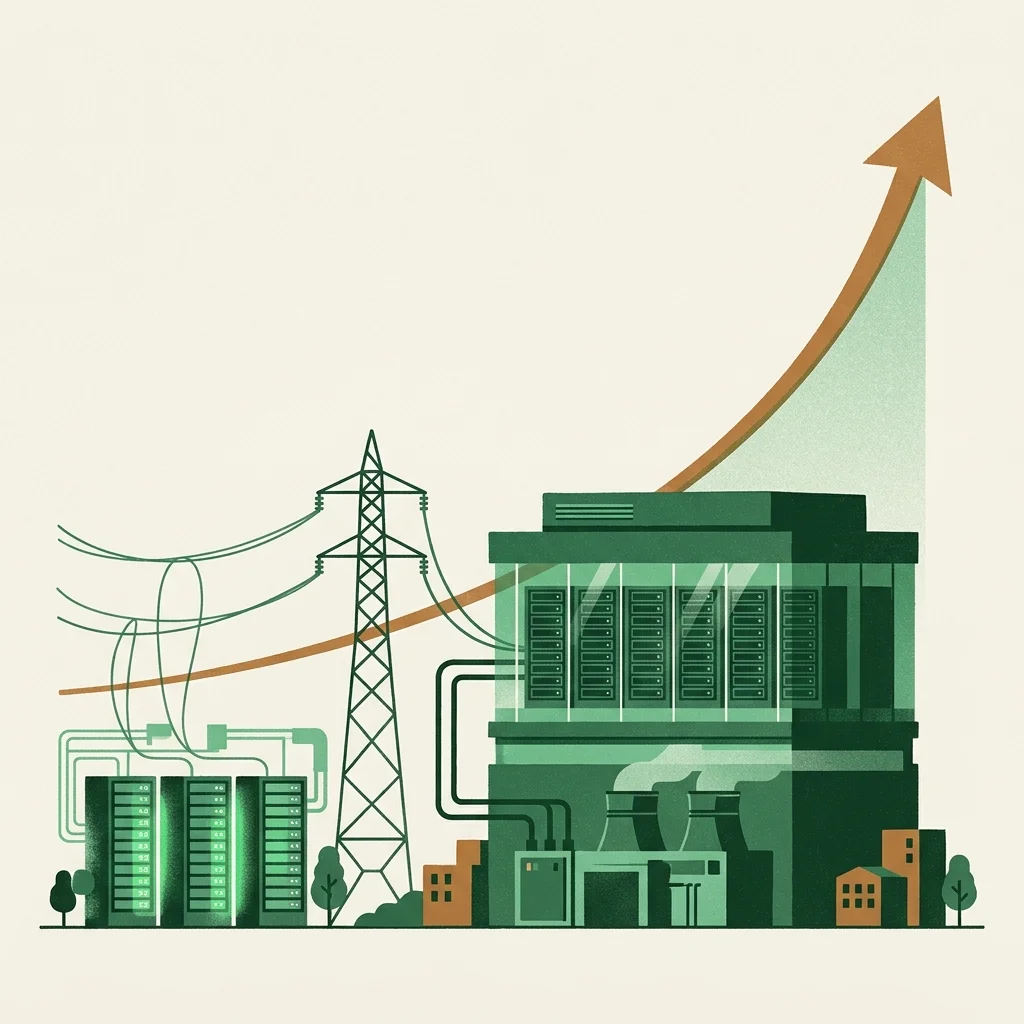
This is where the flip side comes in, and it is the real reason this deal belongs in a magazine about sustainable living. Every one of these AI assistants – whether Cursor, Grok, Claude or ChatGPT – runs not in a vacuum but in data centres that consume gigantic amounts of electricity.
Musk's own infrastructure illustrates the point. According to industry analyses, the power demand of xAI's supercomputer "Colossus" in Memphis has risen from around 13 megawatts in 2019 to roughly 280 to 300 megawatts in 2025 – more than a twentyfold increase in six years. The facility houses around 200,000 high-performance graphics processors from Nvidia. Its successor, "Colossus 2", aims to become one of the first data centres in the world to reach the gigawatt threshold – an output on the scale of a mid-sized nuclear power plant, solely for training and running AI.
And Colossus is no isolated case. In 2026, several gigawatt-scale data centres are expected to come online, each operated by a different hyperscaler. The five largest of these corporations have together announced investments of $660 to $725 billion for 2026 – almost exclusively for AI infrastructure. Global electricity consumption by data centres, according to the International Energy Agency and several industry forecasts, is set to double to around 980 terawatt-hours by 2030. The share attributable to AI alone is projected to rise from about 93 terawatt-hours in 2025 to around 432 terawatt-hours in 2030 – nearly a fivefold increase.
This demand is hitting power grids that cannot grow as fast. Because grid connections often take years, operators are increasingly turning to their own generators – burning additional fossil fuels in the process. This is precisely where Musk's xAI has already left itself exposed: the US environmental law organisation Southern Environmental Law Center threatened legal action, accusing the company of operating gas turbines at its Memphis site without the required environmental permits, in violation of the Clean Air Act.
What this has to do with Austria
The data centres stand in Memphis or Virginia, not in Styria – and yet the connection is closer than it seems. AI's global hunger for electricity fuels demand and prices on an energy market that has long been internationally intertwined. When the five biggest tech corporations pour hundreds of billions into power contracts, the effects reach all the way to European wholesale prices, which in turn help determine electricity prices in Austria.
Then there is a more fundamental tension. Austria has set itself ambitious climate targets and is expanding its renewable capacity – while the very digitalisation regarded as a tool of climate protection is, with AI, suddenly becoming one of its biggest new consumers of electricity. Data centres are being built in Europe too, and here as well they compete with households and industry for green power. The question of whether the growth of AI keeps pace with the growth of renewables or devours it is therefore not a distant American one, but a very European one.
Conclusion: what $60 billion really buys
On paper, the purchase of Cursor is a software deal of historic proportions: the fastest-growing B2B company in history, acquired at thirty times its revenue, four days after the biggest IPO of all time. It is the kind of news that markets celebrate.
But behind the valuation stands a second, more uncomfortable number – not in dollars, but in terawatt-hours. Every additional AI assistant, every billion in extra revenue, every new feature means more computing power, more data centres, more electricity. The $60 billion for Cursor is visible; it appears in every headline. The energy bill of the AI boom is not – and that is exactly why it is worth reading alongside it. Whether AI ends up a tool of sustainability or one of its greatest adversaries will be decided not on the stock exchange, but on the power grid.