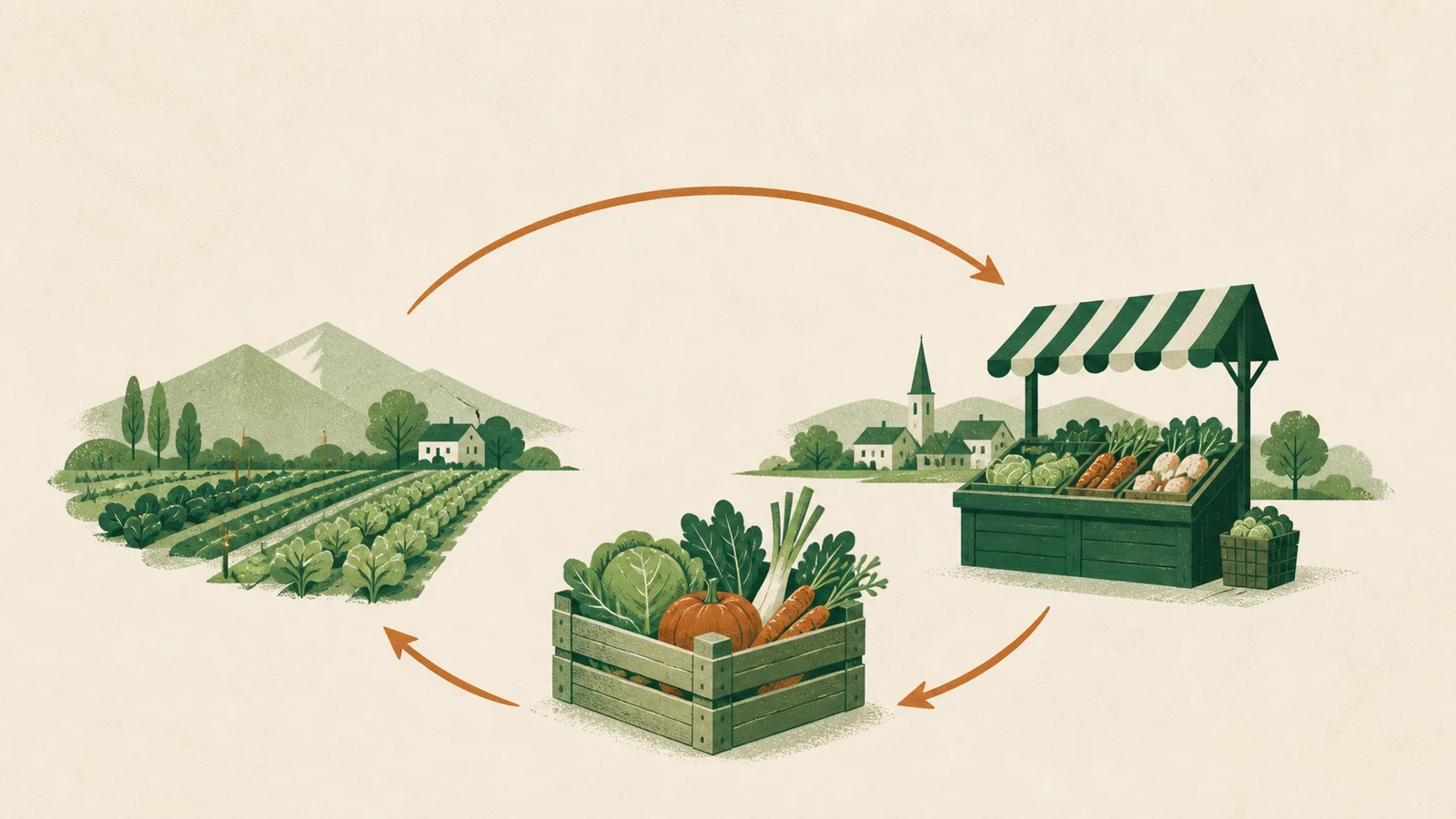
Walk across Vienna's Karmelitermarkt or the Kaiser-Josef-Markt in Graz on a Saturday morning and you will see a scene that has changed noticeably in recent years. Stalls selling potatoes from the Marchfeld plain, cheese from the Bregenzerwald and apples from Styria are once again drawing people who would once have driven to the supermarket without a second thought. Behind this return lies more than a fashionable yearning for the authentic. Short supply chains touch on questions of food security, farm incomes and — with a few caveats — climate protection. At the same time, one misunderstanding proves stubbornly persistent: that regional and climate-friendly are the same thing. The two are related, but they are not identical.
What seasonality actually means
The decisive factor in a food's environmental footprint is often not the distance it has travelled but the way it was produced. A tomato ripened in a heated greenhouse during the Austrian winter can have a worse climate balance than one grown in an open field in Spain and trucked to Vienna. The Umweltbundesamt, Austria's federal environment agency, regularly points out that the heating energy required for protected cultivation can outweigh the supposed advantage of proximity.
Seasonality is therefore the underrated lever. Buy Austrian strawberries in June, pumpkin in autumn and storage vegetables such as cabbage, carrots and potatoes in winter, and you genuinely benefit from short distances and low energy input at the same time. Things become problematic where regionality promises year-round availability. A home-grown tomato harvested in February is not a seasonal product; it is an energy-intensive one. That does not make regional produce worse — it simply shifts the focus. The relevant question is less "where from" than "when" and "how".
Transport, honestly accounted for
Transport accounts for a smaller share of many foods' overall climate footprint than intuition suggests. For plant-based products, most emissions arise from cultivation, fertilisation and — in the case of protected crops — heating. The transport lobby group VCÖ has been pointing out for years that the final kilometres to the consumer play a role of their own: anyone who drives their car out to a farm on the edge of town specifically to pick up a sack of potatoes can quickly wipe out that transport advantage.
With animal products, livestock farming dominates the balance sheet in any case, not logistics. Beef from the neighbouring district remains more climate-intensive than pulses from overseas. This distinction is no academic quibble. It guards against reinterpreting regionality as a seal of quality it is not. Short distances are a value in their own right — for freshness, for value creation in the region, for traceability. But they are not automatically the ecologically best choice.
Farmers' markets and the question of value creation
Direct marketing has a long tradition in Austria and is regaining importance. At farmers' markets, in farm shops and through cooperatives, a markedly larger share of the sale price stays with the producer than in the retail trade, with its margins and intermediaries. For many smaller farms that can barely survive the price competition of the supermarket chains, this direct selling is what keeps them in business.
Structural change in agriculture makes this urgent. According to Statistik Austria, the national statistics office, the number of agricultural and forestry holdings has fallen steadily over recent decades while the average farm size has grown. Small farms give up; larger ones take over. Short supply chains will not reverse this trend on their own, but they open up a niche in which quality and personal relationships pay off rather than sheer volume.
Add to this a social effect that is hard to quantify. The weekly market is a meeting place, not just a point of sale. In Linz, Salzburg or Innsbruck, markets are a fixture of city life. Especially in cities fighting summer overheating, such open-air meeting places gain additional value. That function cannot be translated into a carbon balance, but it belongs in any honest overall reckoning of short supply chains.
The AMA seal and the limits of origin
Anyone looking for provenance quickly encounters the red-white-red AMA seal of quality. It is awarded by Agrarmarkt Austria, the national agricultural marketing body, and stands for traceable origin and controlled quality. For the seal, raw materials must be sourced, processed and refined in Austria, provided the raw material in question is available domestically in sufficient quantity. Alongside it exists the AMA organic seal for organic production. For consumers seeking orientation on the shelf, it is a tangible help.
What matters, though, is understanding what the seal delivers and what it does not. It guarantees origin and inspection, but it makes no direct statement about the climate footprint of an individual product. AMA-certified greenhouse vegetables in winter remain energy-intensive, however Austrian they may be. The seal does not replace your own judgement about season and production method; it complements it. It solves the origin problem, not the climate problem — and it never claims to.
Resilience: the argument that recently gained weight
Little has changed the debate about regional supply as much as the experience of broken supply chains. The pandemic and, later, the energy price crisis showed how vulnerable globally interwoven supply systems can be. When borders close, freight costs explode or individual growing regions fail — not least as a result of advancing climate change — proximity suddenly becomes a strategic asset.
Austria achieves a high degree of self-sufficiency in staples such as milk, beef and grain, while it depends more heavily on imports for vegetables, fruit and, above all, plant oils. The Chamber of Labour (Arbeiterkammer) and agricultural policy bodies point out that these dependencies vary considerably from region to region. A broadly based domestic production base and functioning short supply chains increase the capacity to absorb disruption. Resilience here does not mean autarky. Nobody seriously proposes sourcing coffee or citrus fruit from the Alps. It is about a degree of self-reliance where it is sensible and feasible — and about preserving the structures, land and farms that can deliver when it counts.
This is precisely where the resilience argument meets structural change. Lose the diversity of family farms and you lose food security too. Short supply chains are thus not merely a matter of taste or carbon accounting, but one of forward-looking risk management.
What remains
Local food and short supply chains are more than a consumer trend, but they are no panacea either. Their strongest argument lies less in the climate than in local value creation and in the resilience of the food supply. Anyone who wants to make ecologically sound decisions cannot avoid the question of season and production method: an Austrian carrot from the root cellar clearly beats heated greenhouse vegetables, while in winter some imported field-grown produce can outperform the short-haul alternative.
The AMA seal helps with origin but does not replace your own judgement. Farmers' markets strengthen farms and city life, but they will not resolve structural change on their own. They also stand for a broader culture of conscious consumption, to which the country's growing repair café movement belongs as well. And the resilience of domestic production is a value that only fully reveals itself in a crisis. Short supply chains deserve attention not because they are better across the board, but because they act on several fronts at once — provided you look at them soberly and without exaggeration.