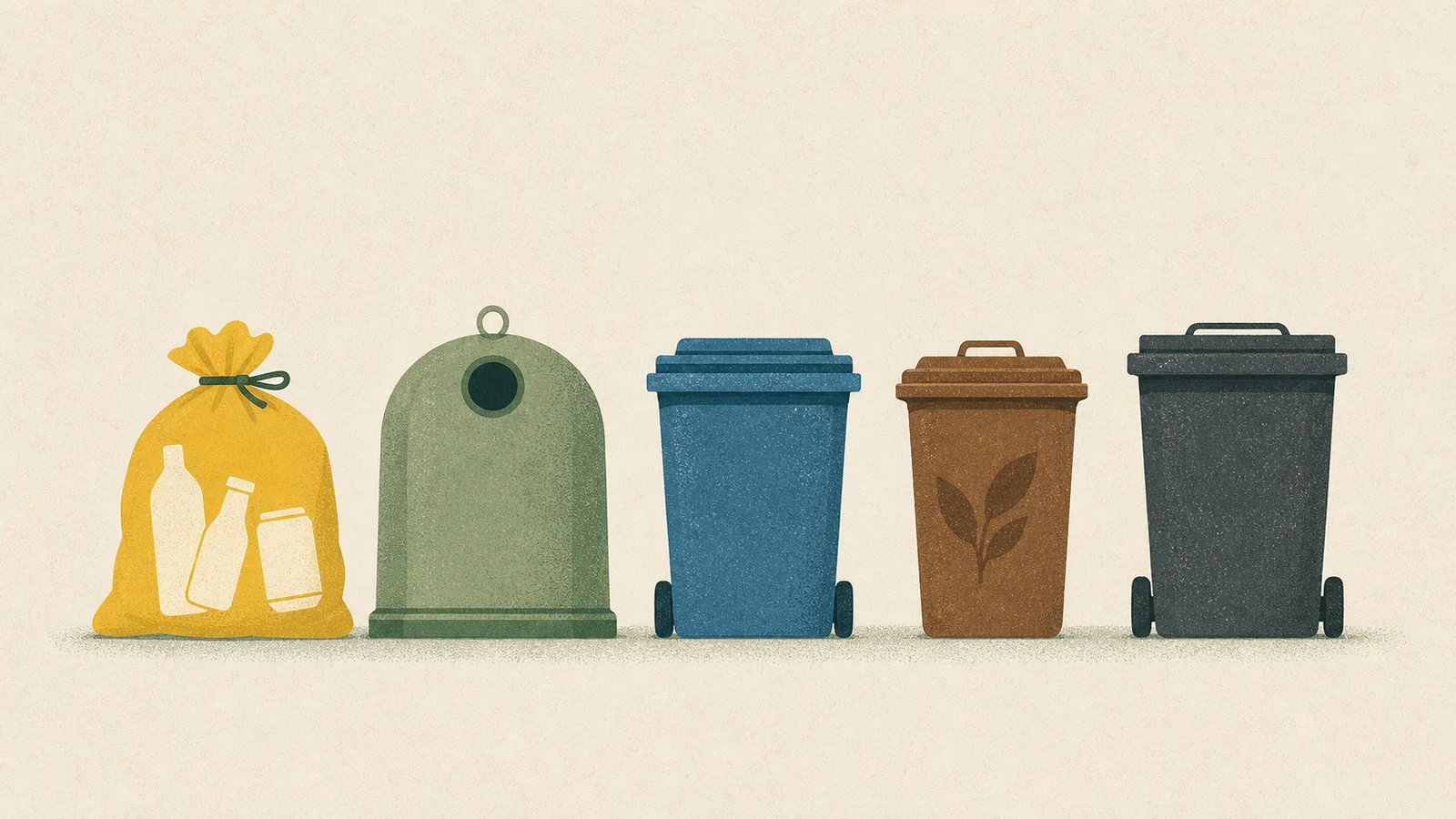
In Austria, separating your rubbish is as much a part of everyday life as bringing your own bag to the supermarket checkout. And yet a surprising amount still ends up in the wrong bin. Residual waste analyses from the federal states have shown the same picture for years: a large share of what lands in the black bin never belonged there. This is no cosmetic flaw. Every yoghurt pot and every tin can in the wrong bin is lost to the recycling loop and has to be incinerated at high cost instead of being recovered cheaply.
The good news: since the nationwide harmonisation, the system has become simpler than many people think. Know a few ground rules and you can sort correctly in seconds. This overview explains what changed in 2023 and 2025, what goes where, and which mistakes prove particularly stubborn.
The new system: all lightweight packaging in one bin
For a long time, Austria was a patchwork. Depending on the federal state and district, different things were allowed in the yellow bag or yellow bin, while elsewhere metal packaging was collected separately. Anyone who moved house practically had to relearn how to sort.
Nationwide harmonisation changed that. Introduced in 2023 in the first federal states (Vienna, Lower Austria, Carinthia, Salzburg) and mandatory across all of Austria since 1 January 2025, one uniform rule now applies: all lightweight packaging made of plastic and metal goes together into the yellow bag or yellow bin. For households, the old separation between plastic and metal no longer exists.
In concrete terms, the yellow bag or yellow bin takes:
- plastic bottles without a deposit, yoghurt pots, margarine tubs, plastic tubes
- plastic bags, film and packaging foil
- beverage cartons (Tetra Pak) and milk cartons
- tin cans, drink cans without a deposit, aluminium lids, crown caps
- smaller metal and composite packaging, such as tubes or ready-meal trays
Rule of thumb: if it was packaging, it's lightweight, and it's made of plastic or metal, it belongs in the yellow bin — unless it carries a deposit.
According to ARA, Austria's packaging collection and recovery organisation, the switch has delivered measurable results. The volume of plastic collected separately from households has risen significantly compared with the years before harmonisation, and the recycling rate for plastic packaging stands at around 25 per cent according to ARA — above the previous EU target of 22.5 per cent. In total, more than a million tonnes of packaging and waste paper were collected separately from Austrian households in 2024. The new EU target of 50 per cent recycling, in force from 2025, is ambitious, however — and it can only be reached if packaging ends up cleanly in the yellow bin rather than in residual waste.
Glass, paper, organic: the remaining streams
Alongside the yellow bin, there are four other central collection streams, which remain unchanged.
Waste glass
Glass packaging goes into the glass container, sorted into clear glass and coloured glass. This separation isn't bureaucracy — it's engineering: even a small amount of coloured glass discolours an entire batch of clear glass, which can then no longer be recycled into clear glass. Important: drinking glasses, mirrors, window glass and glassware do not belong in the glass container. They have a different chemical composition and melting point from packaging glass and disrupt the recycling process — they go in the residual waste.
Waste paper
Paper and cardboard are collected separately, in many places in the red bin. This is where newspapers, catalogues, cardboard and envelopes belong. Common misconceptions: coated baking paper, heavily soiled pizza boxes and till receipts do not belong in the paper bin. Till receipts are usually made of thermal paper and must go in the residual waste.
Organic waste
The brown organic waste bin takes fruit and vegetable scraps, coffee grounds, eggshells, garden waste and spoiled leftovers. The crucial rule: no plastic. Even so-called "compostable" plastic bags are unwelcome in many collection regions, because in practice they decompose too slowly and have to be sorted out as contaminants at the processing plants; there are no uniform rules across Austria, so it pays to check the guidelines of your local waste management association. Bones and large quantities of cooked food waste are also restricted in some regions — when in doubt, check the local rules.
Residual waste
Residual waste is the catch-all for everything that cannot be recovered: hygiene products, tissues, vacuum cleaner bags, nappies, broken crockery, ash or soiled composite materials. But it should be exactly that — a residue, not the default route for convenient disposal.
The most common mistakes
Residual waste analyses from the federal states reveal the same weak spots year after year. Avoid these and you're already sorting better than average:
- Packaging in the residual waste. The classic. Pots, cans and film end up in the black bin out of convenience instead of the yellow one. This is the most expensive and most frequent mistake.
- Organic waste in the residual waste. A substantial share of residual waste is organic material — the 2025 Lower Austria residual waste analysis found more than a quarter (around 27 per cent) organic matter and food waste, much of it food waste that could have been avoided in the first place. Here, waste separation ties in closely with the issue of food waste.
- Batteries and rechargeable batteries in household waste. Particularly dangerous. Lithium-ion batteries from phones, headphones or power tools can ignite when compacted and cause fires in collection vehicles and sorting plants. They belong at the hazardous waste collection point or in retail take-back schemes — never in a household bin.
- Dirty packaging. Packaging doesn't need to be washed out — "spoon-clean" is perfectly sufficient. Items heavily caked with food residue, however, belong in the residual waste.
Ultimately, sensible waste separation is the first step towards a functioning circular economy: only cleanly separated materials can be turned into new raw material at all. Sorting is not an end in itself, then, but the ticket into recycling.
One distinction: deposits are not waste separation
Since 1 January 2025, Austria has had a single-use deposit on single-use drinks packaging made of plastic and metal — that is, PET bottles and drink cans from 0.1 to 3 litres. A deposit of 25 cents is charged per container, identifiable by the official deposit logo on the packaging. Exempt items include milk cartons and beverage cartons — these remain deposit-free and still go in the yellow bin.
This causes some confusion at first, because PET bottles and cans used to go straight into the yellow bag. But the rule is clear:
- With a deposit logo: return to a shop, uncrushed and with the label legible. This packaging does not belong in the yellow bag.
- Without a deposit logo: into the yellow bag or yellow bin, as before.
During the 2025 transition phase, both variants were in circulation. Since 2026, practically no deposit-free drink bottles and cans may be newly sold — making the distinction easier. The system is performing better than expected: according to its operators, the return rate reached 81.5 per cent in the very first year, above the statutory target of 80 per cent (90 per cent is planned by 2027); around 1.4 billion bottles and cans had returned to the material loop by the end of 2025. For the details of how the deposit scheme works, see our overview of Austria's single-use deposit.
What matters is keeping the two systems mentally separate: the deposit is a return scheme with a financial incentive; waste separation is a sorting system. A beer can with a deposit logo gets you 25 cents back — the same can without the logo remains a case for the yellow bin.
The bottom line
Since harmonisation, waste separation in Austria has become considerably clearer: lightweight plastic and metal packaging together in the yellow bin, glass sorted by colour, paper and organic waste each cleanly in their own bin, and everything else in the residual waste. Return your deposit containers and keep batteries out of the bins, and you've got the essentials right. The biggest levers aren't complicated — they're a matter of habit: put less in the residual waste, check your local waste management association's rules when in doubt, and consistently send packaging to where it can become raw material again. And if you want to take the sustainability mindset beyond the household, you'll find similar principles at work in sustainable investing: look closely rather than relying on labels.