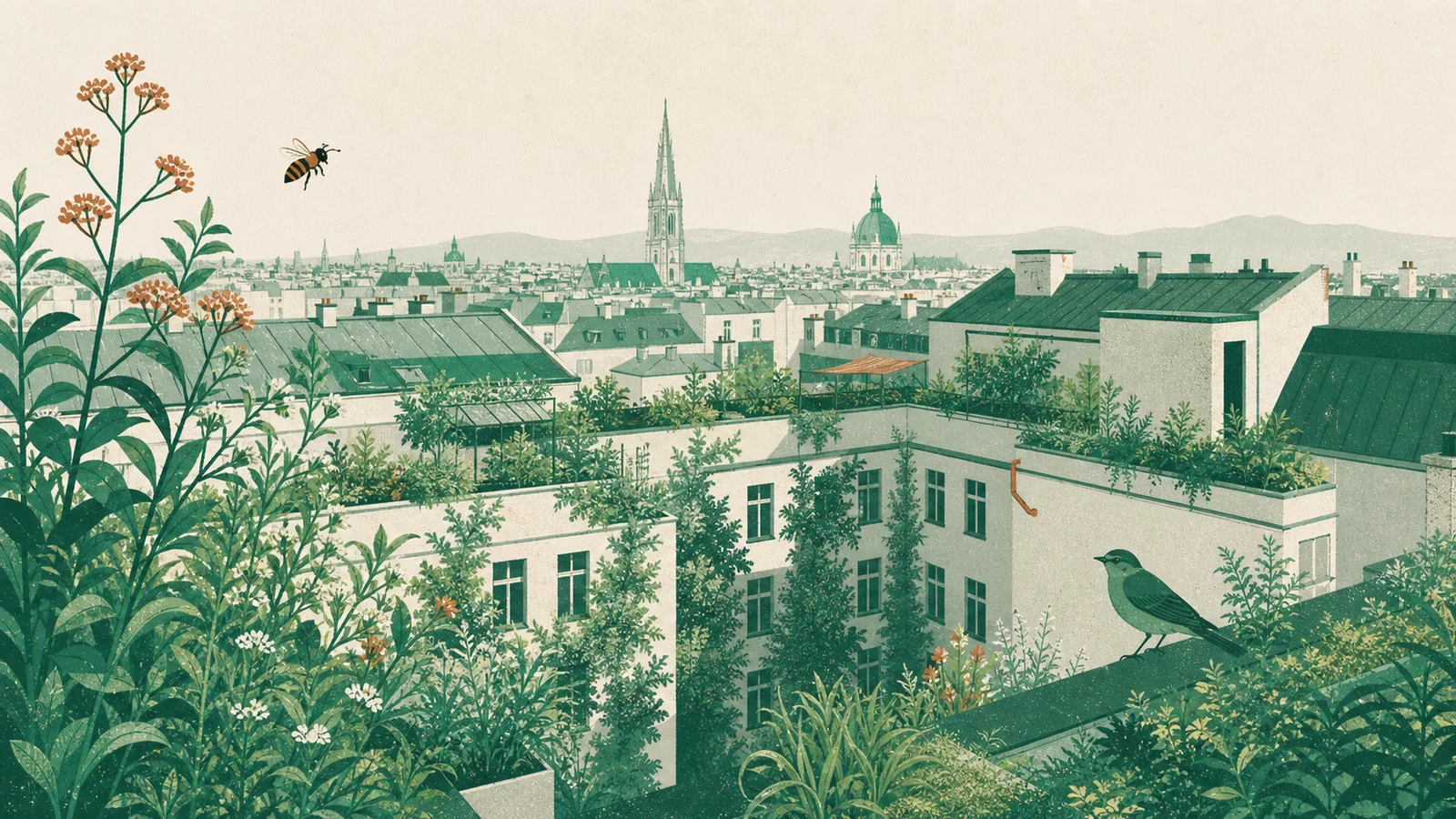
On hot summer days, the difference between a shaded avenue and a sealed concrete square can amount to several degrees. What was long dismissed as a matter of mere comfort has become a planning question in Austria's cities: according to the Environment Agency Austria (Umweltbundesamt), the number of heat days has risen markedly over recent decades, and densely built inner cities heat up more than their surroundings. At the same time, habitats for insects, birds and wild plants are shrinking. Vienna, Graz and Linz are trying to think both problems together — with trees, unsealed surfaces, greened facades and meadows that are no longer mown every week. The approaches are similar; the emphases differ.
Why cities become heat islands
The effect is well documented: asphalt, concrete and rooftops store heat during the day and release it again at night. As a result, cities cool down less than rural areas. The Environment Agency Austria has been pointing to these so-called urban heat islands for years — during heatwaves they become a genuine health burden, particularly for older people and small children. Greenery works on two fronts here. Trees provide shade, and by evaporating water through their leaves they cool the surrounding air. On a summer day, a mature urban tree canopy can make a tangible difference — provided the tree has enough root space and water to survive.
That is precisely where dense urban space often falls short. Utility lines run beneath pavements, the soil is compacted, road salt and dog urine take their toll on the roots. Many young trees dry out before they grow large enough to cast any shade. Biodiversity adds a second dimension: a species-rich city with wildflowers, shrubs and old trees offers habitat for pollinators and birds. A close-cropped lawn barely does. Both — cooling and biodiversity — depend on the same factor: how much near-natural, permeable ground a city allows.
Vienna: sponge city and thousands of new trees
In recent years, Vienna has leaned heavily on the so-called sponge-city principle. The idea: rather than channelling rainwater into the sewers as quickly as possible, store it in the ground, where it benefits trees and plants. Technically, this means installing a coarse gravel substrate beneath pavements and squares, whose cavities give roots room to spread and water a place to collect. During heavy rain, this layer acts as a buffer; in dry spells, as a reservoir. The City of Vienna has applied the technique in numerous street conversions and square redesigns, including the remodelling of major thoroughfares.
Alongside this, the city runs an extensive tree-planting programme and regularly stresses that it plants several thousand trees a year, partly to offset losses to drought and disease. Then there are the smaller-scale measures that stand out in the streetscape: misting showers and drinking fountains at heat hotspots, and so-called Cool Streets, where traffic is pushed back and water and greenery take centre stage. Facade greening is supported through subsidy schemes that give building owners grants for climbing plants and vertical planting systems. Greened facades shade walls, dampen the heating of buildings and, as a side effect, provide food for insects.
Vienna has also changed course on wildflowers. Many green spaces are now mown less often, so that meadow flowers can bloom and set seed. What may initially strike some residents as unkempt follows an ecological calculus: over the course of a season, an extensively managed meadow offers far more blossoms and habitat than a permanently short lawn.
Graz: a tight basin, targeted unsealing
Graz faces a particular challenge. The city sits in a basin where heat — and in winter, particulate matter — accumulates because air exchange is limited. Here, greening is not an optional extra but part of the strategy against pressures that the Environment Agency Austria has repeatedly flagged for the Graz area. In recent years the city has begun deliberately breaking open sealed surfaces and converting them into green space. When squares and streets are redesigned, trees are planted with larger root zones, in some cases likewise following the sponge-city principle.
One focus is the question of where space for greenery can be found at all in the densely built centre. Green roofs and greened facades therefore play an important role, because they make use of surfaces that would otherwise lie idle. Green roofs retain rainwater, insulate buildings and reduce overheating. Graz has anchored such measures in its building regulations, so that greening must be factored into larger new developments. The city also invests in awareness-raising and smaller participatory projects that let residents plant tree pits and small patches outside their own front doors.
Linz: from industrial image to green axis
Linz still carries the label of an industrial city, but on greening it has caught up in recent years. The city lies on the Danube and, with the Danube floodplain forests on its edge, has valuable near-natural areas that serve as a backbone for biodiversity. The challenge is to connect these green fringes with the densely built centre. Linz is working on green corridors and on upgrading existing parks, complemented by new tree plantings along streets and on squares.
Here too, water management is moving to the fore. Renovation projects increasingly aim to let rainwater seep away on site rather than piping it into the sewers — the same underlying idea as the sponge city. Facade and roof greening is subsidised, and on public land the city is experimenting with wildflower meadows that feed pollinators while cutting maintenance costs. The journey from steel town to greener municipality is not complete, but the direction is clear.
What the measures achieve — and what they don't
However different the local emphases, the toolbox looks much the same. At heart, all three cities rely on the same levers:
- more trees, and better-supplied ones, against heat islands — often with underground sponge-city substrates
- unsealing and infiltration, so that rainwater stays in the ground
- facade and roof greening to activate unused surfaces
- extensively managed wildflower areas for greater biodiversity
For all the momentum, the scale remains modest. A newly planted tree takes years to develop its cooling effect, and local measures can do little against the broader trajectory of the climate. They can soften the consequences, not fix the cause — all the more so as AI's growing hunger for electricity pushes global energy demand even higher. Moreover, green space in the dense urban core competes fiercely with other uses — parking, utility lines, building rights. Every unsealed square metre is the product of trade-offs and, often, of conflict. How reliably the programmes work also cannot yet be judged conclusively, because many of the measures are only a few years old.
What remains
Vienna, Graz and Linz have turned greening from a decorative question into a component of their urban planning. Sponge-city substrates, subsidised facade greening and less frequently mown meadows are no longer buzzwords — they have found their way into building codes, funding guidelines and maintenance plans. The common denominator is the insight that cooling and biodiversity belong together, and that both depend on permeable, living soil. And while the debate over sustainability in space shows that environmental questions have long taken on global dimensions, biodiversity is still decided on the doorstep too. What counts in the end is less the number of trees planted than the question of how many of them will still be standing — and casting shade — in ten years' time. That is where it will become clear whether the programmes really do produce cooler, more species-rich cities.