By 2040, Austria wants to be climate neutral — a date that sounds ambitious by international standards. But the real test comes earlier. As soon as 2030, the republic must nearly halve its greenhouse gas emissions, compared with 2005, in the sectors not covered by the European emissions trading system. It is precisely here — in transport, buildings and agriculture — that progress is slowest. The Environment Agency Austria (Umweltbundesamt) points out year after year that the measures taken so far will not be enough to meet the targets that are binding under both international and EU law. So how is Austria supposed to close the gap?
What the EU requires
The 2030 climate targets did not emerge in a vacuum. They flow from the European framework that divides the Union's overall effort among its member states. For the sectors outside emissions trading — chiefly transport, buildings, agriculture and parts of industry — the so-called Effort Sharing Regulation applies. It sets a national reduction target for each country, calibrated to its economic strength. For Austria, that means cutting these emissions by 48 per cent from 2005 levels. Not covered, by contrast, are growing global emission sources such as the environmental footprint of spaceflight, which appears in no national budget.
Unlike in emissions trading, where the price of CO2 certificates does the steering, responsibility in the effort-sharing sectors rests directly with national policymakers. If a state misses its target, it must buy emission allocations from countries that overachieve on theirs. The climate ministry has purchased such certificates in the past to avoid penalty payments — costs ultimately borne by the national budget. It is exactly this financial pressure that makes the 2030 target more than a symbolic figure.
The greenhouse gas budget as a yardstick
Behind the percentages lies a physical logic: the quantity of greenhouse gases Austria can still emit by a given date without breaking its commitments is finite. Experts call this a greenhouse gas budget. Every tonne of CO2 emitted in excess today shrinks the room for manoeuvre in the years ahead. That applies to power plants as much as to everyday life, where consistent waste separation, for instance, helps cut emissions from the waste sector. In its annual inventories, the Environment Agency Austria tracks how national emissions are developing and how far they deviate from the prescribed reduction path.
In total, Austria's greenhouse gas emissions most recently stood at around 70 million tonnes of CO2 equivalent per year. After a marked decline during the years shaped by the pandemic and the energy crisis, the Environment Agency Austria has again confirmed a downward trend — one that is not steady enough, however, to guarantee the target will be met. The economic research institute WIFO has stressed repeatedly that merely extending existing measures will lead to a permanent shortfall — with the follow-on costs to match.
Transport: the biggest problem area
No sector gives Austrian climate policy as much of a headache as transport. While emissions from industry and power generation have fallen over the years, the transport sector long remained stuck at a high level and today sits barely below its 2005 figure. The transport advocacy group VCÖ regularly points out that the number of cars on the road keeps growing and that Austria's per-capita fuel consumption sits in the European midfield — partly because of so-called fuel tourism, in which vehicles registered abroad fill up comparatively cheaply at Austrian petrol stations.
The policy levers are well known, but slow to move. Expanding public transport — for instance through Austria's Klimaticket travel pass, which since 2021 has offered an annual pass for all public transport nationwide — is meant to make alternatives to the car more attractive. Cities such as Vienna, Graz and Linz are investing in trams, cycle paths and more frequent services. The decisive factor, however, is the ramp-up of electric mobility: Austria ranks among the more active EU countries for new electric car registrations, but the vehicle fleet will be dominated by combustion engines for a long time yet. As long as freight moves predominantly by road rather than rail, the sector remains the central weak point.
Buildings: heating without oil and gas
The picture for buildings is almost as difficult. A substantial share of Austrian flats and houses is still heated with oil or gas boilers. Every fossil-fuel boiler installed today typically runs for two decades — locking in emissions well beyond 2030. The Renewable Heat Act (Erneuerbare-Wärme-Gesetz) is meant to speed up replacement by restricting the installation of new fossil-fuel heating systems and supporting the switch to heat pumps, district heating and biomass.
Pace is everything. The Chamber of Labour (Arbeiterkammer) calculates that, without subsidies, thermal retrofits of older buildings and boiler replacements are barely affordable for many households — which is why state grants such as the "Raus aus Öl und Gas" (out of oil and gas) bonus play a central role. Federalism complicates matters further: building codes and housing subsidies fall under the competence of the federal provinces, so the conditions in Salzburg look different from those in Styria or Tyrol. Finding a uniform nationwide approach is one of the underestimated hurdles.
Electricity: the great hope
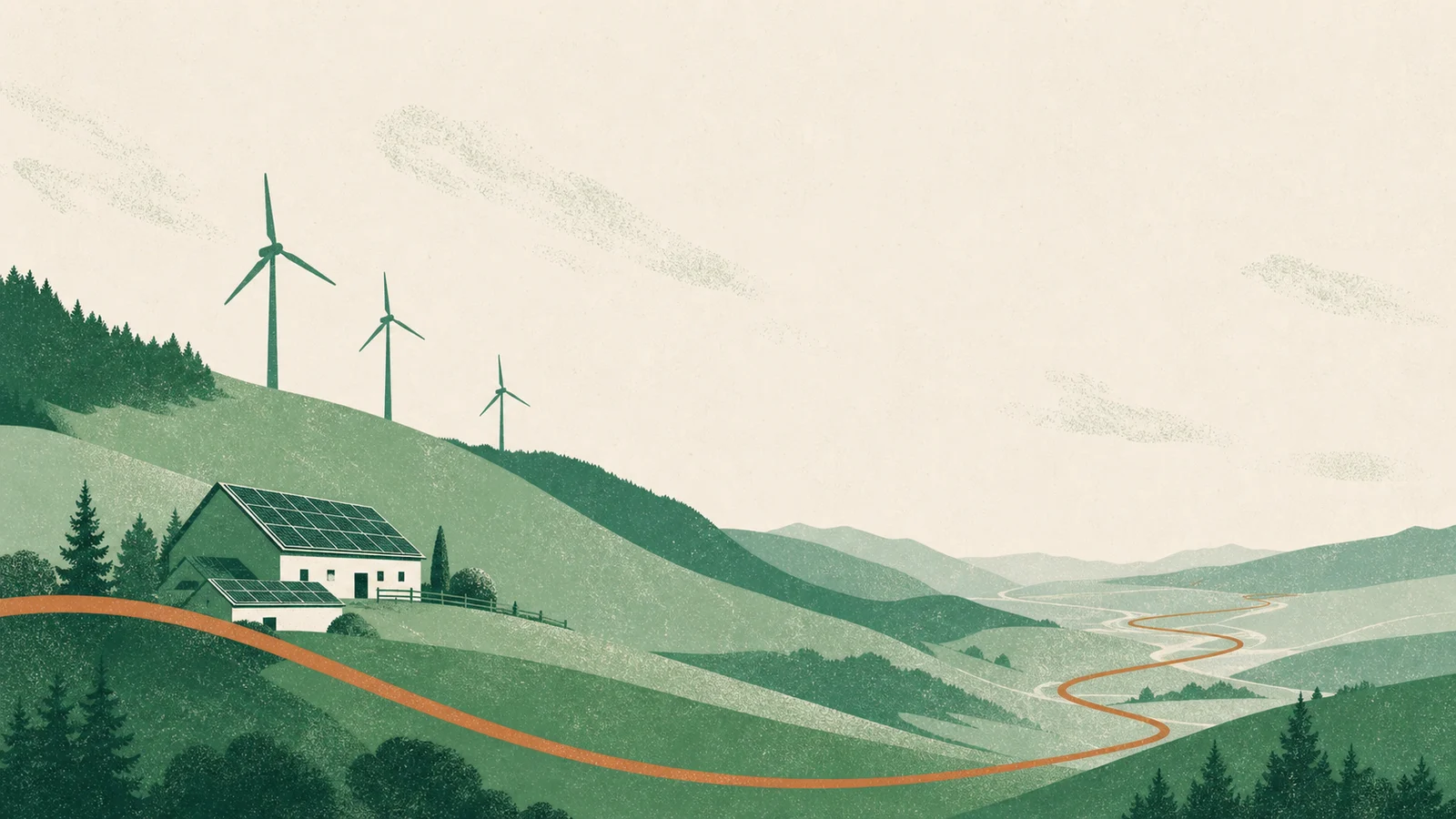
Austria is in comparatively good shape on electricity — a legacy of decades of hydropower, which carries a large share of domestic generation. The Renewable Energy Expansion Act (Erneuerbaren-Ausbau-Gesetz) has enshrined the goal of covering electricity demand entirely from renewable sources on an annual balance basis by 2030. This is to be achieved above all through a massive build-out of photovoltaics and wind power, supplemented by hydropower and biomass.
The momentum in photovoltaics has been remarkable of late: substantial capacity sprang up on rooftops, façades and open land in a short space of time, driven in part by high energy prices. Wind power expansion, by contrast, divides the country — while Burgenland and Lower Austria have built extensively, wind use further west, in Tyrol or Vorarlberg for instance, is limited by topography and politically contested. Then there is the bottleneck in the electricity grid: without new transmission lines, renewable power cannot be moved to where it is needed. It is precisely this grid expansion that many experts regard as the real chokepoint of the energy transition.
The gap that remains
Despite this progress, a perceptible distance remains between what has been politically agreed and what would be needed to hit the target. In its scenarios, the Environment Agency Austria has repeatedly recorded that the measures adopted so far are likely to miss the 48 per cent effort-sharing target. Exactly how large the remaining gap turns out to be depends on assumptions about economic growth, energy prices and the pace of the transition — the only certainty is that it has not yet been closed.
A major point of contention is the national Climate Protection Act, which is supposed to set binding sectoral targets and a mechanism for course correction. Negotiations over its revision dragged on without result, leaving Austria at times without a valid framework law. WIFO and other economic voices argue for a stronger reliance on market-based instruments such as consistent carbon pricing, whose steering effect grows as the price rises — flanked by the Klimabonus, the climate dividend that returns the revenue to households.
What remains
Austria's path to its 2030 climate targets is clearly mapped out, but far from secured. On electricity, the country is on a promising course thanks to hydropower and a rapid solar build-out, while transport and buildings remain the decisive brakes. Whether the gap to the EU target is closed depends less on fresh pledges than on the speed of implementation: the pace of boiler replacement, the ramp-up of electric mobility, grid expansion and a binding legal framework. And, not least, on households themselves, where initiatives such as repair cafés across the country show that climate action also starts small. The Environment Agency Austria delivers the sober balance sheet every year. It makes plain that 2030 is no longer a distant date but a deadline whose observance will be decided by the choices of the coming months.