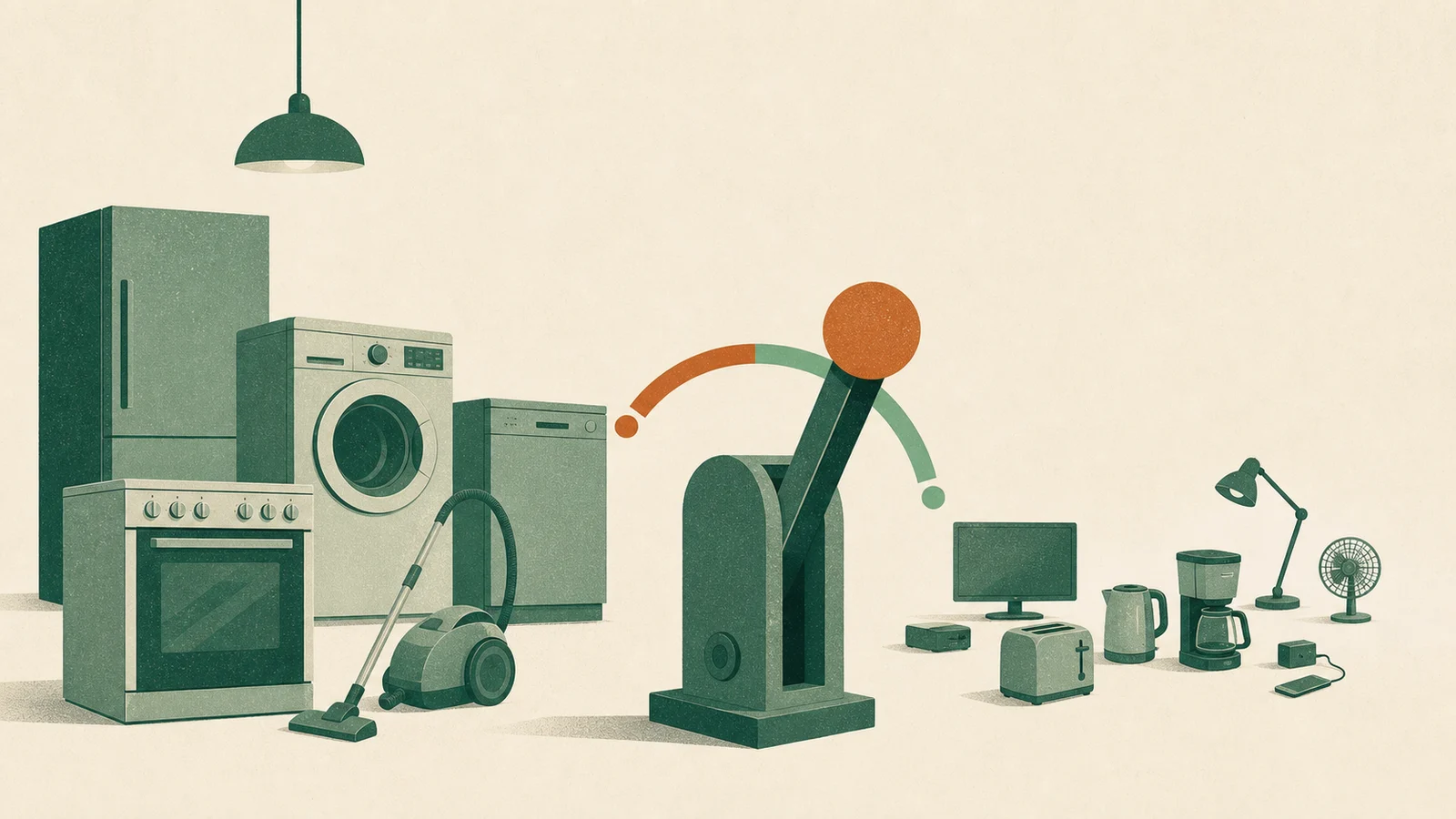
Every autumn, the same routine: power strips are switched off, chargers pulled from the wall, the little standby light on the television declared public enemy number one. The feeling of having done something arrives quickly. On the electricity bill, what follows is — almost nothing. That is no coincidence; it is arithmetic. Anyone serious about cutting household electricity use first has to understand where the electricity actually goes. And the honest answer is: rarely where most energy-saving tips aim.
According to standard industry data, the average Austrian household uses around 3,500 kilowatt-hours of electricity a year, ranging from roughly 1,500 kWh for a single-person household to over 5,000 kWh for a family of four. With a unit price for private households in 2026 sitting roughly between 23 and 35 cents per kilowatt-hour depending on supplier and region — grid charges, taxes and levies included — the annual sums quickly run into four figures. Which is exactly why it pays to rank the levers by impact, not by gut feeling.
The great misconception: electricity is not the same as energy
The most important error in energy-saving thinking is baked into the word itself. In most of Austria's existing building stock, 70 to 85 per cent of total energy consumption goes on heating and hot water. Electricity for lighting, appliances and entertainment often accounts for just 15 to 30 per cent of the overall energy balance. If you heat with oil, gas or district heating, your biggest lever is not on the electricity bill at all — it is on the heating statement — and ultimately in the thermal renovation of the building itself.
That shifts the perspective fundamentally. The interesting question is not just "How do I save electricity?" but "What generates the heat in this household?". Because as soon as heat enters the picture — whether for space heating or hot water — we are talking about orders of magnitude that dwarf every standby tip. A kilowatt-hour that never flows into heat is the cheapest kilowatt-hour of all.
Where the electricity really goes
If we look purely at the electricity bill, it is not the many small devices that dominate but a handful of big-ticket items. Four of them determine the picture almost entirely.
The first, and often the largest, is electric water heating. Households that heat their water with an electric boiler or an instantaneous water heater add roughly 800 to 1,800 kilowatt-hours a year to their consumption — depending on household size and showering habits. A four-person household with electric water heating can reach 4,800 kWh, while the same household without it lands closer to 3,200 kWh. That is not a detail; that is the difference between a normal bill and a high one.
The second item is heating with electricity. Direct electric or night-storage heaters can quite simply double a household's annual electricity consumption. Heat pumps use electricity too — but many times more efficiently, because they deliver several kilowatt-hours of heat for every kilowatt-hour put in. Anyone still heating with old direct electric heaters is sitting on by far the most expensive lever in the entire house.
The third block is made up of the big always-on and heat-generating appliances: fridge and chest freezer together, depending on their age, 300 to 500 kWh a year; hob and oven in the region of 400 kWh; the tumble dryer around 350 kWh. What matters here is less how they are used than how old they are and their efficiency class. A 15-year-old fridge can draw twice as much as a new one — and it runs 8,760 hours a year.
The uncomfortable truth: nearly all of a household's biggest electricity guzzlers have to do with heat — hot water, heating, cooling, drying, cooking. Anything that merely processes information is harmless by comparison.
The fourth block is everything else — lighting, home entertainment, computers, routers. Relevant in aggregate, but rarely the point at which a bill can be turned around.
The standby myth — and the grain of truth in it
Which brings us to the darling of every advice column: standby consumption. It exists, no question. Summed across all devices, it comes to around 200 to 400 kilowatt-hours a year in a typical household, which can amount to roughly ten per cent of the electricity bill. That is not nothing — at current prices it can easily be €50 to over €100 a year.
But two things puncture the hype. First, the EU's ecodesign rules have largely defused modern devices: new televisions or chargers often draw just 0.5 to 2 watts on standby. Today's real standby offenders are less the obvious devices than the always-on infrastructure — routers, set-top boxes, old games consoles, some bean-to-cup coffee machines with permanent heating elements. Second, standby is precisely the lever that sits at the top of every list even though it is almost never the main problem. A household with a 4,500 kWh bill caused by an electric boiler running around the clock might recover 150 kWh by switching off the power strip — while overlooking the 1,500 kWh right next to it.
The sober order of priorities, then: heat-related levers first, then the big appliances, then behaviour — and standby is the finishing touch, not the foundation.
Behaviour beats sacrifice: the measures that actually work
So where to start? With hot water, it pays surprisingly well to cap the boiler temperature at 55 to 60 degrees — hotter only encourages limescale, colder raises the risk of legionella. That alone easily saves 100 to 200 kWh a year. Shorter, cooler showers work immediately, because every litre of water not heated saves electricity directly.
When it comes to drying, the biggest lever is the cheapest: the drying rack costs zero electricity. If you cannot or will not give up the dryer, a modern heat-pump dryer run consistently at full load is the most economical option. For refrigeration, checking the age of your appliances matters more than any setting — replacing a unit after 12 to 15 years often pays for itself through electricity savings alone.
And finally room temperature, the underrated giant: one degree less means roughly six per cent less heating energy — provided the reduction holds on average and around the clock. For an 80-square-metre flat, that can mean roughly €80 to €150 a year depending on the energy source — and those who heat electrically save correspondingly more electricity. How to optimise heating and ventilation without sacrificing comfort is a subject in its own right, and one that touches the largest item in the household budget.
Making your own consumption visible
Rather than following generic tips, it is worth looking at your own data — and that is exactly what the smart meter rollout in Austria now makes possible. In your grid operator's customer portal, consumption can be tracked in 15-minute intervals; under the new Electricity Industry Act (ElWG), this fine-grained resolution is gradually becoming the standard in 2026, and anyone who does not want it can actively opt out. It lets you hunt down electricity guzzlers in earnest: the base load — consumption with no major appliances running — should typically sit below 0.05 kWh per quarter-hour at night. If it is higher, something is running somewhere that need not be.
Knowing your own consumption also lets you pull the next lever, one that has nothing to do with behaviour: switching supplier. According to the energy regulator E-Control, pure energy prices vary considerably between tariffs, and comparing them is the most honest form of saving because it costs no comfort at all. The current trajectory of electricity prices in Austria in 2026 shows that for many households, the effort of switching still pays off.
The bottom line: honest priorities instead of gesture politics
Saving electricity works — but not through symbolic gestures. The uncomfortable order of business: first establish whether heating and hot water run on electricity — that is where the greatest potential lies. Then target the ageing large appliances, because they draw power around the clock. Then your own behaviour and the room temperature. And right at the end, as the finishing touch, the power strip. Follow that order and you will save something tangible — not just a clear conscience.