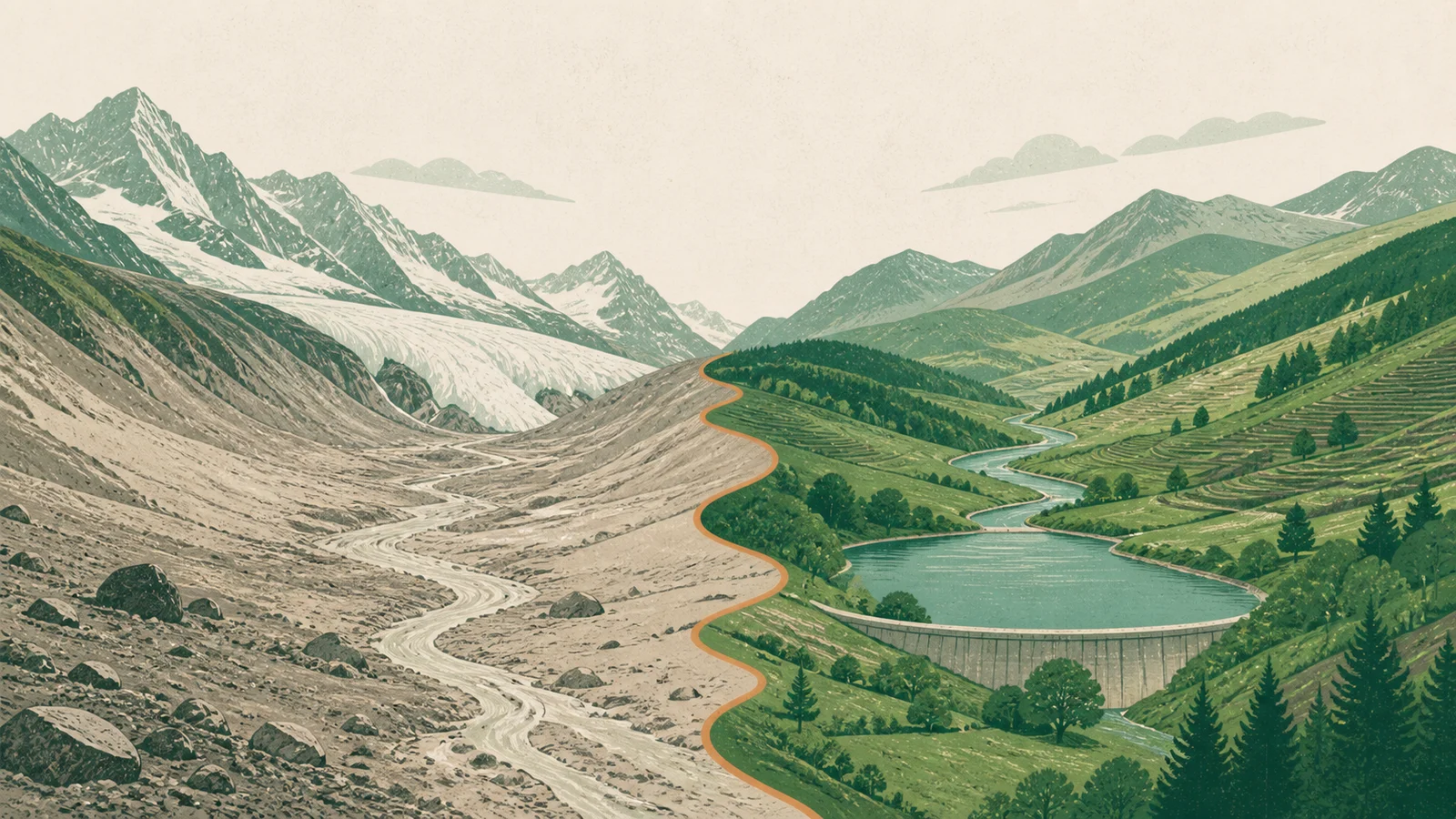
Austria is warming faster than the global average. That is not a rhetorical flourish but a matter of measurement: while global mean temperature has risen by around one and a half degrees since pre-industrial times, the figure for Austria stands at roughly three degrees, according to GeoSphere Austria, the national weather service. The reason is physical, and typical of a landlocked, mountainous country: land masses heat up more than oceans, and the Alps amplify many of the effects. What sounds abstract has long left visible traces in everyday life — from tropical nights in Vienna to disintegrating glaciers in Tyrol.
This article sets out what is actually changing, where the consequences are felt most keenly, and what measures municipalities, businesses and households are taking to adapt. The aim is neither alarmism nor reassurance, but a picture of the state of play as documented by Austria's expert institutions.
Why Austria is hit harder
The second Austrian Assessment Report on Climate Change, produced over several years by around 200 experts, sums up the data soberly: warming in Austria is proceeding faster and with greater swings than the global mean. The result is not just a higher average, but a shift in the extremes. Hot spells are becoming longer and more intense, dry periods more frequent, heavy rainfall events more severe.
An important distinction sits at the heart of the response. Climate mitigation — reducing greenhouse gas emissions — is meant to stop warming from increasing further. Climate adaptation, by contrast, deals with what is already unavoidable: even with rigorous mitigation, part of the change is locked in, because the climate system responds sluggishly. The two work in tandem, and it is adaptation above all that will determine how well Austria copes with the coming decades. Anyone wanting to explore the link to personal behaviour will find practical starting points in our guide to cutting your carbon footprint.
Tangible consequences: heat in the cities
People experience the change most directly in the summer months. The number of hot days — days reaching at least 30 degrees — has risen markedly over recent decades. Vienna's city centre recently recorded more than 50 hot days in a single year, a record in the history of measurement. Even harder on health and sleep are the so-called tropical nights, when the temperature never drops below 20 degrees: in the record year, Vienna counted more than 50 of them; two decades ago there were only a handful.
Heat is a problem in its own right in densely built-up areas. Asphalt, concrete and sealed surfaces store warmth during the day and release it again at night. This urban heat island effect hits older people, children and the chronically ill hardest. It is no coincidence that Vienna has long run a preventive heat warning service, which flags approaching periods of stress in cooperation with the meteorological service.
Glaciers, floods and mudslides
In the high mountains, the change is perhaps at its most striking. The latest glacier report by the Austrian Alpine Club (Alpenverein) no longer speaks of retreat but of disintegration. In the 2024/2025 measurement period, almost all monitored glaciers shrank, by around 20 metres on average. Some tongues lost more than 100 metres in length. The area covered by Austria's glaciers has contracted by dozens of square kilometres within a decade — a process that is now all but irreversible.
Researchers now speak not of the melting but of the disintegration of Austria's glaciers.
At the other end of the water cycle sit extreme rainfall events. The floods of September 2024 affected large parts of eastern and central Austria, hitting Lower Austria and Vienna hardest. Total damage ran into the billions. Such events can never be attributed to a single factor, but a warmer atmosphere can hold more moisture and, under certain weather patterns, release it in concentrated bursts. Mudslides and landslips are also becoming more frequent where heavy rain meets unstable ground. This overview of the consequences of climate change in Austria offers a broader framing of these connections.
Farming and winter tourism under pressure
Two economically significant sectors are feeling the change with particular force. In agriculture, weather-related losses in 2024 added up to around €260 million, according to the Austrian hail insurer (Hagelversicherung) — the result of an unfortunate sequence of late spring frost, summer drought and storms. Crops such as maize, soya, sugar beet and grassland were hit hardest. Where major droughts used to occur roughly once a decade, they now strike almost every other year. That raises new questions for crop planning and, ultimately, for food security.
Winter tourism, for its part, lives off snow that is becoming increasingly unreliable. As temperatures rise, the freezing level shifts upwards; for every bit more than one degree of warming, the snow line climbs by around 200 metres of altitude. Higher-lying ski resorts will remain snow-sure in the medium term, while lower-altitude areas come under pressure. Artificial snowmaking evens out short-term fluctuations, but it is no answer to long-term warming — and it costs water and electricity, resources that AI's growing power demand is increasingly competing for as well. How snowy the winters turn out from mid-century onwards depends largely on how rigorously global climate action succeeds.
Adaptation: what cities, water management and protective structures deliver
Serious as the consequences are, Austria is far from powerless when it comes to adaptation. In the cities, the "sponge city" principle is gaining ground: trees are given generous underground root zones that double as reservoirs for rainwater, rather than channelling it into the sewers. Water stays available for dry spells, and the trees provide shade and cooling in times of heat. The concept has been implemented in Graz, Vienna and Innsbruck, among other places.
Greening roofs and façades, light-coloured surfaces, more shaded squares and unsealed ground measurably lower street-level temperatures. Such measures work twice over — they make cities more bearable in summer and improve the urban climate for good.
In water management, Austria is banking on the expansion and modernisation of flood and torrent defences. Retention basins, embankments and near-natural river restoration give watercourses more room when floods come. Experts stress that such protective structures prevented damage on a substantial scale during the most recent events — evidence that adaptation pays off. At farm level, water-saving cultivation methods, drought-tolerant varieties and insurance solutions round out the picture.
Private decisions matter too. Anyone who factors shading, greenery and rainwater harvesting into a house build, or starts with their energy use, contributes to resilience. Even the question of where savings end up has a climate dimension: a green investment tends to steer capital towards more future-proof structures.
Conclusion
In Austria, climate change is not a matter for the future but a measurable present — and the country is disproportionately affected. Heat in the cities, disintegrating glaciers, more frequent floods, crop losses and unreliable snow are the visible consequences of warming well above the global mean. At the same time, adaptation is clearly possible: sponge cities, urban greening, modern flood defences and adapted farming demonstrably soften the impact. Climate mitigation remains essential to limit the long-term trajectory — but adapting to what has already arrived will decide how well Austria comes through the warmer decades ahead.