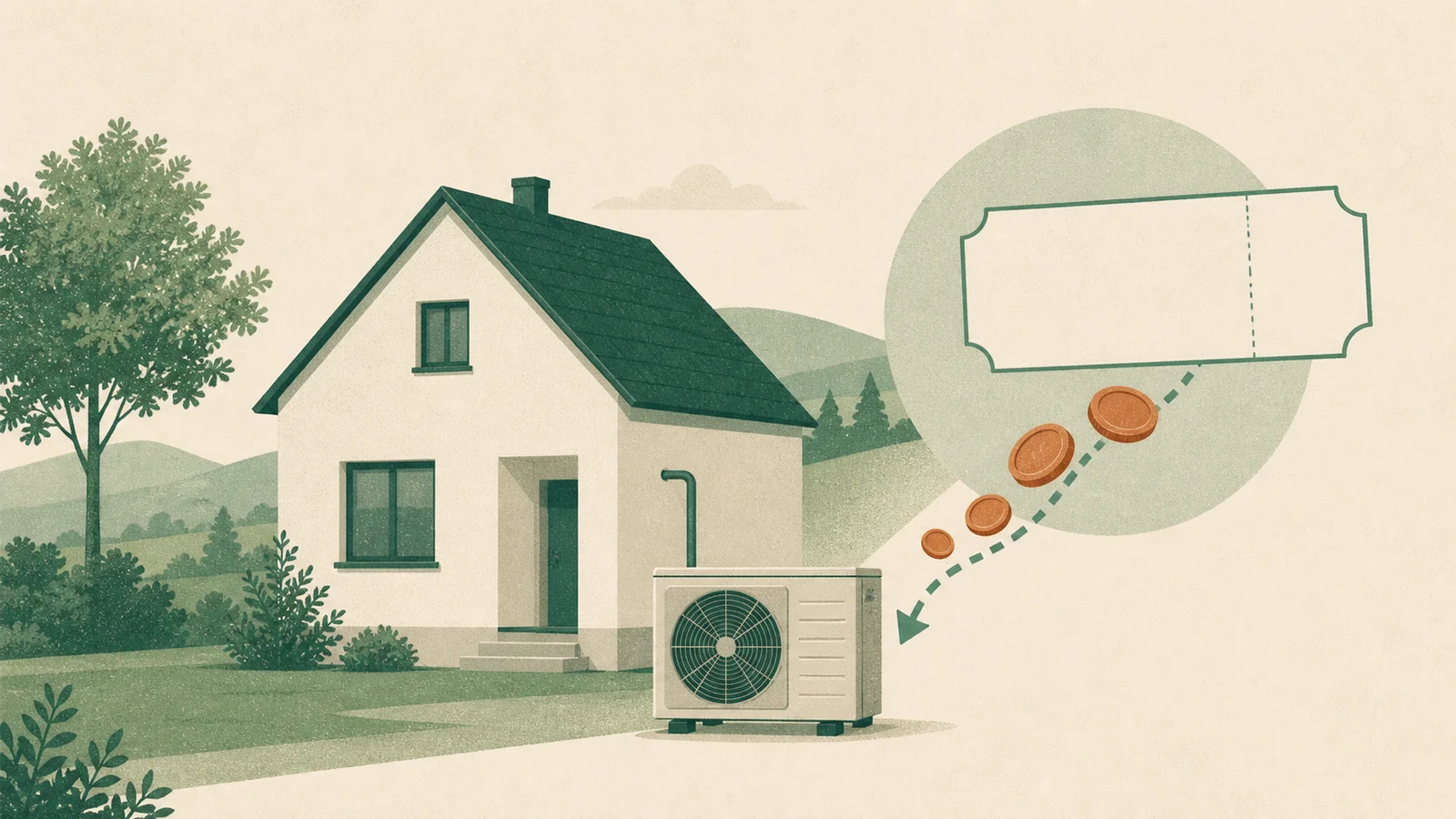
Anyone swapping an old oil or gas boiler for a heat pump in Austria in 2026 can draw on several pots of public money at once. The catch: the schemes no longer carry the names they did two years ago, some of the amounts have been revised downwards, and the most important federal budget is draining fast. If you are planning a switch now, you need to know the order in which to apply — get it wrong and, in the worst case, you walk away empty-handed despite being fully eligible.
This overview sorts out the three tiers that matter to private homeowners in 2026: the federal subsidy under the Sanierungsoffensive (the government's renovation drive), the income-tested "Sauber Heizen für Alle" (Clean Heating for All) scheme, and the top-up grants offered by the federal states. The practical questions around installation, flow temperatures and renovation work are covered separately in our article on heat pumps in older buildings — this piece is purely about the money.
"Raus aus Öl und Gas" no longer exists in that form
Many homeowners are still searching for "Raus aus Öl und Gas" (Out of Oil and Gas). That federal scheme, financed from the EU recovery plan, expired in 2025 once its funds were exhausted. It was replaced at the end of 2025 by the new Sanierungsoffensive 2026 — structurally similar, but with its own rules and its own budget envelope.
According to the climate ministry responsible (the BMLUK), the Sanierungsoffensive has been allocated 360 million euros a year from 2026 to 2030 — 1.8 billion euros in total. It is administered by Kommunalkredit Public Consulting (KPC), the state's funding agency, and registration runs exclusively online via sanierungsoffensive.gv.at. Within the programme, the term "Kesseltausch" (boiler swap) refers to the strand that funds the replacement of the heating system itself.
The federal subsidy: up to €7,500 for a heat pump
Under the boiler-swap strand, grants of up to 30 per cent of eligible investment costs have been available since registration opened at the end of November 2025, capped at 7,500 euros for an air-source heat pump. Those opting for geothermal — a brine-to-water heat pump with a deep borehole or ground collector — can count on up to 12,500 euros. For comparison: switching to a pellet boiler is subsidised at up to 8,500 euros, and connecting to district heating at up to 6,500 euros.
Crucially, this federal subsidy involves no means test. Private individuals — owners, holders of building rights or tenants — are eligible for single-family and two-family homes as well as terraced houses. Nor is there a minimum age for the old fossil-fuel system; even someone whose gas boiler is only ten years old may switch. The installation, however, must be carried out by a licensed specialist firm — DIY installations are excluded.
The federal subsidy has no income ceiling — but it does have a budget ceiling. And in 2026 that ceiling is approaching faster than many would like.
The budget is running out — and that changes the strategy
Here lies the trickiest point for anyone still hoping to switch in 2026. Grants are awarded on a first-come, first-served basis. Once the budget is spent, applications close immediately — even if the formal cut-off date of 31 December 2026 has not yet been reached.
And the funds are dwindling fast. According to industry reports, only around 51 million of the 360 million euros remained available in mid-May 2026; official budget-monitor figures show the remainder had fallen to roughly 29 million euros by early June — meaning a good four fifths of the annual budget had already been allocated or reserved. There is a further restriction: since 2 February 2026, new registrations and grant applications have been possible only for the boiler swap — the separate Sanierungsbonus for thermal renovation was closed to new submissions on that date. Anyone replacing only the heating system is unaffected, but should be aware that the pot is finite — and in 2026 will likely be empty before the year is out.
In practical terms: register first, act second. Anyone who commissions the installer before registering risks losing their entitlement. We recommend clarifying the subsidy landscape early in the planning phase — much as we describe in more detail in our piece on replacing an oil or gas heating system.
"Sauber Heizen für Alle": up to 100 per cent for low-income households
There is a dedicated track for households on low incomes. The "Sauber Heizen für Alle 2026" scheme funds the switch from fossil-fuel or outdated electric heating to an air-to-water heat pump or a biomass boiler — covering up to 100 per cent of the investment costs. Rather than a fixed grant, the scheme works with cost ceilings: for air-to-water heat pumps this stands at around 25,586 euros according to Umweltförderung, the federal environmental funding portal, and at roughly 37,550 euros for brine-to-water systems.
The condition is that household income falls below certain thresholds. For a single-person household, the official guidelines cite a monthly net income of around 1,870 euros (twelve times a year); the figure rises in increments for each additional adult and each child, so that a family with two children, for instance, sits at roughly 3,900 to 4,000 euros. Proof is provided not through payslips but through receipt of certain benefits — social assistance, an exemption from the ORF broadcasting fee (formerly GIS), or housing allowance, for example.
Eligible applicants are owners of a single-family, two-family or terraced house whose principal residence is registered at the project site. Registration runs via sauber-heizen.at, open since 1 January 2026 and for as long as budget remains. Once a grant is confirmed, applicants have nine months to complete the project. Important: "Sauber Heizen für Alle" is designed as full funding and as a rule cannot be combined with an additional federal boiler-swap grant — it is one or the other.
The regional subsidies — and what matters when combining them
Beyond the federal level, most of Austria's federal states add something on top. The exact rates vary considerably, and this is precisely where the final total is decided.
In Vienna, for instance, the switch to environmentally friendly heating systems is supported with 35 per cent of eligible costs, up to a maximum of 8,000 euros — and can be combined with the federal subsidy. Upper Austria offers a boiler-replacement bonus worth around 2,000 to 6,000 euros depending on the system, likewise combinable with the federal grant. Lower Austria takes a different route: instead of a one-off grant, its home-renovation scheme provides an annuity subsidy — an interest-rate support paid out over several years. Styria, meanwhile, scales its rates by system and household size.
The good news: federal and regional subsidies can, in principle, be combined, which noticeably raises the total. The bad news: the sum of all grants may not exceed the actual investment costs, and each state has its own deadlines and sequencing. Some regional schemes require that the federal subsidy has already been applied for or confirmed; others run independently. Since guidelines can change during the year, it pays to check the current state website before signing any contract — or to book an appointment with the free energy advisory service of the relevant federal state.
Applying in the right order
To make sure no entitlement slips away, a clear sequence has proved its worth in 2026. First: survey the subsidy landscape — federal, state and, where applicable, municipal. Second: obtain the mandatory energy-advice report from your federal state, which must already be in hand when you register for the boiler swap. Third: register — via sanierungsoffensive.gv.at for the boiler swap, or via sauber-heizen.at for the income-tested track. Only then commission the installer.
After registering, the actual boiler-swap grant application must be submitted within nine months; work carried out from October 2025 onwards is eligible. Anyone unsure whether the switch adds up overall can weigh the subsidy against running electricity costs — our overview of electricity prices in 2026 provides the necessary context.
The bottom line for 2026: heat pumps remain solidly subsidised in Austria — in the best case to the tune of four or five figures. Those who follow the application sequence and don't wait until year's end stand the best chance of finding budget still available when their application lands. In case of doubt, the official guidelines from KPC, Umweltförderung and the relevant federal state are always authoritative — the amounts cited here reflect the position as of June 2026 and may change during the year.