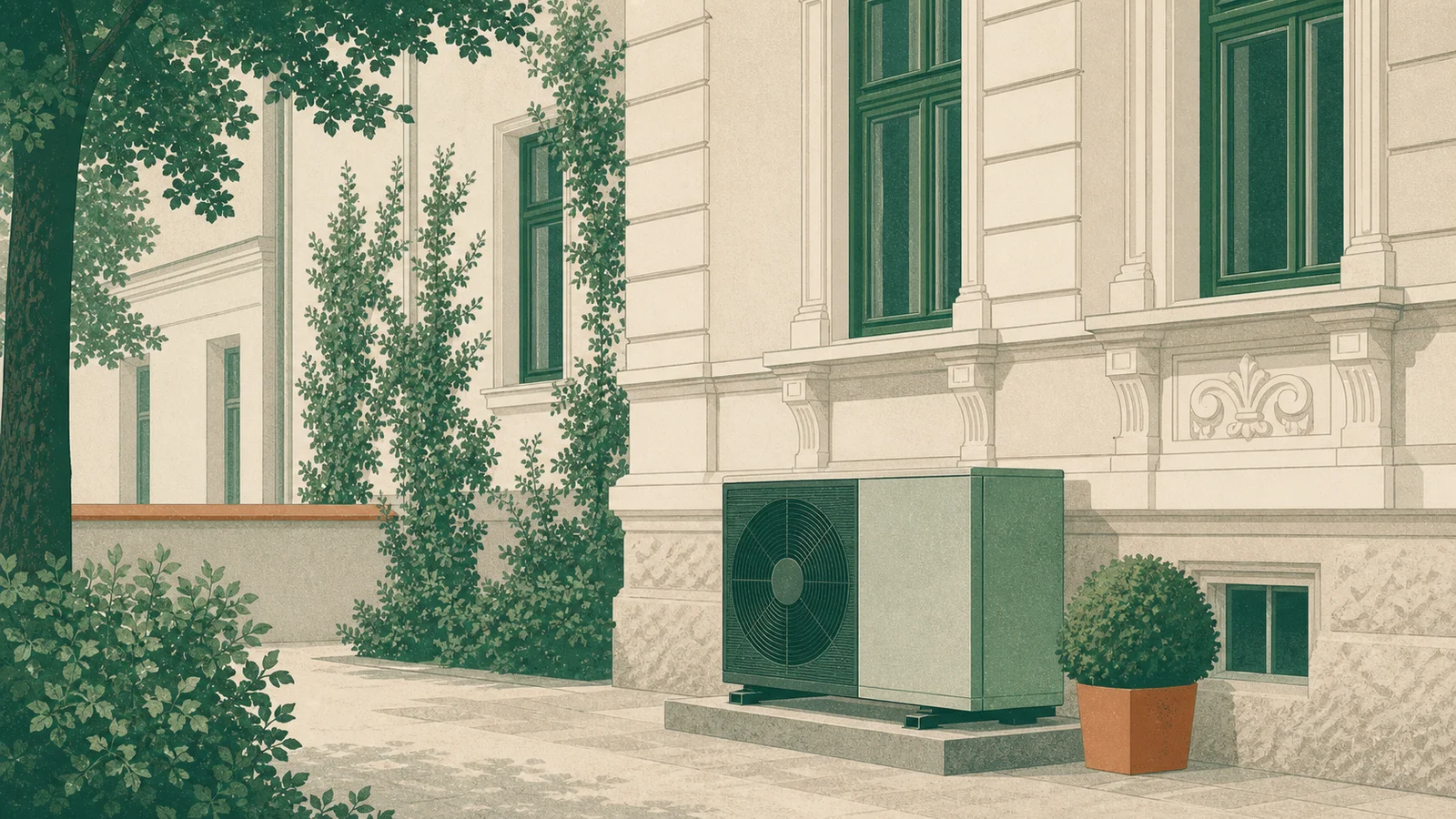
The heat pump is considered the heating system of choice for new builds — where thick insulation, airtight windows and underfloor heating are planned in from the start. When it comes to older buildings, scepticism tends to set in. The old masonry, the cast-iron radiators, the draughty attic: can a heat pump really keep a house like that warm without the electricity bill spiralling? The short answer is yes, it can — but not automatically, and not always without some groundwork. What matters is less the year of construction than the temperature at which a building needs to heat in order to stay warm. Anyone who understands that can make a realistic judgement about whether the switch makes sense for their own home.
Why flow temperature decides everything
A heat pump works on a simple physical principle: it draws heat from the surroundings — from the air, the ground or the groundwater — and uses electricity to lift it to a usable level. The higher that level needs to be, the more electricity it costs. The key figure is called the flow temperature: the temperature at which the heating water travels to the radiators or heating surfaces.
An oil or gas boiler manages this effortlessly. It burns its fuel and delivers 60, 70 degrees or more without difficulty. An air-source heat pump can technically do the same, but with every additional degree its efficiency drops. Specialists talk about the seasonal performance factor: it indicates how many units of heat are produced from one unit of electricity. If the required flow temperature sits at a comfortable 35 degrees, modern units reach values around four — one kilowatt hour of electricity becomes four kilowatt hours of heat. If the system has to deliver 55 or 60 degrees, however, the performance factor falls markedly, and running costs rise accordingly. The Umweltbundesamt, Austria's federal environment agency, regularly points out that a low system temperature is the single most important lever for economical operation. Anyone who can run the pump flexibly also benefits from the fact that exchange electricity prices on sunny middays increasingly dip into negative territory.
For older buildings, that means the interesting question is not whether the house is old, but how hot it has to heat in the depths of winter to bring the rooms up to temperature.
Radiators or underfloor heating — and everything in between
This is where the heating surfaces come in. Underfloor or wall heating distributes warmth across a large area and can therefore manage with low flow temperatures — ideal conditions for a heat pump. Classic radiators from the oil and gas era, by contrast, were often designed for high temperatures because they were sized small.
Yet in practice this apparent opposition is softer than many believe. Plenty of radiators in older buildings are more generously sized than the old system ever required, and after an upgrade of the building envelope they can cope with 45 or 50 degrees. Where individual rooms fall short, targeted retrofitting is often possible: a single undersized radiator can be replaced with a larger model or a so-called low-temperature radiator with a built-in fan. That is considerably cheaper and less invasive than tearing up the whole house.
A well-established middle path is partial underfloor heating. Anyone renewing the ground-floor flooring anyway can lay underfloor heating there and keep the upgraded radiators on the upper floors. klimaaktiv, the climate ministry's advisory platform, recommends as a matter of principle having a heating-load check carried out before replacing the heat source — that is, assessing room by room which temperature is actually needed. It frequently turns out that less remodelling is required than feared.
Insulation: not all or nothing
A persistent myth surrounds the heat pump: that nothing works without full external insulation. That is overstated. It is true that a well-insulated house loses less heat, manages with lower temperatures and thereby lets the heat pump run more efficiently. But between an uninsulated Gründerzeit house and a passive house lie many gradations.
Often it is individual, comparatively inexpensive measures that deliver the biggest effect. Insulating the top-floor ceiling, replacing old single-glazed windows or insulating the cellar ceiling noticeably reduce the heating load without touching the facade. Precisely this sequence — improve the envelope first, then size the heating — is the economic core of any renovation of an older building. Insulate first, and you subsequently need a smaller, cheaper heat pump and pay less in operation. Your own heating and ventilation habits also reduce the heating load noticeably — without any building work.
For listed buildings or facades worth preserving, as are common in the Gründerzeit quarters of Vienna, Graz or Linz, external insulation is not always possible. Then internal insulation, window refurbishment and the careful design of the heating surfaces move to the fore. Here too, a heat pump is not ruled out — it simply demands more precise planning.
Noise, and keeping the neighbours on side
One point that is easily underestimated in densely built-up areas is noise. Air-source heat pumps stand outdoors with their fan, and particularly in tight urban settings or terraced housing, the hum can become a neighbourhood issue. The units have become significantly quieter in recent years, but the siting remains delicate.
In Austria, the building codes of the federal provinces and the relevant ÖNORM standards regulate the permissible noise levels at the property boundary, especially at night. In practice, problems can usually be avoided if the pump is not mounted directly under the neighbour's bedroom window, keeps sufficient distance from the boundary and sits on a vibration-damped foundation. Talking early to the municipality and the neighbours saves trouble later. In very cramped conditions, a brine-to-water heat pump with a ground collector or a deep borehole can be the quieter, if more expensive, alternative.
What the subsidies deliver
The financial boost is considerable. Through the federal subsidy scheme "Raus aus Öl und Gas" ("Out of Oil and Gas"), the national government supports the replacement of fossil-fuel heating with climate-friendly systems such as heat pumps through substantial grants, which depending on the programme phase can cover a significant share of the investment costs. On top of this, most federal provinces run their own subsidy schemes that can be combined with the federal one — Vienna, Lower Austria, Styria and Upper Austria each have their own programmes.
For lower-income households there is additionally the programme "Sauber Heizen für Alle" ("Clean Heating for All"), which in particular cases can bring the switch close to full funding. The exact rates and conditions change with every funding period, however, so it pays to check the current terms before applying. A practical tip from the advisory trenches: applications should generally be submitted before the work is commissioned, otherwise the entitlement lapses. Independent energy advice, as offered by klimaaktiv and the provinces, is often the best first port of call here. It is usually also the place to clarify whether generating your own solar power pays off as well — on the roof or, for tenants, as a small balcony solar system.
The bottom line
A heat pump in an older building is no sure thing, but nor is it a special case for idealists. It works well where the house can manage with moderate flow temperatures — and in most existing buildings that can be achieved with manageable measures: targeted insulation of the envelope, upgraded or supplemented heating surfaces, a well-considered siting. The order matters: reduce the heating load first, then size the pump to match. Anyone who arranges a heating-load check and energy advice beforehand and applies for the subsidies in good time can largely rule out nasty surprises. The old masonry is rarely the problem. What counts is the temperature at which a house gets warm — and that is far more within your own control than the myth of the unsuitable old building suggests.