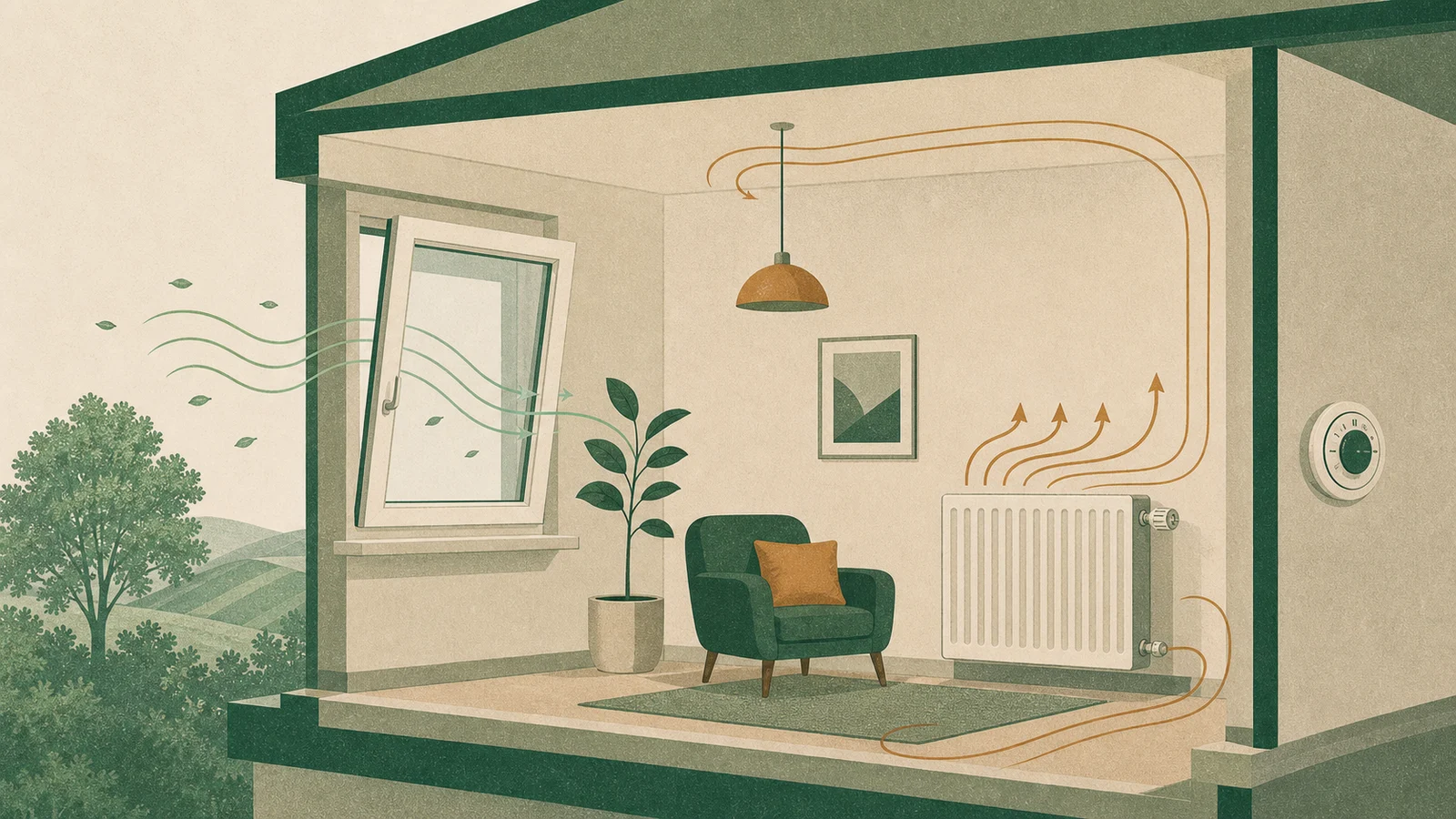
Heating is the single largest item in household energy consumption. According to the Umweltbundesamt, Austria's federal environment agency, around two thirds to three quarters of the total energy used in an average Austrian household goes on space heating — considerably more than hot water, lighting and appliances combined. Tackle heating, and you will see the difference on your annual bill faster than with any other saving measure. While public debate revolves around the power appetite of data centres, the biggest private lever remains space heating. The good news: a substantial share of the potential savings lies not in expensive renovations but in everyday behaviour. Heating and ventilating properly costs nothing, but it does require a little routine — and knowing which habits actually cost money and which are merely stubborn myths.
Every degree counts — literally
The best-known rule of thumb comes from advisory bodies such as Umweltberatung and the Austrian Energy Agency: for every degree you lower the room temperature, heating energy consumption falls by around six per cent. Turn the flat down from a habitual 23 to 21 degrees and you save roughly twelve per cent over a heating season — without feeling cold, provided everything else is in order. The experts' recommendation is around 20 to 21 degrees for living rooms and other occupied spaces, 16 to 18 degrees for bedrooms, and lower still for rarely used rooms.
What matters here is the sense of comfort, which does not depend on air temperature alone. Cold walls, draughts from leaky windows or damp indoor air make a room feel cooler than the thermometer suggests. Conversely, well-insulated flats feel warm at just 20 degrees. So if you want to lower the temperature, seal the obvious sources of cold first — a few euros spent on sealing tape for old window casements often pays for itself within a single season.
It is also important not to let individual rooms cool down completely. A permanently unheated room draws warmth and moisture from the rooms around it, which puts more strain on the heating there and raises the risk of mould on the coldest wall. A moderate base temperature throughout the flat makes more sense than a steep gradient from room to room.
Burst ventilation, not the permanently tilted window
On hardly any subject do habit and expert advice diverge as widely as on ventilation. The tilted window, often left open for hours, strikes many people as perfectly normal — in energy terms it is the most expensive option. Barely any air is exchanged, while the reveal around the window and the adjoining wall cool down continuously. Over a full heating season, according to calculations by energy advice centres, a permanently tilted window can swallow several hundred additional kilowatt hours.
The alternative is burst ventilation (Stoßlüften): open the windows wide — ideally on opposite sides for a cross-draught — and close them again after a few minutes. In winter, depending on the outside temperature, five to ten minutes are enough to swap the stale, humid air completely for fresh. Because the walls barely cool down in that short time, the room is quickly warm again — the heating energy is stored in the walls and furniture, not in the air. Two to four times a day is the guideline, especially in bedrooms in the morning, when a great deal of moisture has accumulated overnight.
According to Umweltberatung, a single person releases around half a litre of water into the air while sleeping, on top of which come cooking, showering, drying laundry and houseplants. That moisture has to get out, or it will condense on the coldest surfaces. One important detail: turn the thermostat down while airing, so the heating does not battle against the open window.
Understanding the thermostat properly
Many heating bills come out higher because the thermostatic valve is used incorrectly. The numbers on it are not degrees in the strict sense but settings that correspond to a target temperature: on most valves, setting 3 stands for around 20 degrees, and each setting above or below shifts the target by roughly four degrees. The thermostat regulates itself — once the set temperature is reached, it throttles the flow. Turning it up to 5 to warm the room faster therefore does not heat faster, only longer and past the target, until eventually the window gets opened because it has become too hot.
The sensible approach is to find a suitable setting and keep it constant, rather than constantly turning the valve up and down. If you leave the house during the day, there is no need to switch the heating off entirely — a fully cooled room needs more energy to reheat than a lowered base temperature consumes over the course of the day. A moderate reduction of two to three degrees when you are out and overnight is the better path. Programmable thermostats that handle this automatically cost little and pay for themselves quickly in most flats. Radiators should also stand clear: curtains, furniture or covers in front of them trap the heat and distort the valve's reading, so the room stays cooler than intended.
Avoiding mould: the interplay of warmth and moisture
Mould is not purely a hygiene problem but almost always the result of too much moisture on surfaces that are too cold. It develops where warm, humid indoor air meets cool building elements and the water condenses out — typically in room corners, behind wardrobes on external walls, in window reveals. This is exactly where keeping individual rooms cold while ventilating too little comes back to bite.
Prevention follows from everything above: air the flat consistently in short bursts, keep all rooms at a sensible base temperature, and pull furniture a few centimetres away from cool external walls so the air can circulate. If you want to be on the safe side, a simple hygrometer lets you keep an eye on relative humidity; readings persistently above 60 per cent are considered critical. If mould is already visible over a larger area, or keeps returning despite correct ventilation, a structural problem is usually behind it — a thermal bridge, rising damp, a water leak. Then no amount of airing will help; only fixing the cause will, in rented flats together with the building management.
When the system itself runs inefficiently
Behaviour is one side; the technology is the other. In many apartment buildings in Vienna, Graz or Linz, the central heating runs without hydronic balancing — the process of distributing the heating water so that every radiator receives exactly the amount it needs. Without it, rooms near the boiler room are oversupplied and gurgle audibly, while distant or higher-up flats barely get warm — the residents there turn everything up to full, the system runs at too high a flow temperature, and in the end everyone consumes more.
Hydronic balancing is a comparatively cheap measure with a good ratio of effort to effect; specialist bodies put the potential savings, depending on the starting point, at several per cent of heating consumption. In buildings with a heat pump or condensing boiler it is practically a prerequisite for efficient operation — anyone planning the switch and looking into the subsidies for heat pumps should factor the balancing in from the start. For tenants, this is above all an argument to raise with the owner and the building management. Anyone weighing up concrete measures will find reliable points of contact in the independent energy advice services run by the federal provinces and at the energy regulator E-Control — which also operates a tariff calculator for comparing electricity and gas suppliers, often the fastest saving of all, regardless of your heating habits.
What it comes down to
The biggest levers in heating are unspectacular and cost nothing: one to two degrees less room temperature, short and vigorous burst ventilation instead of permanently tilted windows, a thermostat you set and then leave alone, and unobstructed radiators. These routines cut consumption noticeably and guard against mould at the same time, without the flat losing any of its comfort — on the contrary, dry air at a stable temperature feels more pleasant than an overheated, humid one. Where behaviour reaches its limits, because the system distributes heat unevenly or the tariff is too expensive, it is worth taking a second look at the technology and the contract — or at community-generated electricity from your own neighbourhood. The provinces' advice centres and E-Control help with this free of charge — and spare you the guesswork over which of the many saving tips really matters in your particular case.