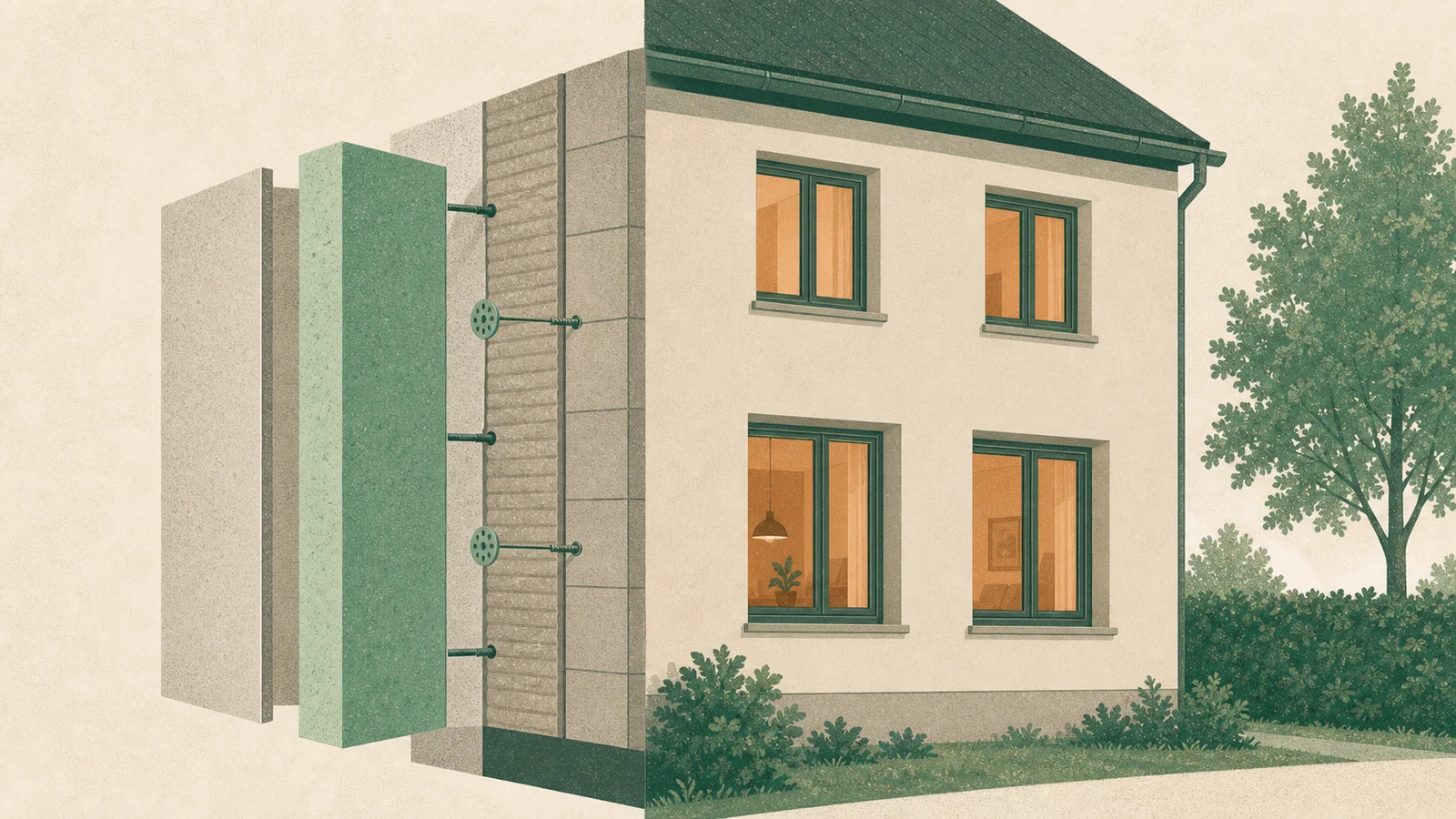
Anyone in Austria who owns a house built between the 1960s and 1980s will know the phenomenon: draughts in winter despite a new heating system, walls that never warm up, and an energy bill that brings a sinking feeling every year. Thermal renovation — insulating the building envelope and replacing old windows — is the lever that can often halve the heating demand of such buildings. In 2026 the topic is doubly relevant: energy prices have settled at a higher level since the crisis, and the federal subsidy scheme was overhauled mid-year. Anyone renovating should know the right order of works, understand what delivers the most, and take a realistic view of the funding landscape.
Why renovating pays off at all
A typical older building from that era usually sits in class C to E on its energy certificate — equivalent to a heating demand of roughly 100 to 200 kilowatt-hours per square metre per year. By comparison, new builds today must achieve at least class B, meaning no more than 50 kWh/m²a. In between lies the full range of potential savings.
The individual measures contribute in different proportions. Insulating the façade, together with solar shading, typically cuts consumption by around 10 to 35 per cent; insulating the roof and top-floor ceiling by roughly 10 to 30 per cent; an optimised or replaced heating system by 10 to 40 per cent. Combine façade, roof, cellar ceiling, new windows and an efficient heating system, and reductions of up to 70 per cent are realistic in practice. An uninsulated roof, moreover, loses a substantial share of a home's heat — a point that is often underestimated.
On costs, a concrete example helps as a rough guide: for a detached house with around 130 square metres of uninsulated façade, an external thermal insulation composite system can save roughly 7,800 kWh a year, which — depending on energy source and tariff — can amount to somewhere in the region of €850 to €900 annually. The investment tends to hover around €25,000, correspondingly less after subsidies. Such figures are indicative only — building condition, heating system and workmanship shift them considerably.
What delivers most — and in what order
The most important rule of thumb: envelope first, building services second. Replace the heating system before the house is insulated and you will inevitably oversize it — and pay twice. The sensible sequence therefore usually runs from top to bottom: roof insulation or the top-floor ceiling first, then window replacement, then insulating the external walls, and finally the cellar ceiling. Only once heating demand has fallen is the heating system re-dimensioned and, ideally, switched to a renewable one.
Replace the heating system before the house is insulated and you will inevitably oversize it — and pay twice.
One important distinction concerns the building's age. For houses built after 1984, where the envelope, windows and roof already meet a minimum standard, replacing the heating system is often the single most effective measure. For older houses, by contrast, it pays to consider every building component — here insulation delivers the biggest leap. Precisely on the question of when switching to a heat pump or district heating makes sense, it is worth reading our overview of replacing oil and gas heating.
Window replacement is a special case. New windows noticeably improve comfort, but without an insulated wall they merely shift the cold spot to the junctions and can, in unfavourable cases, even encourage damp problems. All the more important, after the swap, are proper heating and ventilation habits to keep mould from taking hold in the first place. Planning windows and façade in one go avoids structural damage and saves on scaffolding costs.
The energy certificate as a compass
Before any major renovation, the sensible first step is an energy certificate. It states the heating demand in kWh/m²a, making visible where the building stands and which measures will have the greatest effect. For a flat, costs start at around €55; for a detached house they typically run between €250 and €550 — money well spent, since many subsidies require a demonstrable improvement in the energy performance figure anyway.
Legally, the certificate is mandatory for sales, lettings and new builds. Anyone carrying out a comprehensive renovation that alters more than a quarter of the building envelope will generally need a new certificate in any case. In practice it serves as before-and-after evidence: if the house jumps from class E to C, that is not just a matter of conscience — it is often the basis on which provincial subsidies are calculated.
Subsidies in 2026: a moving target
Here particular caution is warranted in 2026, because the situation has shifted within a matter of months. The nationwide renovation drive (Sanierungsoffensive) is set up with a total budget of €1.8 billion for the years 2026 to 2030, or around €360 million per year. It rests on two pillars: boiler replacement (switching heating systems) and thermal renovation.
The well-known federal renovation bonus (Sanierungsbonus), however, was — according to the federal environmental funding agency (Umweltförderung) — halted early for new applications on 2 February 2026 owing to enormous demand and exhausted funds; freed-up money was channelled primarily into heating replacement. Anyone who had been counting on the classic renovation bonus during this phase was, for individual measures such as insulation or window replacement, initially left empty-handed.
Its successor, a funding line called "Thermal Renovation with a Renovation Concept" (Thermische Sanierung mit Sanierungskonzept), has been announced: according to official information it launches on 1 June 2026 and — funds permitting — runs for now until 31 December 2026. Total support here is capped at 30 per cent of eligible costs. As for the size of the freely available pot: as of 20 April 2026, around €70 million remained, according to the funding agency. Since budget pots have a habit of emptying quickly, the rule is: register first, commission later — and double-check the current conditions on sanierungsoffensive.gv.at before signing any contracts.
The logic of the federal scheme also matters: individual measures have so far been supported with up to €5,000 per dwelling unit, while comprehensive renovations to klimaaktiv or "good" standard attracted considerably higher amounts. For window replacement as a stand-alone measure, for instance, at least 75 per cent of the existing windows had to be replaced. The precise parameters of the successor programme should be checked case by case.
Don't forget the provincial subsidies
Alongside the federal government, Austria's provinces also provide support through their housing subsidy schemes (Wohnbauförderung) — and this channel continues independently of the federal budget. In Lower Austria, grants are tiered according to the improvement in the energy certificate, supplemented by an annuity subsidy when switching to climate-friendly heating systems. Styria supports the thermal quality of external building components — façade insulation, window replacement, roof insulation — through its housing subsidy scheme, and offers "Sanieren für Alle" ("Renovation for All"), a special track for low-income households under which, in individual cases, up to 100 per cent of eligible costs can be covered. In Vienna, the responsible authority supports thermal renovations through loans and grants, depending on the scope of the works.
Federal and provincial subsidies can often be combined, though not at will — double funding of the same measure is usually ruled out. Those on low incomes should additionally look into housing assistance (Wohnbeihilfe).
The bottom line: plan, document, move fast
Thermal renovation remains, in 2026, the most effective lever for permanently reducing an older building's energy consumption — provided the order is right. Insulate the envelope first, then replace the heating — often with a heat pump, which comes with its own subsidy scheme; use the energy certificate as a compass; think of windows and façade together. On funding, 2026 is a transition year: the old renovation bonus is closed to new applications, and the successor programme has launched but is budget-limited. Anyone renovating should verify the current conditions directly with the federal and provincial bodies before commissioning any work, and submit applications early. Because the best subsidy is worth little if the pot is empty before the first invoice arrives.