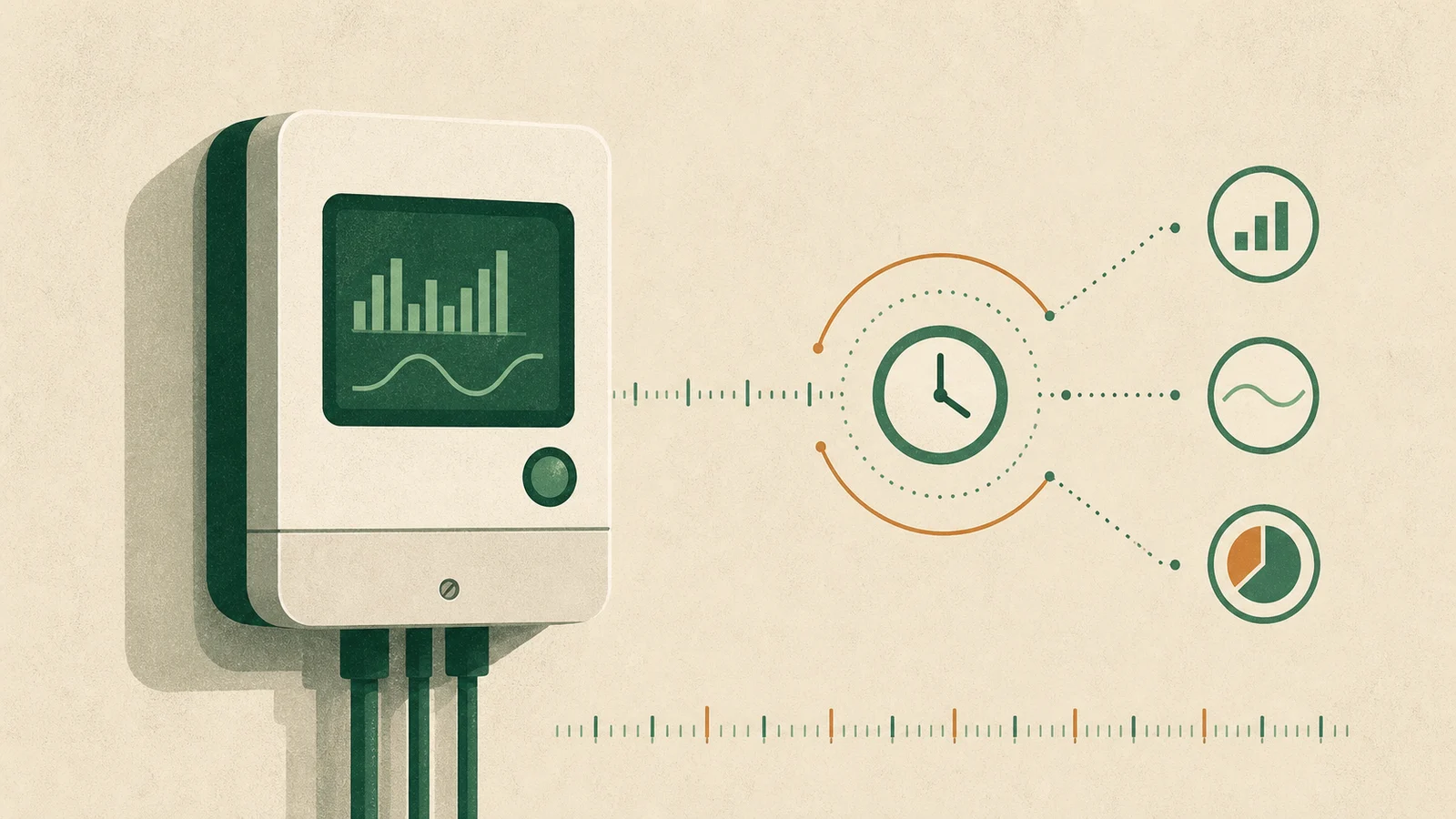
The old Ferraris meter with its spinning disc is all but history in Austria. In most households, a small black box with a display now hangs in the fuse cabinet — the smart meter. According to the energy regulator E-Control, around 97 per cent of all metering points had been switched to a digital meter by the end of 2025, putting Austria among the front-runners in Europe. Yet what the meter actually measures, who sees the data, and whether any of this translates into a financial benefit for your own household remains unclear to many. And since the new Electricity Industry Act (ElWG) came into force at the end of December 2025, the rules of the game have shifted in several respects. High time for a sober stocktake.
The rollout is nearly complete — but not everywhere "smart"
The legal target was clear enough: by the end of 2024, 95 per cent of Austrian households were to have an intelligent electricity meter. That quota was met and exceeded, apart from a few individual grid operators. By the end of 2024, according to E-Control, around 6.5 of 6.7 million metering points had been fitted; by the end of 2025 the figure had risen to roughly 97 per cent.
An important distinction is worth making here, though. A digital meter on the wall does not automatically mean all of its "intelligent" functions are in use. What matters is whether the meter records consumption in 15-minute intervals and transmits those readings to the grid operator. For a long time, that was precisely the exception: only a small share of devices — around 13 per cent, according to E-Control's analysis — were actually delivering quarter-hourly readings. The rest ran in the so-called standard mode, which transmits just one daily value.
This gap between installed hardware and functions actually used is the real lever the new ElWG is designed to pull.
What the ElWG changes
Under the new Electricity Industry Act, since the end of 2025 there are essentially only two relevant settings for the smart meter: opt-in with quarter-hourly metering — the meter measures, stores and transmits consumption every 15 minutes — or opt-out with significantly reduced data collection, meaning, for instance, only a daily or monthly reading.
The main novelty is that grid operators are gradually switching meters to the quarter-hourly mode automatically. According to the operators' announcements, households with an annual consumption above 5,000 kilowatt-hours go first, from 1 April 2026. Those between 1,500 and 5,000 kilowatt-hours follow, before all remaining households are eventually switched over. Anyone who does not want this must actively object — the logic thus flips from a pure opt-in system to a default in which the more precise metering becomes the norm.
For most people, this switch happens in the background, with nothing to do at home. If you want to know which mode your own meter is running in, you can find out in your grid operator's online customer portal.
The real payoff: switching tariffs, dynamic pricing and solar
For a long time, many regarded the smart meter as a pure box-ticking exercise with no discernible added value. With the 15-minute interval now becoming standard, however, tangible benefits emerge — provided you use them.
The first is transparency. Once you can see your consumption in a quarter-hourly grid, you can tell for the first time which appliances and which times of day are driving up your electricity bill. That is the foundation for targeted savings, as we show in our piece on the biggest levers for cutting household electricity use.
The second, and financially the most interesting, point is dynamic electricity tariffs. Since 2025, every Austrian electricity supplier has been required to offer such a tariff. Here, the wholesale power price — specifically the EPEX spot market for Austria — is passed straight through to the end customer on an hourly or quarter-hourly basis. Without a smart meter with quarter-hourly metering activated, such a tariff cannot be billed correctly.
The appeal: in hours with plenty of wind and solar power, the wholesale price can be very low — occasionally even negative. If you are flexible and can shift consumption — charging the electric car overnight, running the heat pump or the dishwasher in cheap windows — you can save noticeably compared with a classic fixed price. Depending on your behaviour, double-digit percentages are realistic. If, on the other hand, you cannot or will not shift consumption, you gain little while carrying the risk of price spikes. A dynamic tariff is no sure thing, then; it pays off above all for active, flexible households.
The smart meter is only the measuring device. Whether it turns into a saving comes down to whether you can shift your consumption into cheap time windows — or not.
For owners of a photovoltaic system, too, granular metering is a prerequisite for cleanly attributing self-consumption and grid feed-in over time. That matters for the feed-in remuneration — the OeMAG tariff stood at around 6.8 cents per kilowatt-hour in spring 2026, according to the national smart-meter portal — and above all for participating in an energy community, where electricity is shared locally. There, surplus solar power can often fetch better terms than through classic feed-in.
The solar discount: 20 per cent off the grid price
A tangible new incentive comes from the regulator itself. Since 1 April 2026, there has been the so-called summer low usage price (Sommer-Nieder-Arbeitspreis, SNAP), colloquially the "solar discount" (Sonnenrabatt). Anyone with a smart meter and quarter-hourly metering activated pays, according to E-Control, 20 per cent less on the grid-usage energy charge every day between 10am and 4pm from April to September. The deduction is applied automatically.
The idea behind it makes sound energy-market sense: at midday in summer, photovoltaics deliver a particularly large amount of power. If you shift consumption into that window — running the washing machine at noon rather than in the evening, say — you relieve the grid and are rewarded for it. An important caveat: the discount applies only to the grid energy charge, not to the energy price and not to taxes. Depending on the federal state, grid fees account for only about 15 to 20 per cent of the total bill. The saving is real, then, but modest — and it strictly requires the opt-in to be activated. No quarter-hourly metering, no solar discount. For how overall costs are shaping up in 2026, see our overview of electricity prices in Austria in 2026.
Data protection and criticism: the Chamber of Labour's objections
As sober as the benefits are, the concerns raised for years — above all by the Chamber of Labour (Arbeiterkammer) and data-protection initiatives — are serious.
At its core, the issue is that a smart meter recording in 15-minute intervals can paint a detailed picture of a person's daily routine: when someone gets up, cooks, leaves the house or is away on holiday can, in part, be read from the load profile. The Chamber of Labour points out that the metering data are stored in the device itself for up to 60 days and end up with the respective grid operator. According to the operators, the data are transmitted in pseudonymised form — assigned to a metering point rather than directly to a person — but a residual risk of re-identification remains a live theme in the debate.
A second criticism concerns a technical capability: the grid operator can limit power remotely or disconnect the connection altogether. This is intended as an emergency and maintenance function, but it fuels fears of misuse or state-ordered shutdowns in times of shortage. There are no documented cases of widespread abuse to date; the criticism is aimed at the possibility as such.
Finally, the Chamber of Labour has long complained that the opt-out procedure is not cleanly regulated in law. What is clear, at least: the installation of the device itself can be refused only within narrow limits, but the intelligent functions very much can be. If you want to do so, you request the opt-out from your grid operator by letter or email; the Chamber of Labour provides template letters on its regional websites. In the opt-out, only a reduced reading is then collected — at the price of forgoing dynamic tariffs and the solar discount.
Verdict: a mandatory device with real potential
The smart meter has, in effect, arrived across the board in Austria, and with the ElWG, precise quarter-hourly metering is gradually becoming the standard. For households, that means the device is there — the only question is whether you use what it can do. If you can consume flexibly, run a photovoltaic system or are considering a dynamic tariff, you can extract a tangible advantage from the digital meter, solar discount in summer included. If you shy away from the effort or weigh data protection more heavily, you can object via the opt-out — but then forgo precisely those advantages. There is no one-size-fits-all answer; it depends on your own consumption habits. A look at your grid operator's customer portal — which mode is my meter running in, and does it match my tariff? — is the sensible first step.