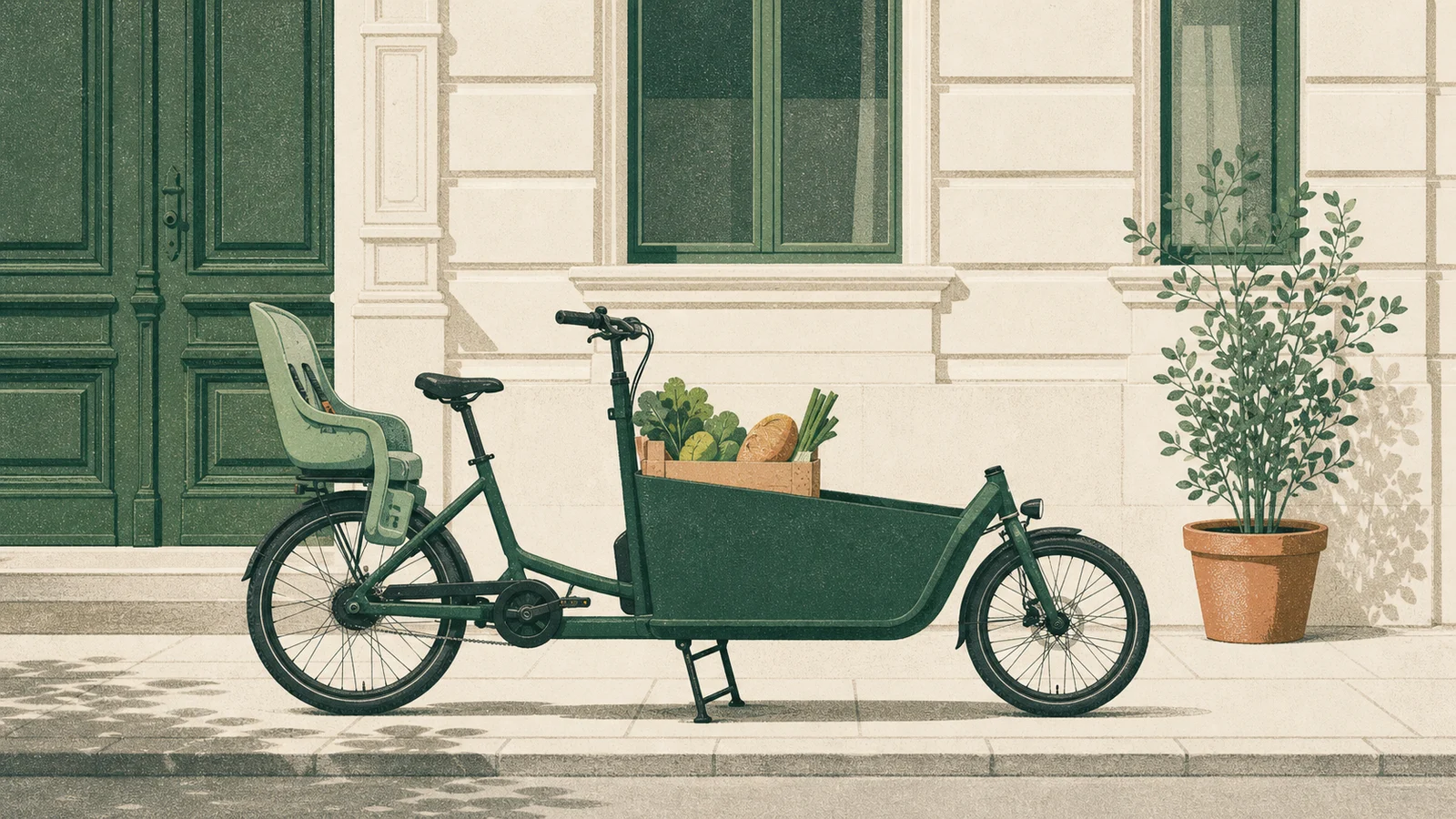
The second car spends most of its life parked outside the door. It takes the children to school in the morning, drives to the supermarket in the afternoon and to the DIY store at the weekend — and costs money all year round, whether it moves or not. This is precisely where more and more Austrian households are wielding the red pen, replacing the rarely used second car with a cargo bike. What was long seen as a niche pursuit for committed cyclists in Vienna's Neubau district has, by 2026, arrived squarely in the family mainstream — not least because the federal government, the provinces and municipalities are subsidising purchases with sums that sometimes run to four figures.
This article sets out which designs exist, what they can handle in everyday life, what they cost — and above all, how to get hold of the subsidies in Austria in 2026. Anyone doing the sums soberly should also read our cost comparison between public transport and the car, because in practice the cargo bike rarely competes with the main family car — but very much with the expensive second one.
The main types of cargo bike
Cargo bikes are not a single, uniform product. Anyone considering one as a car replacement should know the three main designs, because they behave quite differently in daily use.
The Long John carries its load platform or transport box between the handlebars and the front wheel. Depending on the model, the box seats up to two children — up to three in larger versions — with seatbelts and often a rain canopy. The advantage: the children sit within your field of vision, you can talk to them, and the centre of gravity is low. The handling takes a little getting used to at first, because the long front end steers more sluggishly than a normal bike. For families in the city, the Long John is the classic choice.
The longtail extends the rear of the bike instead. Behind the rider's saddle sits a long bench for one or two children, or a wide luggage platform. Longtails ride almost like a conventional bike, are more agile and usually cheaper, but carry somewhat less load. For households shuttling between school, work and the weekly shop, they are often the most pragmatic choice.
The three-wheeled cargo bike with a large box up front offers the most stability when stationary and the greatest carrying capacity — ideal for very heavy shopping or three children. In return, it is wider, heavier and more unwieldy on narrow cycle paths. Depending on the design, payload ranges from around 60 kilograms for a light longtail to over 150 kilograms for large Long Johns and trikes.
These days, buyers almost always opt for an electric drive. A mid-mounted motor with plenty of torque makes the difference between "theoretically possible" and "genuinely usable in hilly terrain" — especially in Graz, Linz or on Vienna's outskirts, where the ground is rarely entirely flat.
In practice: children, shopping, everyday life
The honest test of a cargo bike is not the Sunday outing but the perfectly ordinary Tuesday. Two children in the box, school bags on top, drop one child off, continue to nursery, then load two full shopping bags and a crate of drinks at the supermarket — a properly sized cargo bike handles all of this without complaint. It is precisely within this radius — most everyday journeys under five kilometres — that it replaces the second car most convincingly.
Realistic expectations matter. The cargo bike does not replace every car journey. The big furniture-store haul, the holiday trip with four suitcases or the visit to grandparents 200 kilometres away remain jobs for the car or the train. But a great many families conclude that for these rare cases it makes more sense to hire a car or take the train than to finance a second vehicle all year round. In municipalities with an e-car-sharing scheme, that gap can be closed particularly elegantly.
Three things decide between frustration and joy in daily use: a dry, ground-level parking spot — you don't carry a 30-kilo bike up to the third floor; good lights and mudguards, because the bike will be ridden in the rain and in the dark; and experience in handling wind and loads, which in any case becomes second nature after a fortnight. Anyone planning to ride year-round will find the right kit in our guide to cycling in winter.
What a cargo bike costs — and what it saves
In 2026, a solid e-cargo bike with a reliable drivetrain and child-carrying equipment starts at roughly 4,000 to 5,000 euros; branded models from established manufacturers often sit between 5,000 and 7,000 euros, with high-end trikes above that. It sounds like a lot — until you set it against the cost of a car.
The ÖAMTC, Austria's automobile club, has been pointing out for years that the running and maintenance costs of private cars in Austria have recently risen faster than average. Insurance, the engine-based vehicle tax, servicing, tyres, depreciation and fuel quickly add up to several thousand euros a year even for a little-driven second car — and largely irrespective of how often the vehicle actually moves. That is exactly what makes the rarely used second car so economically unattractive: the fixed costs keep running while the vehicle stands still.
A cargo bike doesn't pay for itself against the main car, but against the expensive second car that spends most of its time generating nothing but parking fees.
Against that calculation, a cargo bike looks positively cheap: after the purchase, the main outgoings are maintenance, the occasional set of tyres and brake pads, and charging electricity — at current electricity prices in Austria, a negligible sum for the few kilowatt-hours a battery needs. And this is precisely where the subsidies come in, making the switch easier still.
The 2026 subsidies in detail
Austria subsidises cargo bikes at several levels, some of which can be combined. What matters is knowing the right sequence and acting early, because almost all of these pots only last as long as the budget does.
Federal level (klimaaktiv mobil / BMIMI). The nationwide programme run through the Umweltförderung, Austria's federal environmental funding scheme, most recently supported the purchase of private (e-)cargo bikes with 900 euros per bike and (e-)folding bikes with 500 euros, according to klimaaktiv — the latter only on proof of a valid annual public transport network pass. In every case the subsidy was capped at 50 per cent of eligible costs. The application window was originally set to run until 27 February 2026 at 12 noon, but was closed early because the funds were exhausted: since 20 January 2026, according to the Umweltförderung, no new applications have been possible. Whether and in what form a follow-up programme will come in 2026 depends on the budget and remained open at the time of writing; anyone planning to buy should watch the official Umweltförderung pages for a possible relaunch. Important: purchases by businesses and municipalities were not covered by this private-buyer programme.
Provinces and municipalities. This is where things get fiddly but lucrative — and where the real money often lies. In Graz, according to the city, a 2026 programme covers 50 per cent of eligible purchase costs: up to 1,000 euros per motorised cargo bike and 800 euros per non-motorised one. In Linz, up to 30 per cent of investment costs are eligible — a maximum of 1,000 euros for an e-cargo bike, 800 euros for one without a motor and 150 euros for a trailer — and explicitly for businesses and organisations too. The City of Salzburg has set aside its own budget for 2026 and offers a 30 per cent grant of up to 1,000 euros for e-cargo bikes, tiered by trailer, cargo bike and conversion. Many Vorarlberg municipalities — Dornbirn, Bregenz, Lustenau and Wolfurt among them — also run their own purchase premiums.
An important note for the capital: the much-used Vienna cargo-bike subsidy for private buyers was already halted in April 2025 because the funds were exhausted; whether a new pot will open in 2026 remained unclear at the time of writing. Viennese residents should therefore keep an eye on whether the city tops up the scheme — and, in parallel, watch for a possible relaunch of the federal subsidy.
How to apply. Practically all the subsidies follow the same pattern: apply online only after the purchase, with the original invoice and proof of payment — usually via the Umweltförderung (federal level) or the funding portal of the city in question. The sequence matters: check the funding conditions before you buy, because some pots require a minimum specification with a defined payload or exclude second-hand bikes. Federal and municipal subsidies can often be combined, but as a rule may not together exceed 50 per cent of the costs. Anyone who maxes this out can quickly knock 1,500 to 1,900 euros off the purchase price of a 5,000-euro bike — and that is exactly what tips the maths against the second car for good.
Verdict: who should make the switch
The cargo bike does not replace a car for everyone — but for many Austrian families it very convincingly replaces the one car that mostly just sits around anyway. If you live in a city or a well-connected commuter belt, do most of your journeys under five kilometres, have a ground-level parking spot and cover the rare long-distance trips by rail, with Austria's Klimaticket travel pass or via car sharing, a subsidised e-cargo bike will as a rule work out cheaper, healthier — and in city traffic often even faster. The key is not to sleep through the 2026 funding deadlines and to soberly check your own city's and the federal government's conditions before buying. Then the expensive second car that mostly stands idle becomes a car that has been sold — and a bike that rides every single day.