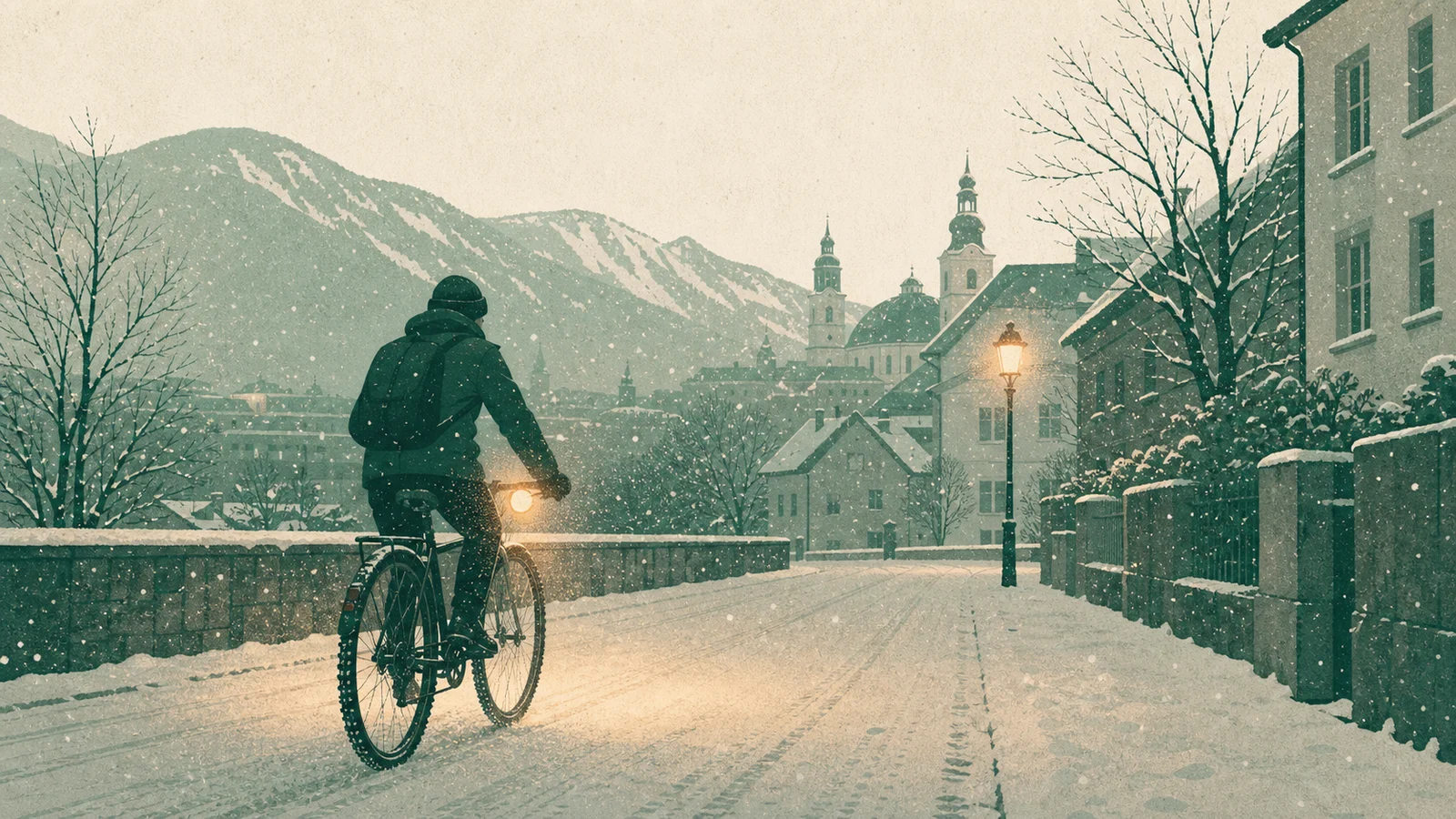
As soon as the days grow shorter and the first sub-zero temperatures arrive, the cycle paths of Vienna, Graz and Linz empty out noticeably. Many people put their bikes in the cellar for the winter — some out of fear of ice, others out of sheer habit. Yet the cities' counting stations show that a growing group rides all year round: in Vienna, the automatic counters regularly register several thousand cyclists a day on the main routes even in January — among them a growing number of families using a cargo bike as a second-car replacement all year round. Anyone who gets on a bike in winter, however, is moving through a more demanding environment than in summer. Darkness, wet roads, snow and patchy snow clearance change the conditions so markedly that equipment and riding style carry more weight than they do in the warmer months.
Being seen is half the battle
The biggest risk in winter is a banal one: not being noticed. A considerable share of winter cycling happens during the commute — in daylight hours that barely exist at that time of year. The Austrian Road Safety Board (Kuratorium für Verkehrssicherheit) has been pointing out for years that poor visibility is among the most common factors in accidents involving cyclists in the cold season. Anyone riding in dark clothing without working lights only becomes visible to drivers at a distance of a few metres — too late to react safely on a wet road.
The legal position is unambiguous. Austria's bicycle regulation (Fahrradverordnung) requires a white or pale yellow front light and a red rear light when riding in darkness or poor visibility, plus reflectors and reflective pedals. In practice, though, the legal minimum is often not enough in winter. Steady lights with sufficient brightness make more sense than cheap flashing units, supplemented by reflective elements on the moving parts of the body. Reflectors on ankles or pedals create a pattern through their movement that the human eye recognises as a person faster than a static high-vis vest. The cycling advocacy group Radlobby recommends treating visibility not as a question of assigning blame — legally, the duty of care rests with all road users — but as pragmatic self-protection.
On snow and ice, the tyre decides
On an icy road, the difference between a normal summer tyre and a winter-ready one is a world apart. In wet conditions and loose snow, a chunkier tread and slightly lower tyre pressure already help, because the contact patch grows and the tyre finds more grip. On bare ice, however, every rubber-based tyre reaches its limits. Only studded tyres help here — their metal pins, embedded in the rubber, claw into the layer of ice.
Studded tyres are legal for bicycles in Austria and permitted all year round; there is no fixed winter-tyre requirement as there is for cars. But they have two drawbacks: on dry asphalt they roll noticeably heavier and louder, and they cost considerably more to buy than an ordinary tyre. Anyone who only occasionally rides on ice is often better off with a grippy all-weather tyre, because an urban route is usually a mix of cleared and iced-over surfaces. Whatever the tyre, the same rules apply: slow down, brake earlier, and never brake and steer at the same time in a bend. Most winter falls happen not in the thick of traffic but while slowly setting off or turning on a frozen-over patch you never saw coming.
Clothing against cold and headwind
The cold on a bike is not the cold of a walk. The headwind lowers the perceived temperature significantly, especially on the hands, ears and face. At the same time, the body generates heat while pedalling, so with clothing that is too thick you quickly start sweating and then get chilled afterwards. The principle of several thin layers, familiar from hiking, works here too: a breathable base layer, a warming mid layer, and something wind- and water-repellent on the outside.
The extremities are what matter. Cold, stiff fingers operate the brakes and bell less well — and that can be exactly what is missing at the decisive moment. Windproof gloves, a thin cap under the helmet and a tube scarf over mouth and nose make the biggest difference. Against spraying meltwater and grit, mudguards help more than any expensive jacket. On helmets, the old debate repeats itself: in Austria, a helmet is compulsory only for children up to the age of twelve — precisely the age group that is once again making its own way to school more often. The Road Safety Board expressly recommends wearing one, because winter falls frequently involve the head — but for adults, the decision remains voluntary.
Gritting and cycle paths: the invisible variable
Whether winter cycling is pleasant at all depends less on your own bike than on your city. The duty to clear and grit is regulated in Austria, but unevenly applied in practice. Main roads are cleared first; cycle paths often later, or as a lower priority. Where snow is pushed from the carriageway onto the adjacent cycle path, cyclists actually face an additional obstacle.
Some cities have responded. In recent years Vienna has introduced a dedicated clearance programme for selected main cycling routes, under which certain stretches are given priority maintenance. Graz and Salzburg, too, emphasise the winter upkeep of their cycling infrastructure. The Radlobby nevertheless regularly criticises the fluctuating quality and the lack of a continuously cleared network in many places. One practical detail with a big impact is the gritting material itself: salt works down to a certain temperature, below which grit is spread instead. Loose grit on a surface that has already thawed is an underestimated cause of falls, because it behaves like tiny ball bearings under the tyre. Caution is therefore warranted even where the road already looks dry.
How high the risk really is
The raw statistics paint a nuanced picture. In absolute terms, fewer cyclists have accidents in winter than in summer, simply because fewer are on the road. But set the accidents against the actual distance ridden, and the risk per kilometre rises in the cold season. The Road Safety Board attributes this above all to ice, poor visibility and shorter reaction times. Many of these falls are so-called single-vehicle accidents with no second vehicle involved — a slide on ice, a kerb, an unnoticed frozen patch. Such falls often never appear in the official statistics because they go unreported, which probably means the real risk is understated.
That is put into perspective, however, by the health benefits. Regular exercise in the fresh air, winter included, is considered by health experts to be markedly healthier than going without. Anyone who lowers their individual risk of falling through equipment and an adapted riding style tips the balance clearly in the positive direction.
The takeaway
Winter cycling in Austria is not a test of courage but a matter of preparation. The three most important levers together cost less than a tank of petrol: reliable lights, grippy tyres and warm, visible clothing. Riding style does the rest — slower, more anticipatory, with greater distance and the awareness that a harmless-looking puddle can turn into a sheet of ice overnight. Where the city helps out with consistent snow clearance, the exception becomes routine. The experience of year-round riders is unequivocal: anyone who has ridden through a Viennese January well equipped is far less likely to put the bike away the following autumn — and quite often ends up planning the holidays car-free as well, say by travelling on the night train.