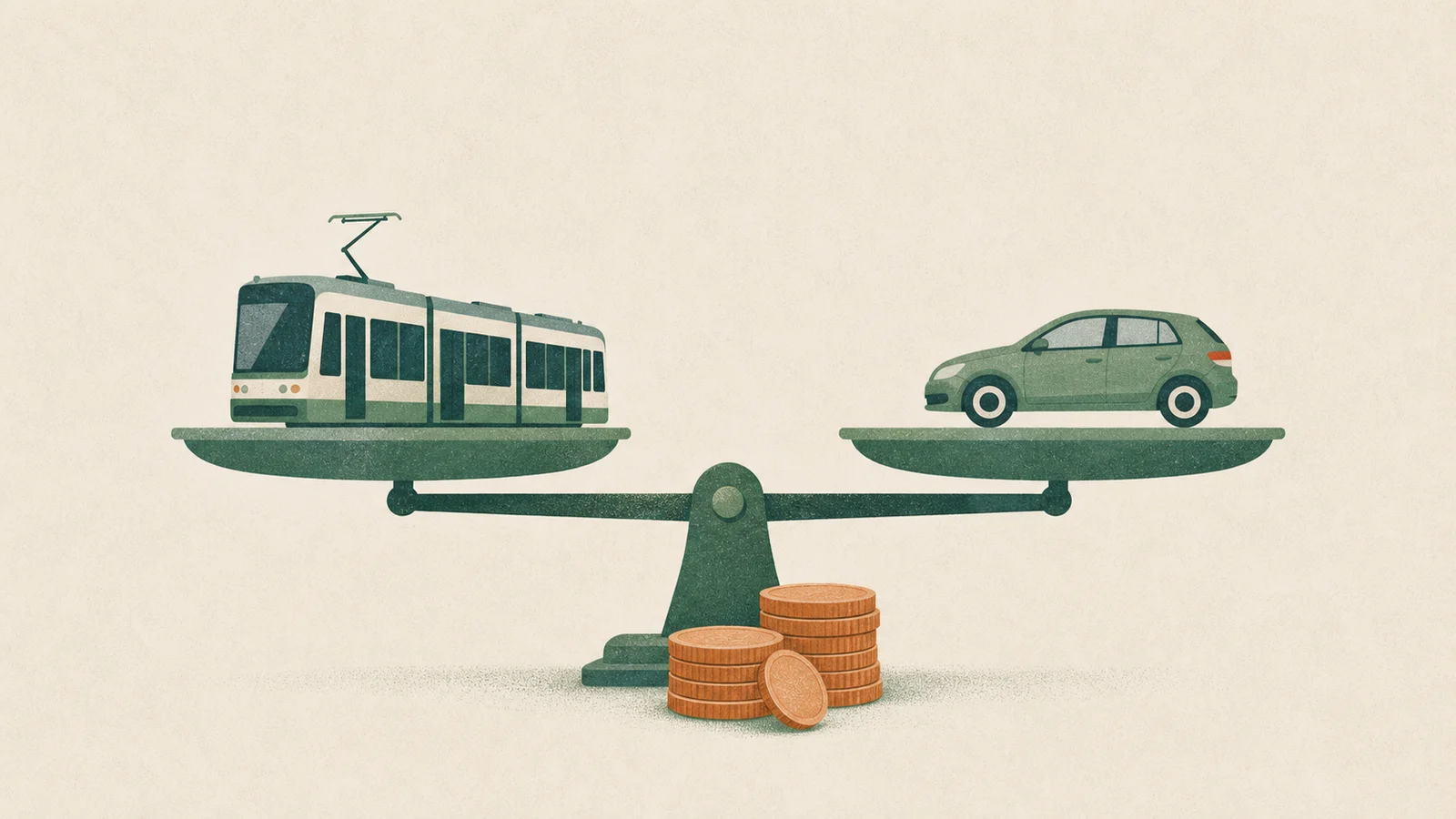
The sums look simple enough: Austria's KlimaTicket travel pass costs around €1,400 a year in 2026, while a litre of diesel runs to just under €1.83. Fill up a few times a week and you've soon spent the price of the ticket — or so many people's gut instinct goes. And that is precisely where the reasoning breaks down. Anyone comparing public transport and car ownership seriously cannot set the ticket price against the fuel bill. On one side sits the complete cost of getting around; on the other, only a fraction of it.
The Austrian motoring club ÖAMTC and the transport advocacy group VCÖ have long worked with what they call cost truth, or full-cost accounting. It adds up everything a car swallows over a year — not just what shows up at the pump. We do the same here, soberly and without ideology, and ask who comes out ahead in 2026.
What a car really costs — and what usually gets forgotten
The single biggest item never appears on any bill: depreciation. According to the ÖAMTC and industry data, a new car loses up to roughly half its purchase price in its first three years. For a car that cost €30,000, that works out at around €5,000 a year simply evaporating — whether you drive it or not. You only feel this line item when you sell, which is why it almost never features in everyday reckoning.
Then come the fixed costs, which accrue regardless of how much you drive. Third-party liability insurance runs roughly between €400 and €900 a year, depending on your no-claims level and where you live. The engine-based insurance tax, which according to the ÖAMTC has risen slightly for many new combustion-engine cars from 1 January 2026 and often works out around €35 a year more expensive than a 2025 first registration — nothing changes for vehicles already on the road. Add the motorway vignette, servicing at the garage, the annual "Pickerl" roadworthiness test, tyres, wear parts. Before the first kilometre is even driven, an average car easily racks up €1,500 to €2,500 a year.
Only then do the variable costs arrive — fuel or electricity. In early June 2026, petrol averaged around €1.73 per litre across Austria according to the ÖAMTC, with diesel at about €1.83, after the fuel price brake was extended into the summer but the market intervention on margins expired at the end of May, leaving only a small tax cut in place. A car burning six litres per 100 km over 12,000 kilometres a year thus costs around €1,300 to €1,400 in fuel alone. For an electric car this item is markedly lower: charge at home and, depending on your tariff, you often pay under 12 cents per kilowatt-hour, shrinking the cost of charging at your own wallbox to a fraction — though the purchase price, and with it the depreciation, is usually higher.
Buying new in 2026 also means reckoning with the NoVA, Austria's standard-consumption tax on new vehicles. It rose at the start of the year for many CO₂-heavy new cars and hits high-emission combustion models hardest; pure electric cars remain NoVA-exempt. Spread over the years of ownership, this one-off levy pushes the annual cost share up further still.
The full tally: roughly €0.30 to €0.60 per kilometre
Add it all up and you land at the figures the ÖAMTC itself works with. Its car-cost tool, which combines depreciation, fixed costs, servicing and fuel, puts full costs for most cars at between roughly €0.30 per kilometre for a frugal small car and €0.80 or more for large SUVs. For a typical compact-class car covering 15,000 kilometres a year, the ÖAMTC and comparable calculators cite total monthly costs of roughly €480 to €620 — around €5,700 to €7,400 a year.
That broadly tallies with the assessment of the comparison portal durchblicker, which puts average car costs in Austria at about €1,100 a month for purchase, maintenance, insurance and taxes — though this much-quoted figure rests on a very high annual mileage of 30,000 kilometres and therefore includes pricier heavy-driver profiles. Even calculated conservatively and at normal mileage, a single everyday car in Austria rarely costs less than €5,000 a year.
The KlimaTicket costs less than the pure depreciation of a single new car over the same period — the comparison flips the moment you honestly count everything.
Against those €5,000 to €7,000 or so stands the nationwide KlimaTicket at €1,400, or €1,050 at the concession rate for young people, seniors and people with disabilities. Even the most expensive regional ticket — the version for Vienna, Lower Austria and Burgenland at €1,000 — sits well below that. The cheapest provincial ticket, in Salzburg, starts at €399 a year. So anyone who can replace a single car outright with an annual pass almost always saves in purely financial terms — provided daily life can actually be organised without a car.
City versus countryside: where it all gets decided
That proviso is exactly the crux. The full-cost calculation almost always comes out in favour of public transport — but it says nothing about whether a car-free life is feasible in the first place.
In Vienna, Graz or Linz the case is usually clear-cut. Dense underground, tram and bus networks, plus managed parking that makes car ownership even dearer: Vienna's residential parking permit (Parkpickerl) costs €13 a month in 2026, or €156 a year, while a rented garage space can quickly run to ten times that. In the city, according to the VCÖ, a car sits parked for an average of around 23 hours a day anyway — most of the time it is an expensive piece of standing equipment. Live here, and a Klimaticket plus occasional e-carsharing in your municipality or a hire car for the furniture run will usually get you around more cheaply and with less stress.
In the countryside, the logic reverses. Where the next bus runs three times a day, the railway station is twelve kilometres away and your job sits in a poorly connected business park, the best ticket price is of little use. Here the car is often less a matter of comfort than of basic access. In many rural regions the realistic answer is a hybrid model: one car per household instead of two, combined with a Klimaticket for the commute into the district town. Scrapping the second car alone — over a million vehicles in Austria, according to the VCÖ, moved on average for just half an hour a day — delivers the biggest saving. How to organise that in practice is the subject of our piece on commuting without a car of your own.
The break-even point: when the ticket starts to pay
A rough rule of thumb helps with the decision. Use the Klimaticket in a way that fully replaces a car, and break-even is reached practically immediately — €1,400 is cheaper than almost any honestly calculated annual car bill. Buy the ticket on top of an existing car, however, and the maths changes: then all that counts is whether the variable per-kilometre costs saved, plus the added convenience, outweigh the ticket price. For heavy users on rail routes it often does; for occasional drivers it doesn't.
What decides it is your personal mileage. The average annual distance driven by private cars in Austria has fallen over the years, according to the VCÖ, and in many places now sits at only around 12,000 to 13,000 kilometres. With that little movement, the fixed costs and depreciation devour the supposed advantage of flexibility — the car becomes the most expensive option, parking space included.
The verdict: do the honest maths, not the gut maths
The sober finding: set full costs against full costs, and the KlimaTicket clearly beats owning a car in most urban and many rural constellations — not narrowly, but by several thousand euros a year. The common mistake is to blank out the fixed depreciation and running fixed costs and see only the fuel receipt.
Even so, the answer is not the same for everyone. In the city, switching is usually a financial and practical no-brainer. In the countryside it is less often about the only car and more often about the dispensable second one. And for some circumstances — shift work far from any route, caring for relatives, a business that moves materials — the car simply remains without alternative. But do the honest arithmetic instead of trusting your gut, and you will often find: the car is not as cheap as it feels — and the ticket not as expensive.