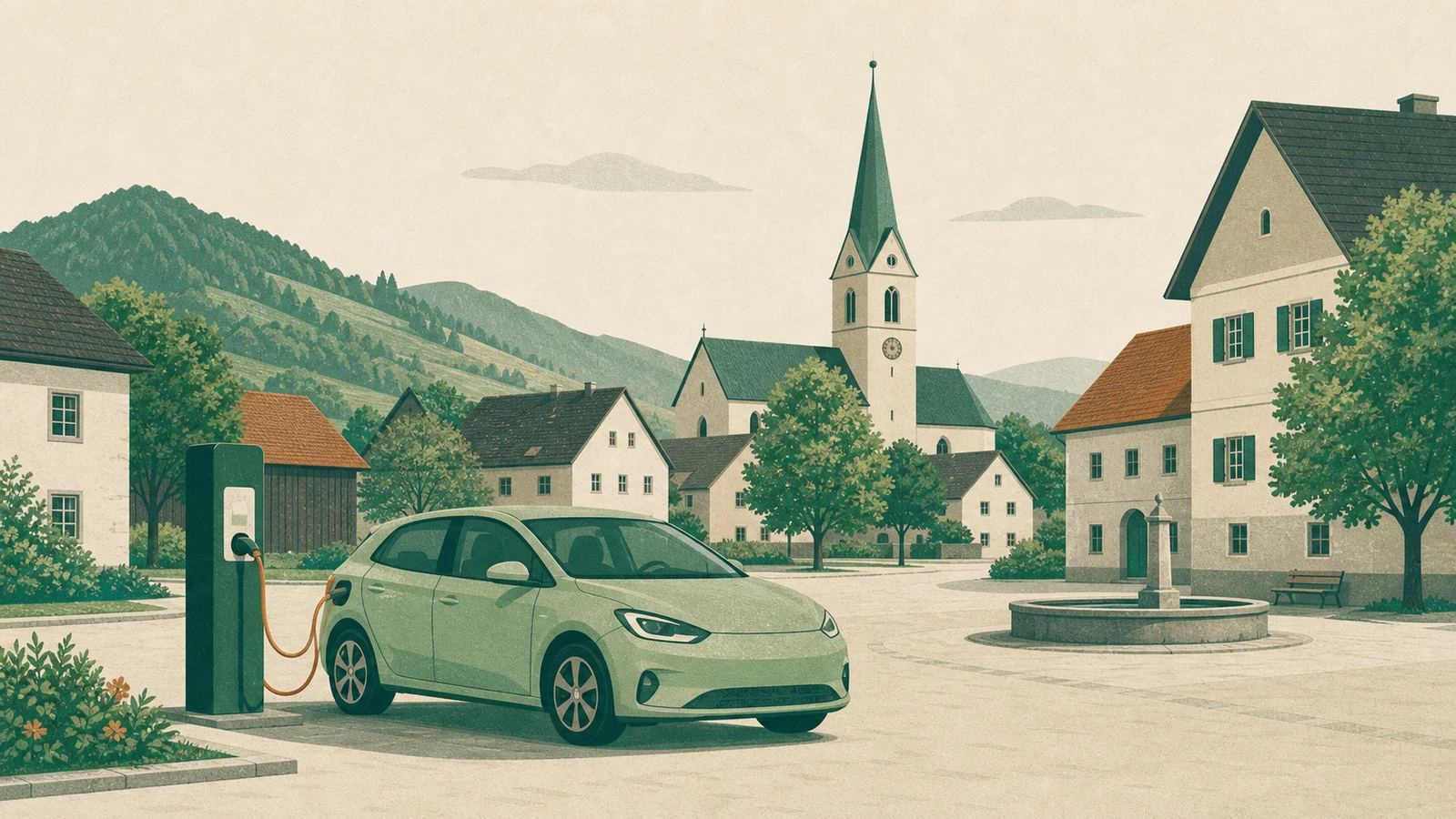
Anyone wanting to live without a car in a city like Vienna or Graz has options: the underground, trams, hire bikes, and commercial carsharing fleets on almost every corner. In a village of 1,200 people in the Mühlviertel or in Tyrol's Oberland, the maths looks rather different. The nearest railway station is often several kilometres away, the bus runs three times a day, and the second car sits unused outside the house for an average of 23 hours out of every 24. This is exactly where a movement that has gathered pace in recent years comes in: the shared electric car at municipal level. What is a business model in urban centres becomes a communal undertaking in rural Austria — carried by municipalities, local associations and a funding landscape built up around the national klimaaktiv mobil programme.
Why the countryside needs a model of its own
Carsharing on the urban pattern works through density. The more people take turns using a vehicle in a small area, the better the sums add up. In the countryside, that density is by definition missing. A commercial operator will not place a car in a village of a few hundred households, because utilisation would never cover the cost. The result is heavy car dependence: according to Statistics Austria, the national statistics office, motorisation rates in many rural districts sit well above the urban average, and in numerous households a second or third vehicle stands ready almost exclusively for occasional trips.
The shared electric car promises to replace precisely that second car. The VCÖ, Austria's transport and mobility advocacy organisation, has long argued that a well-utilised carsharing vehicle can replace several private cars, cutting parking space, purchase costs and emissions. In a rural context there is a second effect: where public transport is thin, a flexible community car fills gaps that no scheduled bus route can cover economically. The electric variant is no end in itself, either — and a world away from the stock-market hype around e-mobility. Short, predictable journeys within the local area suit an EV's range well, and charging is straightforward to set up at a fixed home base.
Clubs, not corporations
The defining feature of rural e-carsharing in Austria is who runs it. Instead of a large mobility corporation, there is usually a local actor behind it — often an association founded for the purpose, sometimes the municipality itself, occasionally a cooperative or a committed local business. In many cases it is a blend: the municipality provides the parking spot and charging infrastructure, an association handles bookings, billing and key handover, and residents pay a membership or usage fee.
There is a practical logic to this model. An association can be founded with modest effort, it can apply for subsidies and pool liability questions, and it anchors the service socially in the village. If you know the car, you also know who used it last — a form of accountability no app can replicate. Booking and access now run digitally almost everywhere: a platform manages reservations, and an on-board computer or chip card unlocks the vehicle. The technology comes from specialised Austrian and German providers, so a municipality does not have to start from scratch.
The range of organisational forms is broad, and a few common variants have crystallised:
- Municipal car: the local authority uses its own fleet vehicle during the day and releases it to residents in the evenings and at weekends.
- Association model: a sponsoring club operates one or more vehicles on its own account, often with start-up funding from the municipality.
- Business partnership: a local firm makes its vehicle available outside business hours.
The funding landscape: klimaaktiv mobil and the municipalities
Hardly any of these projects would get off the ground without public support. The central address is klimaaktiv mobil, the climate ministry's programme bundling advice and investment funding for mobility projects. Depending on the call, funding covers the purchase of the electric vehicles, the charging infrastructure and, in part, the set-up work. Municipalities, associations and businesses each have dedicated funding tracks, so a communal operator can apply different rates than a private-sector one.
On top of this come provincial subsidies, which vary from one federal state to the next, as well as guidance from the Austrian Association of Municipalities (Gemeindebund), which treats shared mobility as a building block of communal services of general interest. The Gemeindebund regularly points out that rural mobility cannot be solved through conventional scheduled services alone, and that flexible complementary offerings are gaining in importance. The funding logic therefore deliberately targets the start-up phase: the biggest hurdle is not day-to-day operation but the initial investment and the entrepreneurial risk of the first months, when user numbers still have to grow.
Utilisation — the real test
Utilisation is where a project stands or falls. A vehicle driven only a few hours a week racks up fixed costs — insurance, maintenance, platform fees, depreciation — without generating enough revenue. Experience from Austrian pilot municipalities shows there is a critical threshold above which a location pays for itself; below it, the scheme stays dependent on subsidies.
Several factors shape usage. The location must be central and visible, ideally where journeys converge anyway — on the main square, at the municipal office, at the railway station. Tariffs must be simple and predictable, because complicated pricing scares off occasional users. And a launch phase with active promotion is essential, since many people only try shared mobility once they know someone who already does. The Chamber of Labour (Arbeiterkammer) has repeatedly demonstrated in its mobility analyses that owning a car is expensive above all through its fixed costs; shared models pay off particularly for households that need a vehicle only sporadically — and for short everyday trips, a subsidised cargo bike is often the cheaper alternative to a second car. Precisely this group — infrequent drivers, older people without a car of their own, young adults not yet at the second-car stage — forms the most viable target audience in rural areas.
The last mile and the interplay with public transport
Community carsharing unlocks its full potential where it does not stand alone but docks onto public transport. The key phrase is the last mile: the stretch between the railway station or bus stop and the actual destination, which decides how attractive the whole journey is. Anyone commuting by train to the nearest district town, but lacking a sensible connection to the station, ends up taking their own car anyway.
An e-carsharing vehicle on the station forecourt can close that gap, as can combined offerings of hire bikes, micro public transport and shared taxis being trialled in some regions. Part of the same rethink is that in many places children are once again covering the school run on foot instead of being chauffeured there by car. The Umweltbundesamt, Austria's federal environment agency, points out that transport is among the sectors with the country's most difficult emissions trajectory, and that rural areas hold particularly large levers because car dependence is highest there. Carsharing alone will not tip that balance. But as one element in a coordinated mobility offering, it can make the difference between a household giving up its second car or keeping it.
What remains
The shared electric car will not rebuild rural transport in Austria single-handedly, and it is no substitute for a properly functioning public transport timetable. But where it is set up intelligently — with a central location, simple tariffs, a committed sponsoring association and solid start-up funding through klimaaktiv mobil — it closes a real gap. It replaces second cars, lowers households' fixed costs and, at its best, links up with rail and bus into an offering that works even without owning a car in the village. The decisive variable remains utilisation: it separates showcase projects from locations that vanish once the funding expires. For many municipalities, the shared EV is therefore less a ready-made recipe than an experiment — one that succeeds precisely when it is rooted in the community and not just on paper.