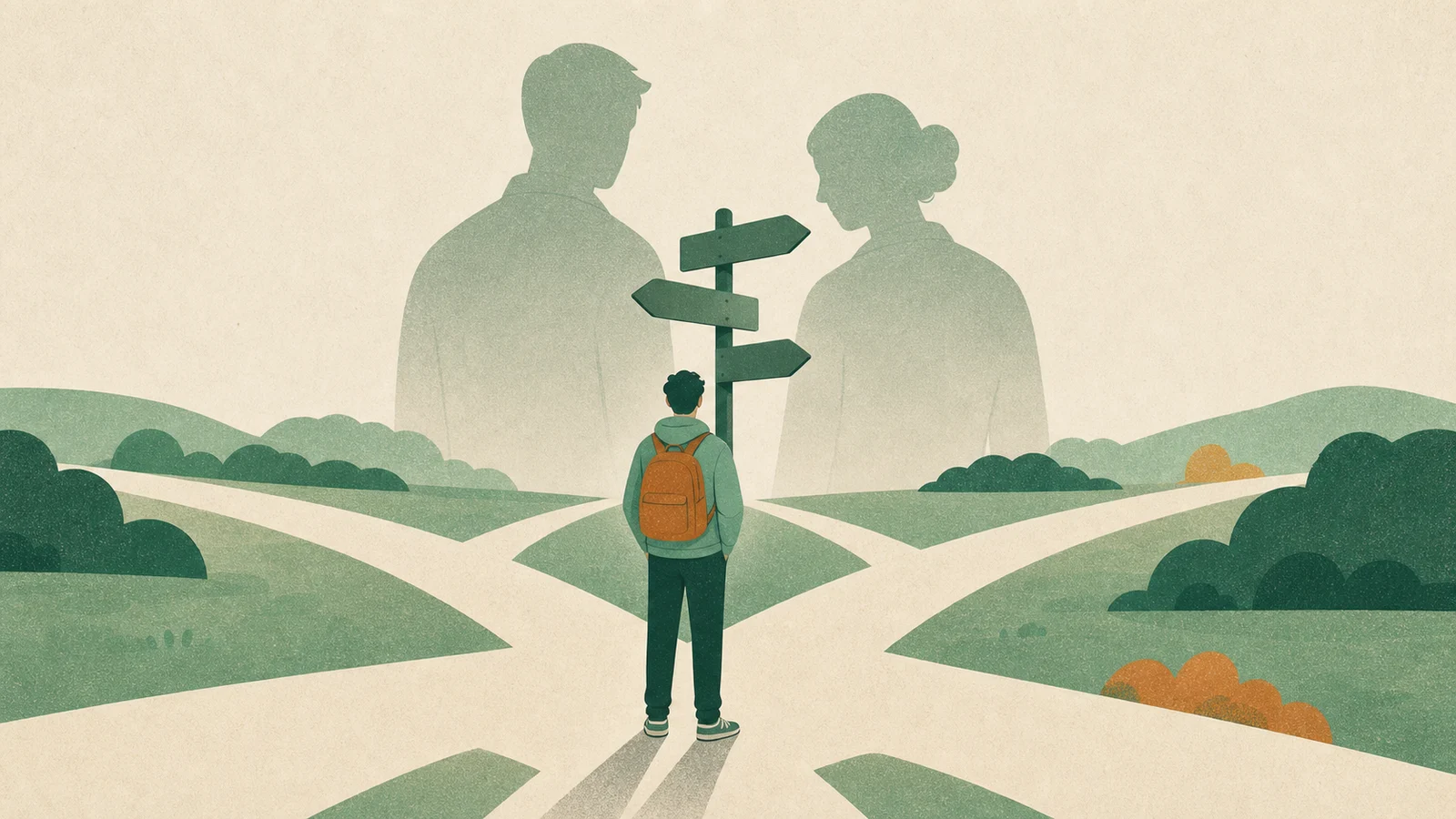
Whenever Austria debates who goes to university and what they study, one term surfaces sooner or later: social background. Behind the slightly unwieldy phrase lies a strikingly concrete reality. Whether a young person heads to the University of Vienna, Graz University of Technology or the Johannes Kepler University in Linz — whether they choose medicine, teaching or none of the above — correlates measurably with the educational qualifications of their own parents. The question of how much influence parents have on the choice of degree cannot, therefore, be answered with parenting styles or well-meant advice at the kitchen table alone. It runs deeper, right down into the statistics.
Education is inherited, not just chosen
The Student Social Survey, carried out at regular intervals by the Institute for Advanced Studies (IHS), a Vienna-based research institute, on behalf of the responsible ministry, has shown a stable pattern for years: children from families in which at least one parent holds a university degree are markedly over-represented at Austria's universities. Conversely, young people whose parents have at most compulsory schooling or an apprenticeship qualification are found in higher education less often than their share of the population would suggest.
Experts call this the inheritance of education. The point is not that intelligence is passed down, but that educational trajectories reproduce themselves across generations. Someone who grew up in a household where university was the self-evident next step after the Matura, Austria's school-leaving exam, approaches the decision quite differently from someone in whose family nobody has ever enrolled. Even the question of whether to study at all is pre-shaped long before any specific subject comes into view.
And the tracks are laid earlier than the phrase "choice of degree" suggests. The early separation of school pathways — the transition after primary school, still relevant according to Statistics Austria, the national statistics office — sorts children into different lanes as early as age ten. By the time the actual decision about university arrives at 18 or 19, families have long since made a series of prior choices, often without recognising them as such.
Expectations that are never spoken aloud
Parental influence rarely operates through commands. Hardly any mother instructs her child to study law rather than history. Far more effective are the unspoken expectations — what counts as normal and desirable. In a family of graduates, the real question is often not whether but what and where, and even then there is a familiar map of professions, titles and social status to navigate by.
In families where a university degree would be something new, the constellation can cut both ways. Some parents encourage their children all the more, precisely because they want to make possible what was denied to them. Others view a long, unpaid degree with scepticism, because a secure apprenticeship trade seems more tangible and easier to calculate — especially since routes such as the apprenticeship with Matura keep the door to university open anyway. The Austrian Students' Union (ÖH) points out again and again in its advisory work that what first-generation students lack is often not ability but a sense of entitlement — the feeling of belonging at university.
Then there is an economic dimension that cannot be argued away. Studying costs money, even without high tuition fees. Rents in Vienna, Graz or Innsbruck, living expenses, learning materials, and the years in which no full income is earned. Where parents can help financially, the decision in favour of a long degree comes more easily. Where the family budget is tight, many students have to work alongside their studies, which affects both how long they take and how likely they are to finish. Family background operates twice over here: through expectations, and through the wallet.
The first-generation gap
Particularly revealing is a look at the group known in the jargon as educational climbers or first-generation students — those whose parents did not go to university themselves. They often bring the same ambition as their peers from graduate families, but they navigate the system without the informal stock of knowledge that others absorb at home.
That stock is inconspicuous but powerful. It consists of knowing how to organise enrolment, what an ECTS credit means, how to address a professor in office hours, when a semester abroad makes sense, and which degree opens which career doors. Anyone who has to learn all of this during their studies loses time — and sometimes confidence. The IHS Student Social Survey documents that students from non-academic households interrupt or abandon their degrees more often, and not because they achieve less, but because the hurdles are unequally distributed.
Patterns also emerge in the choice of subject. Prestigious and heavily regulated disciplines such as medicine or law show a particularly high share of students from graduate households. The medical admissions test, for which many candidates prepare with expensive preparatory courses, amplifies the effect further, because not all families can afford such courses — or even know they exist.
What schools and the state put up against it
The fact that this link is well known has prompted a series of countermeasures. Study and careers guidance in Austria's schools is meant to step in precisely where the family home cannot provide orientation. Universities and universities of applied sciences run taster days, online self-assessments and advisory services; the ÖH operates its own study counselling; and fairs such as BeSt in Vienna, Graz, Innsbruck and Salzburg bring thousands of young people together with institutions every year.
Alongside these, there are targeted programmes for educational climbers. Mentoring initiatives in which students from non-academic families are accompanied through their degrees, as well as scholarships and grants, are designed to lower the financial barriers. The student grant provided by the state study-support scheme remains the most important instrument for opening higher education to students from lower-income households.
The effect of such offerings is real, but limited. A taster day does not replace years of casual learning at the family table, and a grant does not offset every insecurity. Counselling, moreover, can only reach those who find their way to it — and precisely the people who would need it most seek it out least often. These measures soften the inequality; they do not lift it.
When parents steer too much — or too little
Parental influence has two problematic extremes. On one side is the over-steering variant, in which children choose a degree because it is the expected path, not because it matches their interests. Dropouts in the first or second semester can quite often be traced back to such externally determined decisions. Counselling services report young people who study the subject their parents wanted and only realise late that it was never theirs.
On the other side stands the absence of any orientation at all. Where parents can contribute nothing from their own experience and no other trusted figures step in, young people make their choice flying blind, guided by chance, by a city's reputation or by the entry restrictions of neighbouring subjects. Both extremes show that the issue is not more or less influence, but the right kind of accompaniment: informing, not deciding.
What remains
Parents' influence on the choice of degree is considerable, but it works differently from the image of the stern father dictating a career path. It determines less the individual subject than the taken-for-granted assumptions underneath: whether university happens at all, with how much confidence, how much knowledge and how much financial security. The figures from Statistics Austria and the IHS show that this imprint has a social tilt — one that guidance services and grants can soften, but not fully dissolve. At least the first decision is less final today than it once was: those who want to change course later will find a second chance in the newly regulated educational leave, for instance.
For those affected, this is not a question of abstract education policy but a deeply personal one. Whoever enrols as the first in their family performs an additional, invisible labour alongside their studies: learning a world that others were handed at birth. And whoever comes from a graduate household would do well to recognise that head start rather than mistake it for personal merit. The most honest contribution parents can make is perhaps the least conspicuous one: opening doors without pushing through them.