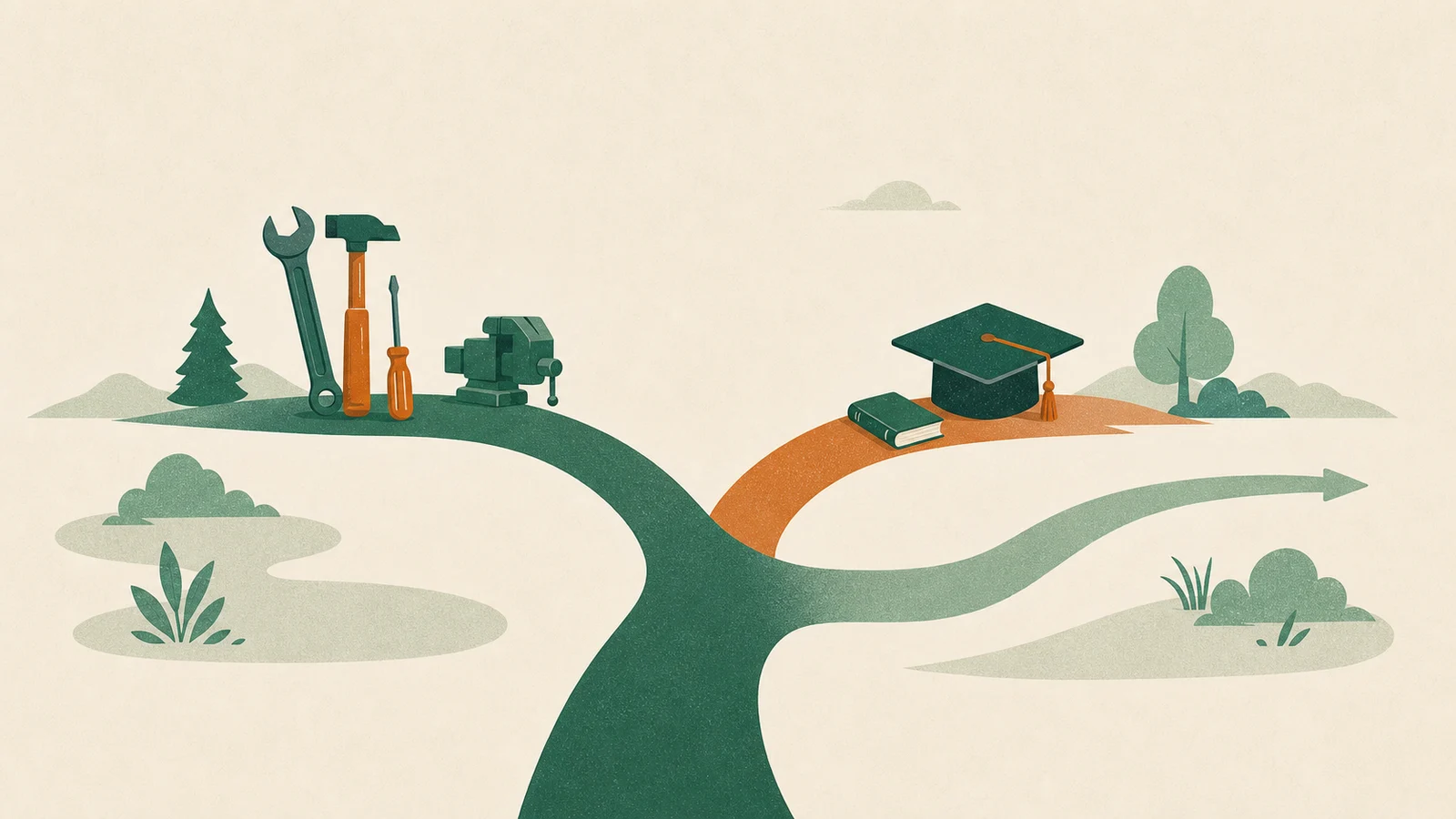
Anyone starting an apprenticeship in Austria no longer has to choose between a trade and the Matura, the school-leaving qualification that opens the door to university. Since 2008, both can be pursued in parallel: practical training in a company alongside the Berufsreifeprüfung, an exam legally equivalent to the classic Matura. The scheme goes by the name "Lehre mit Matura" — apprenticeship with Matura — and is free of charge for participants. Yet in the public imagination it remains overshadowed by academic secondary schools and vocational colleges. That is a pity, because it combines two things long treated as separate worlds in the Austrian education system: a full apprenticeship qualification and university entrance. A closer look shows why this route deserves more attention than it gets.
How the scheme works
"Lehre mit Matura" is not a separate type of school but a combination. Apprentices complete their regular training in the company and at vocational school, and prepare in addition for the four partial exams of the Berufsreifeprüfung: German, mathematics, a modern foreign language, and a specialist subject matched to their trade. Someone training in electrical engineering sits the specialist paper in a technical field; someone working in retail takes it in a business-related one.
The preparatory classes are run by education providers such as WIFI, the training arm of the Economic Chamber, the BFI or the adult education centres (Volkshochschulen), with availability varying from province to province. Teaching usually takes place in the evenings or in blocks — in some sectors partly during working hours, if the employer allows it. The federal education ministry, the BMBWF, funds the preparatory courses from public money. Apprentices therefore pay no course fees, and the exams themselves are also free within the scheme.
One peculiarity concerns timing: three of the four partial exams may be taken during the apprenticeship itself, but the fourth only after the candidate's 19th birthday or after the apprenticeship has been completed. This ensures the Berufsreifeprüfung cannot be finished in full before the vocational training is. Anyone who sees both tracks through ends up holding an apprenticeship certificate and a Matura diploma — often at around the age of 20.
What it costs and what it pays
The financial argument is one of the strongest. While catching up on the Matura later through private providers can cost several thousand euros, "Lehre mit Matura" is free for participants. On top of that, apprentices draw an apprentice wage throughout. They are already earning their own money, rather than remaining financially dependent on their families like pupils at an upper secondary school.
For the Austrian Economic Chamber (Wirtschaftskammer Österreich), the scheme is also a tool against the skilled labour shortage. The WKO regularly points out that qualified tradespeople with additional credentials are sought after in many sectors, and that the combination of hands-on experience and higher education is in strong demand on the labour market. For companies, in turn, offering the scheme can be a selling point in the competition for apprentices — particularly in technical trades, where applicant numbers have fallen in recent years.
The double workload should not be played down
However convincing the balance sheet looks on paper, the route is demanding. An apprenticeship means a full working week in the company, plus vocational school, plus Matura preparation classes in one's free time. Working and studying in parallel over several years takes stamina, self-organisation and a certain willingness to go without. Not everyone who starts makes it through. Education providers and advisory services openly acknowledge that the drop-out rate should not be underestimated, and that it depends heavily on how well the employer, the vocational school and the course provider work together.
Support from one's surroundings is therefore decisive. Where employers grant study time, show consideration before exams or actively encourage course attendance, the double load becomes noticeably easier to carry. Where the company sees the whole undertaking as a nuisance, it gets difficult. The stage of life matters too: spending several extra evenings a week at a desk at 16 or 17, while your peers enjoy their free time, is a question of motivation that no one can impose from outside. The advisory services of the Chamber of Labour (Arbeiterkammer) and the public employment service AMS — which also cover rights in summer jobs and internships — therefore recommend making a realistic assessment, before signing up, of whether one's personal circumstances and chosen employer will hold up.
Permeability: the path to higher education
The real added value of the Berufsreifeprüfung lies in its legal effect. It is a fully fledged Matura and entitles holders to study at all universities, universities of applied sciences (Fachhochschulen) and university colleges of teacher education in Austria, with no restriction on subject. That distinguishes it from the more limited Studienberechtigungsprüfung, a study-entitlement exam valid only for specific fields.
This makes possible a transition long thought to be blocked: from an apprenticeship certificate straight into higher education. In cities such as Vienna, Graz, Linz or Innsbruck, graduates of the scheme have access to the same degree programmes as school-leavers from academic secondary schools — along with the same choice between FH and university that comes with it. At universities of applied sciences in particular, which value professional experience anyway, former apprentices with a Matura are no longer an exception. Some technical bachelor's programmes are deliberately chosen by people who learned a trade first and then wanted to add the theoretical foundation.
This permeability also changes the logic of the educational choice made at 14 or 15. Opting for an apprenticeship no longer means shutting oneself off from the academic path. In its presentation of the education system, the BMBWF regularly stresses that no qualification should be a dead end, and that transitions between vocational and academic education are explicitly built in. "Lehre mit Matura" is one of the most concrete examples of that principle.
Prospects on the job market
Even without going on to study, the additional qualification improves one's starting position. In its careers information, the public employment service AMS notes that formal qualifications lower the risk of unemployment and improve the chances of promotion. Someone combining an apprenticeship certificate with a Matura can both take on responsibility in their learned trade and move into positions once reserved for Matura holders — in the civil service or in administration, for instance.
Then there is the advantage of practical experience. Where a purely academic school-leaving certificate initially attests only to theoretical knowledge, the apprenticeship certificate comes with proven professional practice. Many employers prize this combination, especially in a country where dual vocational training traditionally enjoys high standing. The WKO accordingly counts "Lehre mit Matura" among the schemes meant to raise the profile of apprenticeships overall and position them as an equal alternative to upper secondary school.
The bottom line
"Lehre mit Matura" is no cure-all, and it is not a route for everyone. It demands a years-long double workload that not everyone sustains, and it works best when the employer plays along. But what it offers is remarkable: free access to a fully fledged Matura, an income of one's own during training, a recognised trade qualification and an open path to university. For young people with practical talent who do not want to close off later doors, it is a rare compromise between practice and education. That this route still stands in the shadow of the Gymnasium and the HTL, Austria's technical secondary schools, in public debate says more about outdated notions of education than about the real opportunities it opens up.