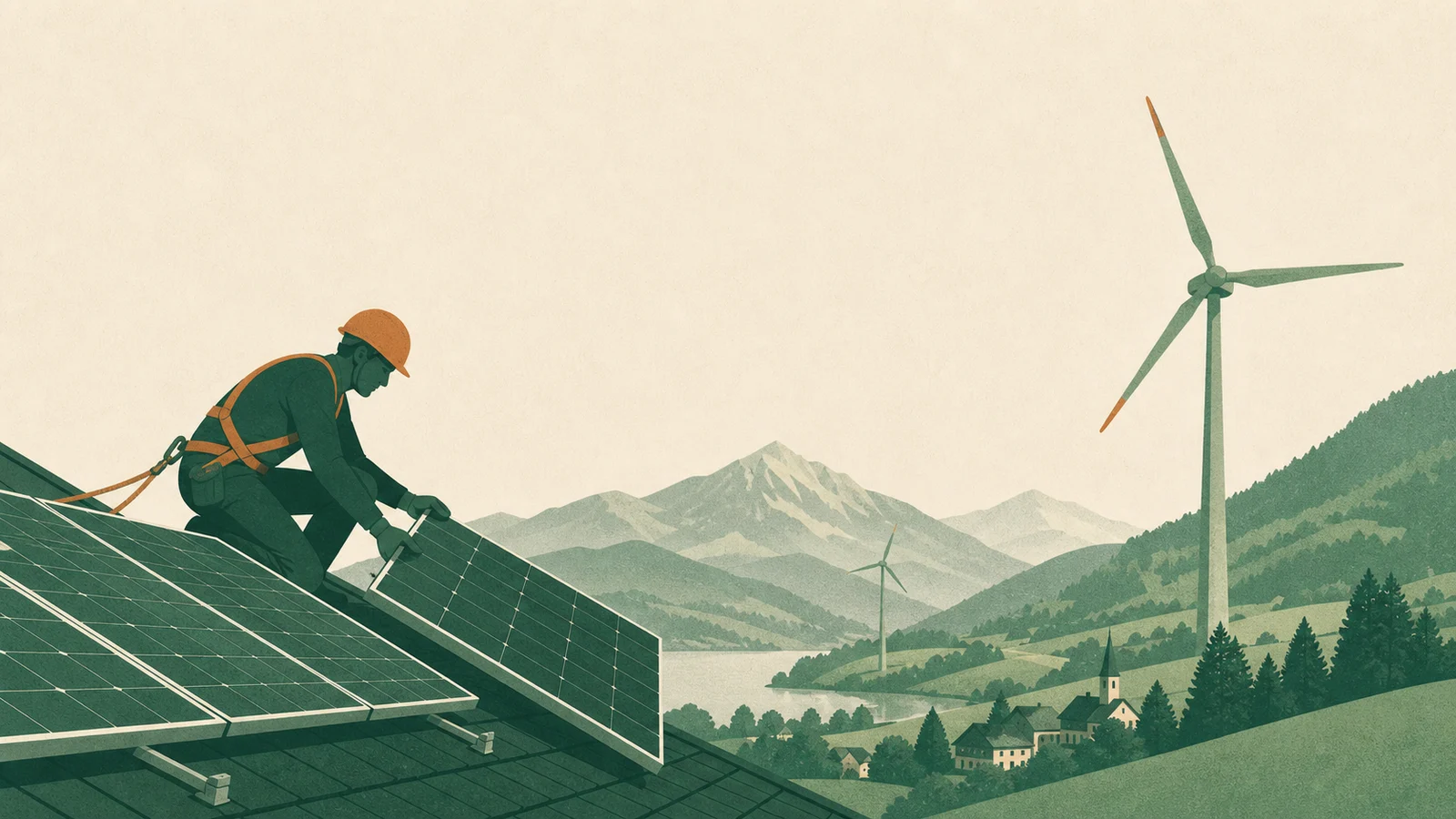
When economic researchers and labour market experts in Austria talk about growth areas these days, one phrase comes up again and again: "green jobs". The term covers work that contributes, directly or indirectly, to protecting the environment, cutting energy consumption or conserving resources. That spans everything from the plumber installing a heat pump to the engineer planning a wind farm and the technician dismantling old appliances for recycling. Behind the somewhat glossy buzzword lies a real structural shift: the switch to renewable energy, the retrofitting of the building stock and the build-up of a circular economy are changing which qualifications the Austrian labour market demands. Anyone starting a training programme today, or contemplating a career change, will find comparatively stable prospects in this field.
What counts as a green job
There is no single, sharply drawn definition — and that is part of the difficulty in measuring the field. Statistics Austria, the national statistics office, counts as the so-called environmental sector those businesses and jobs whose goods and services primarily serve environmental protection or resource management. On this reading, several hundred thousand jobs in Austria depend on the environmental sector, and the trend has been rising for years. The Federal Environment Agency (Umweltbundesamt) and the economic research institute WIFO point out that many of these jobs are not found in dedicated "green" occupations at all, but in traditional industries that are increasingly taking on sustainable tasks.
This is precisely where an important distinction lies. On the one hand, there are inherently green occupations, for instance in photovoltaic installation or recycling. On the other, there are existing professions that are turning green: the roofer now fits solar panels as part of the job, the architect designs for energy efficiency, the farmer focuses on soil protection. For anyone choosing a career, that means you do not necessarily have to take up some exotic new profession to work in this field. Often an existing qualification, topped up with the right additional skills, is enough.
The sectors with the strongest demand
Three fields stand out when you look at where companies are hiring.
The most visible is renewable energy. As photovoltaics, wind and hydropower expand, demand is rising for electrical engineers, plant designers and installers. In Lower Austria and Burgenland, wind farms shape entire stretches of countryside; in Styria and Upper Austria, the solar industry is growing. Photovoltaic Austria, the industry's federal association, has been warning for years of a shortage of qualified installation staff that is slowing the roll-out.
The second big field is the thermal retrofitting of the building stock. Austria has set itself ambitious climate targets, and a substantial share of greenhouse gases comes from buildings. Replacing oil and gas heating with heat pumps, district heating and biomass, along with insulating façades, ties up enormous trade capacity. Plumbers, heating technicians, tinsmiths and construction workers are in permanently high demand here. Subsidy programmes from the federal government and the provinces, such as the boiler-replacement scheme, are keeping order books full.
The third field is the circular economy. Tighter EU rules on recycling quotas and repairability are creating jobs in waste separation, reprocessing and the repair trades. Vienna, with its Repair Network and subsidised repair voucher, runs a model that is attracting attention well beyond the city limits. In process engineering, specialists are being sought who can turn residual materials back into raw materials.
The skills shortage as a brake on growth
However positive the demand sounds, the flip side is just as stark: there is a shortage of people to do the work. The Public Employment Service (AMS) regularly lists electrical engineering, plumbing and building services, and several construction trades on its official register of shortage occupations. WIFO has pointed out in several analyses that the success of the climate transition depends heavily on whether enough qualified staff are available. The Economic Chamber (Wirtschaftskammer) and the Chamber of Labour (Arbeiterkammer) arrive at the same finding from different perspectives: the bottleneck is real and, without countermeasures, is likely to get worse.
The reasons lie partly in demography, partly in the structure of training. Large birth cohorts are retiring, while technical apprenticeships long suffered from an image problem. On top of that, the skills required are changing rapidly. A heating technician today has to master heat pumps and control systems, not just gas boilers. That shift makes ongoing training a necessity — and explains why, despite the open vacancies, not every application is a match.
Routes into the profession
The classic entry point is the apprenticeship. Trades such as electrical engineering, plumbing and building services, or metal technology provide a solid foundation and are increasingly being supplemented with modules on renewable energy. Those who also want to keep the path to university open can choose the apprenticeship with Matura model. The vocational upper secondary schools — for example the HTL technical colleges' branches for environmental, energy and process engineering in Vienna, Graz, Linz and Innsbruck — train the middle and upper technical tiers.
At academic level, universities and universities of applied sciences have expanded what they offer. The Montanuniversität Leoben is a byword for recycling technology and materials science, the technical universities in Vienna and Graz cover energy engineering and building physics, and universities of applied sciences in Salzburg, Wels and Kufstein offer practice-oriented degree programmes in renewable energy and sustainable construction. Which of these routes young people take often also depends on their parents' influence. For many roles, what counts in the end is less the formal qualification than the combination of technical understanding and a willingness to get to grips with new systems.
Retraining and career changers
The field is particularly attractive for people who want to change careers. The AMS specifically supports the switch into shortage occupations — which include many green jobs — through programmes such as on-the-job qualification schemes and various training measures. The cross-regional qualification initiative in the energy sector is aimed at adults retraining, say, as photovoltaic technicians or energy consultants. Anyone coming from a shrinking sector will find a genuine prospect here, often with financial support during training.
Roles are shifting within companies too. An office administrator at a retrofitting firm grows into handling subsidy applications; a field sales rep is trained up as an energy consultant. These quiet transitions never show up in any statistic as a "green job", but they shape the working lives of many employees.
The takeaway
Green jobs are not a passing trend but the expression of a long-term restructuring of the Austrian economy. Demand is concentrated in hands-on technical and skilled trade work in energy, construction and recycling — precisely where skilled workers are already scarce today. For school leavers and career changers alike, that opens up stable prospects, provided they are willing to invest in technical qualifications and continuous training. Many young people get their first taste of the sector anyway through a summer job or compulsory internship. Whether the climate targets are met depends, in the assessment of WIFO and the Federal Environment Agency, not least on whether enough people take up these professions. The labour market, at any rate, is sending a clear signal: anyone qualified in these fields need not worry much about finding work for the foreseeable future.