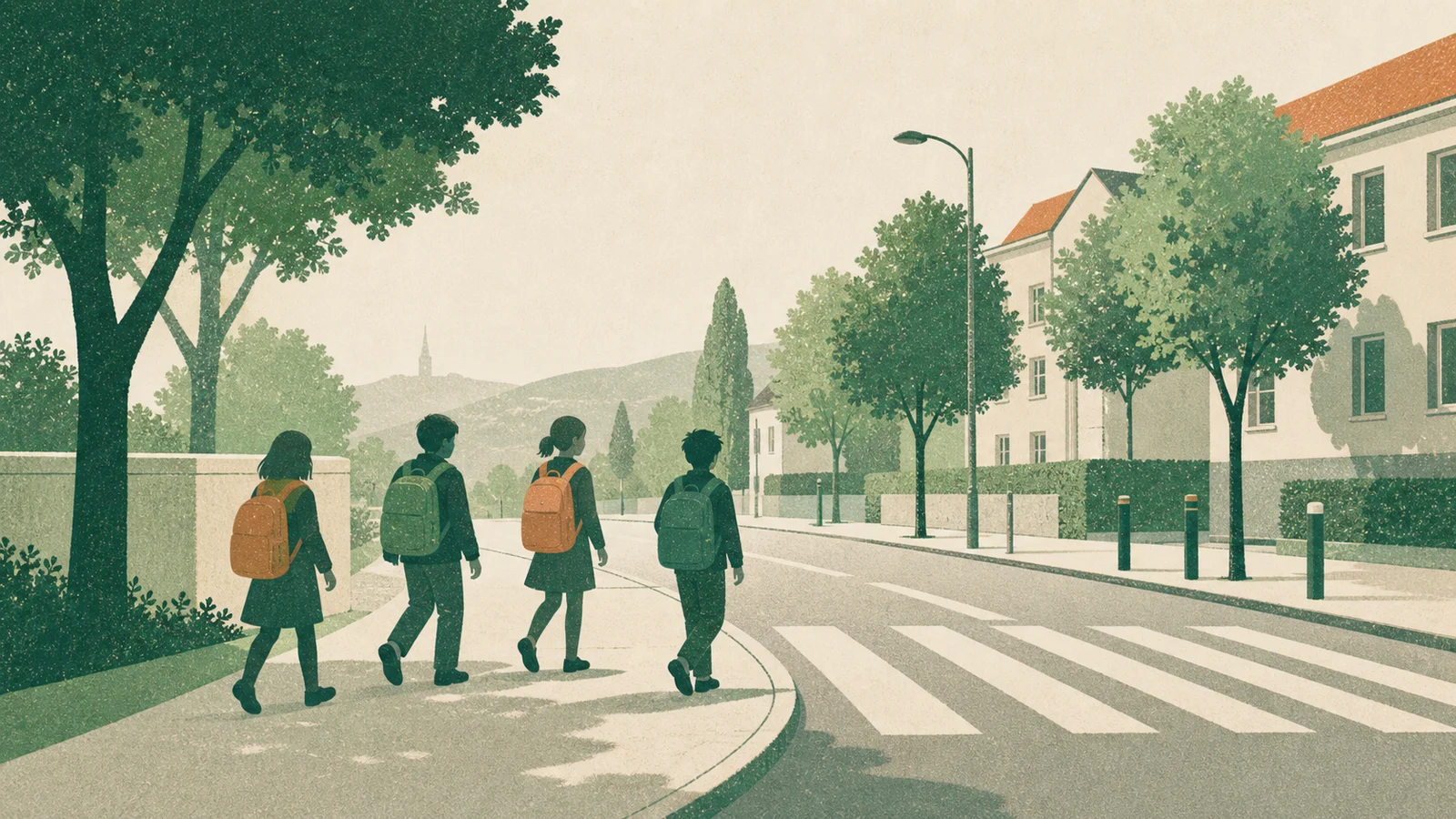
Outside many Austrian primary schools, the same scene plays out on weekday mornings between half past seven and eight: cars double-parked, doors flung open, children hopping between bumpers onto the pavement. The so-called Elterntaxi — the parental school run by car — was long regarded as a practical compromise for working families. These days, traffic planners and school communities tend to see it as a problem to be defused. At the same time — away from the headline debate over e-mobility and the transport transition — a countermovement is taking shape. In several Austrian cities, more children are once again making their way to school on foot, by scooter or by bike. The trend is being carried along by initiatives such as the Pedibus — a supervised walking bus — and by school streets, which are closed to car traffic at set times.
From the Norm to the Exception
For decades, it went without saying that children walked to school alone or in groups. Over recent generations, however, the share of those driven by car has risen markedly. Mobility surveys drawn on by, among others, the transport advocacy group VCÖ show that a substantial proportion of primary school children now cover the journey to school at least occasionally by car, even though most of these trips would be short enough to manage on their own. Many routes are under two kilometres — comfortably within walking distance.
The reasons are understandable. Parents point to time pressure, to routes that pass their workplace anyway, and above all to safety concerns. This creates a cycle that experts describe as self-reinforcing: the more parents drive their children out of worry, the more chaotic and dangerous the situation directly outside the school gate becomes — and the more other parents feel vindicated in doing the same. Klimabündnis Österreich, the climate alliance network that works with schools and municipalities on the issue, has been pointing out for years that the traffic around schools is often largely self-inflicted.
What Happens at the School Gate
The immediate surroundings of a school are a peculiar zone in traffic terms. In a confined space, turning vehicles, stopping cars and large numbers of children converge — children whose behaviour in traffic is not yet fully predictable. AUVA, the Austrian accident insurance body, which also monitors school routes, stresses in its prevention work that children are worse than adults at judging speeds and distances, and that their smaller stature makes them harder to see. Double parking, reversing and doors opening suddenly add further risk. Whether the car was filled up at a petrol station or charged at a home wallbox beforehand makes no difference to that risk.
There is also a learning dimension. A child who never walks anywhere gains hardly any experience of road traffic. Road safety experts argue that managing the journey to school independently is a training opportunity that simply disappears when children are driven. Safety through avoidance can, in this way, lead to greater insecurity in the long run, because the necessary routine never develops.
The Pedibus: A Walk with a Timetable
One concrete answer to the dilemma is the Pedibus, known in some places as the Gehbus or walking bus. The principle is simple: children walk to school together, accompanied, along a fixed route with defined stops and departure times where further children join. Depending on the model, the groups are escorted by parents on a rota or by volunteers.
The advantage is obvious. Parents who cannot walk along every day hand their child over to a supervised group without resorting to the car. Klimabündnis and several of its regional branches support such projects with materials, route planning and guidance. In Vienna, Graz, Linz and smaller municipalities, Pedibus lines have repeatedly sprung up at individual schools in recent years. They work best where a committed group of parents or the school itself carries the organisation over the long term. But that is also precisely the model's weakness: it depends on voluntary commitment and grinds to a halt when the people holding it together drop out.
School Streets: Changing the Infrastructure
Where appeals to parental behaviour reach their limits, cities are increasingly turning to a structural measure: the school street. The road outside a school is closed to private motorised traffic at drop-off and pick-up times, typically for a limited window in the morning. Residents, emergency services and refuse collection remain exempt; through traffic and the school run are kept out.
Vienna trialled the instrument in a pilot scheme and has made it permanent at several locations in recent years. Graz, Salzburg, Innsbruck and other municipalities have comparable models or pilot projects. The legal basis was created by an amendment to the Straßenverkehrsordnung, Austria's road traffic act, which explicitly provides for school streets and makes them easier for municipalities to implement.
The effect is tangibly measurable in everyday life. When the direct drop-off traffic disappears, the area outside the school gate gains space and visibility, and children can cover the final stretch of their journey more safely. Criticism comes chiefly from residents and parents who fear the traffic will simply shift into the surrounding side streets. Traffic planners respond that a school street is therefore best combined with safe crossings, a 30 km/h limit around schools and well-designed drop-off and pick-up zones at some distance, so that the problem is not merely displaced but reduced.
More Than a Traffic Issue
The debate is often narrowed down to safety and congestion, but the arguments reach further. For many children, the journey to school made under their own steam is the most reliable form of daily exercise. Given that health professionals and bodies such as the VCÖ regularly warn of too little everyday physical activity among children and adolescents, the daily walk carries real weight. It contributes to the recommended amount of exercise without requiring a separate appointment in the diary.
There is also an aspect that interests teachers: concentration and receptiveness. A child who has moved about in the fresh air before lessons is, in widespread pedagogical experience, more alert and more settled than one who steps straight from the back seat into the classroom. Robust individual studies on this link are tricky to generalise, but the basic pattern — that exercise eases the start of the school day — is broadly supported in the literature. Not least, it is a matter of independence. For many children, the journey to school is the first route they regularly manage without adults, complete with small decisions, encounters and responsibility.
What Remains
The rise in children's active mobility is no foregone conclusion but the result of concrete measures and a shift in awareness. Pedibus lines show that walking together can be organised; school streets create the physical conditions; and institutions such as the VCÖ, Klimabündnis and AUVA supply data, arguments and practical support. What matters is the interplay. A school street without safe routes around it achieves little, a Pedibus without a group to carry it fizzles out, and an appeal to parents falls flat as long as the space outside the school gate remains chaotic. That more children are once again arriving at school on foot is less a return to a nostalgic picture than the product of sober reasoning: the walk to school is safer, healthier and more instructive than it often looks from behind a windscreen.