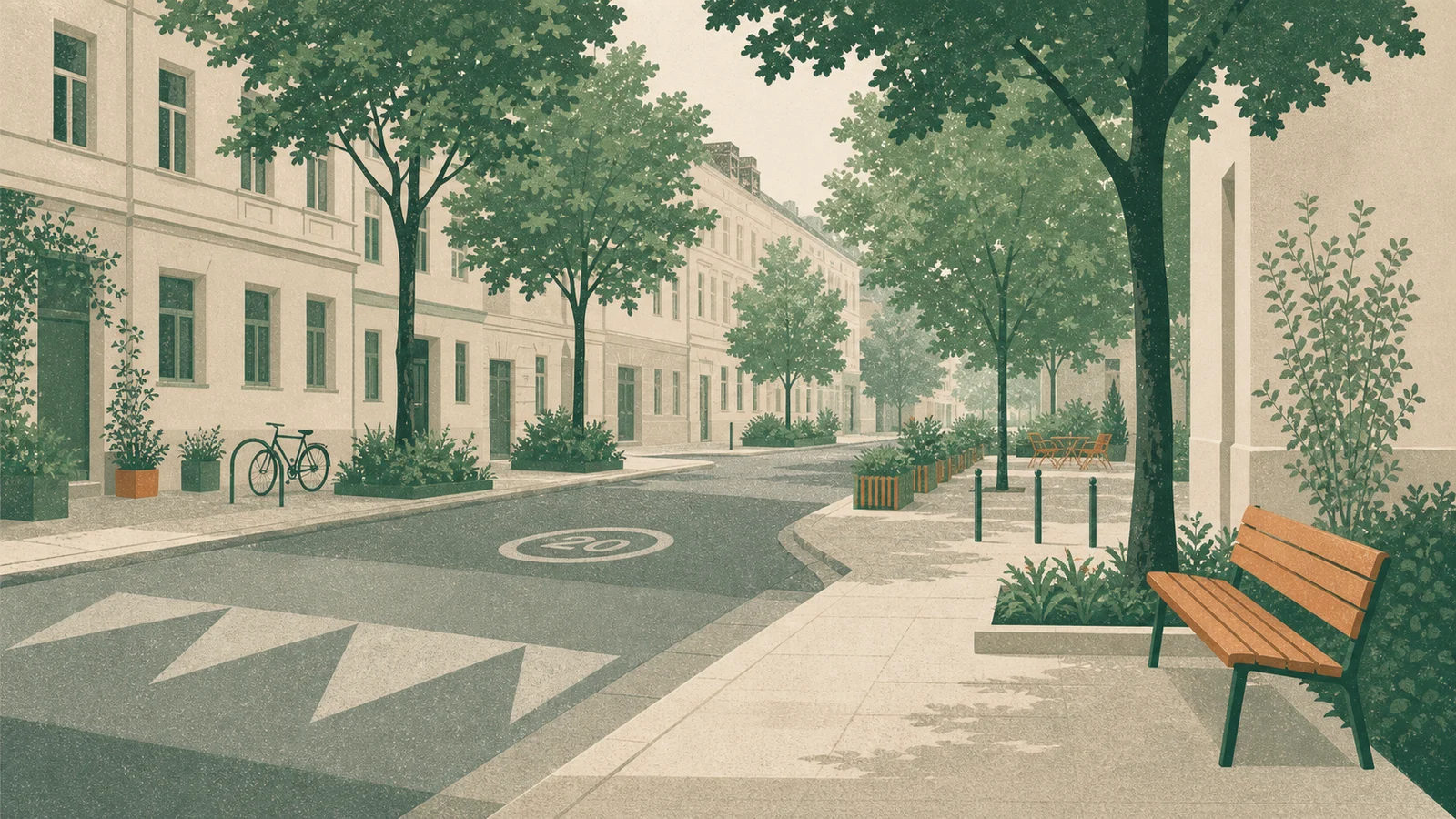
When Austrians argue about speed limits in built-up areas, the dispute is rarely about a few kilometres per hour. It is about who the street belongs to: moving traffic, or the people who live, shop and walk to school along it. Tempo 30 — the 30 km/h limit — has become the symbol of that debate, from small Tyrolean villages to the big provincial capitals. Since an amendment to the Road Traffic Act (StVO) in July 2024 made such limits far easier to enact, more and more municipalities have been taking up the offer. Reason enough to take a sober look at what 30 km/h limits and traffic calming actually achieve — and where the critics have a point.
The physics: why 20 km/h makes all the difference
The crucial figure is not the distance travelled but the stopping distance. A car doing 50 km/h needs around 40 metres to come to a halt, reaction time included. At 30 km/h it is less than half that — roughly 18 metres. Put another way: at the point where a car that set off at 30 km/h has already stopped, the 50 km/h car is still in its reaction phase. It has not even begun to brake.
If a collision does happen, impact speed decides between life and death. According to the prevailing research, a pedestrian struck by a car travelling at 50 km/h is roughly six times more likely to be killed than at 30 km/h. An impact at 50 km/h is comparable to a fall from ten metres; at 30 km/h, to a fall from about three and a half metres. That is not a moral argument but simple mechanics — and it explains why road-safety experts call for 30 km/h limits above all where large numbers of unprotected road users are about.
What the research shows — and what remains open
The most robust evidence concerns accident figures. Empirical studies show that 30 km/h limits in urban areas can cut the number of accidents and injuries by around 20 to 30 per cent. That squares with experience abroad, where blanket 30 km/h strategies have led to measurably fewer serious injuries.
On noise, the effect is real but easily misread. Measurements show that the continuous sound level drops by around three decibels on average at 30 km/h rather than 50. Three decibels sounds like little, but subjectively it corresponds to roughly halving the perceived volume of traffic. The gain is most noticeable where traffic flows more evenly — that is, with less abrupt accelerating and braking. Which is precisely where the criticism bites: the noise benefit depends heavily on driving style. Anyone lurching along in a low gear gains little.
Air quality is the most contested ground. Advocates argue that smoother driving with fewer load changes cuts pollutants. Critics — including parts of the motoring lobby and, in Germany, the federal environment agency (Umweltbundesamt) in a much-quoted assessment — counter that with unfavourable gear choice, 30 km/h can actually push up fuel consumption and nitrogen oxides. The honest answer: the air-quality effect is small and context-dependent, while the safety effect is robustly documented. Anyone who justifies Tempo 30 on clean air alone is arguing on shaky ground.
The safety gain is robustly documented. On noise, the effect is real but moderate — and on air quality the balance remains disputed.
Graz: the city that has been showing how for over 30 years
No Austrian example speaks louder than Graz. Since 1 September 1992, the Styrian capital has applied a blanket 30 km/h limit across around 80 per cent of its road network — only the main arteries stayed at 50. That made Graz one of the first major European cities with a speed limit of such breadth, and a model for cities from Dornbirn and Mödling to Grenoble, Helsinki and Zurich.
The balance sheet after three decades is remarkable. The number of accidents involving personal injury fell by a lasting 20 per cent or so in Graz despite growing traffic — a decline well above the nationwide trend. Just as striking is what contradicts the opponents' fears: average actual speeds fell by only about half a kilometre per hour as a result of the measure. The great dread of citywide gridlock never materialised — because in real urban traffic, hardly anyone was doing 50 anyway.
Equally telling is the shift in public acceptance. At the outset, in autumn 1992, only around 44 per cent of Graz residents viewed the project favourably. Barely two years later, in 1994, it was more than three quarters, and in later surveys approval rose above 80 per cent. This pattern — initial scepticism, later broad support — runs through almost every traffic-calming project, and it is an argument for patience over shock therapy. Graz is now extending its 30 km/h zones further under its mobility plan.
Vienna: from speed limit to rebuilt street
Vienna is taking a somewhat different route. Rather than a citywide speed limit, the capital leans more heavily on structural traffic calming — shared "encounter zones", "Low Traffic Grätzl" (low-traffic neighbourhoods) and completely redesigned streetscapes. The distinction matters: a sign lowers speeds only up to a point, while a rebuilt street enforces them.
The most prominent project under way is the outer Mariahilfer Strasse. The first section, roughly 600 metres between the Gürtel ring road and Clementinengasse, was completed in July 2025 — with a two-way cycle path, 18 new trees, considerably more greenery, seating and cooling features on widened pavements. The one-way scheme noticeably cut through-traffic in the surrounding residential streets. The second section began in spring 2026 and will add further kilometres of cycle path, around 45 new trees and over 1,000 square metres of new green space.
Here it becomes plain that traffic calming is about more than safety. It is about the quality of public space: shade-giving trees against ever-hotter summers, benches, drinking fountains, room for people rather than ranks of parked metal. In the low-traffic Grätzl, through-traffic is kept out of residential quarters without cutting off access for residents. For a sense of how this connects with other mobility decisions, our comparison of public transport versus the car on cost offers further pointers — because calmer streets and attractive public transport reinforce each other.
The debate: where the criticism lands — and where it doesn't
Tempo 30 polarises, and not every objection can be waved away. There is legitimate concern that a blanket reduction on main arteries with synchronised traffic lights and tram lines would congest traffic rather than calm it. That is why most Austrian schemes — Graz included — keep the higher limit on the big through-roads and confine 30 km/h to the secondary network. Where traffic lights and green phases are tuned to 30 km/h, traffic can even flow more smoothly than in stop-and-go at 50.
The arguments around air and noise are weaker when treated as absolutes. Studies here reach differing conclusions depending on who commissioned them and how measurements were taken, and motoring associations such as ÖAMTC and ADAC rightly point out that the pollution and noise benefits are smaller than often claimed. What is more, the exhaust question is losing weight as the electric fleet grows — anyone charging an EV at their own wallbox drives through the 30 km/h zone with zero local emissions. But that does not devalue the 30 km/h limit — it merely shifts the justification to where it is strongest: road safety and quality of life in residential areas. Research from traffic-calmed zones shows, for instance, that children there play outside noticeably longer and with less supervision than on streets with through-traffic and a 50 km/h limit.
The political framework has meanwhile shifted decisively. Under the 35th amendment to the Road Traffic Act (StVO), in force since 1 July 2024, municipalities and cities can now impose 30 km/h limits with less bureaucracy and at lower cost — above all around schools, kindergartens, hospitals and care homes. All that matters now is that the measure improves road safety; the old criterion of preserving the "ease and fluidity of traffic" has been dropped. It is a deliberate rebalancing away from pure traffic flow towards protecting the most vulnerable.
Verdict: no cure-all, but an effective tool
The balance sheet is nuanced. Tempo 30 is no miracle remedy for bad air, nor a guarantee of quiet — sell it as such and you practically invite the backlash. What is robustly documented is the safety gain: shorter stopping distances, dramatically better survival odds in collisions, and in Graz a demonstrable one-fifth reduction in injuries. That carries weight when you consider that 53 pedestrians died on Austria's roads in 2025 — and that older people are disproportionately often killed or injured in built-up areas.
Traffic calming is most convincing where speed limit and redesign come together: a sign that lowers speeds, plus a streetscape that invites lingering rather than driving through. Graz shows that initial scepticism gives way to approval once the benefits become tangible in everyday life. And Vienna shows that calmer streets can be more than slower traffic — they can be public space reclaimed. Anyone looking to leave the car at home more often will find practical starting points in our tips on commuting without a car in Austria, which point in exactly this direction.