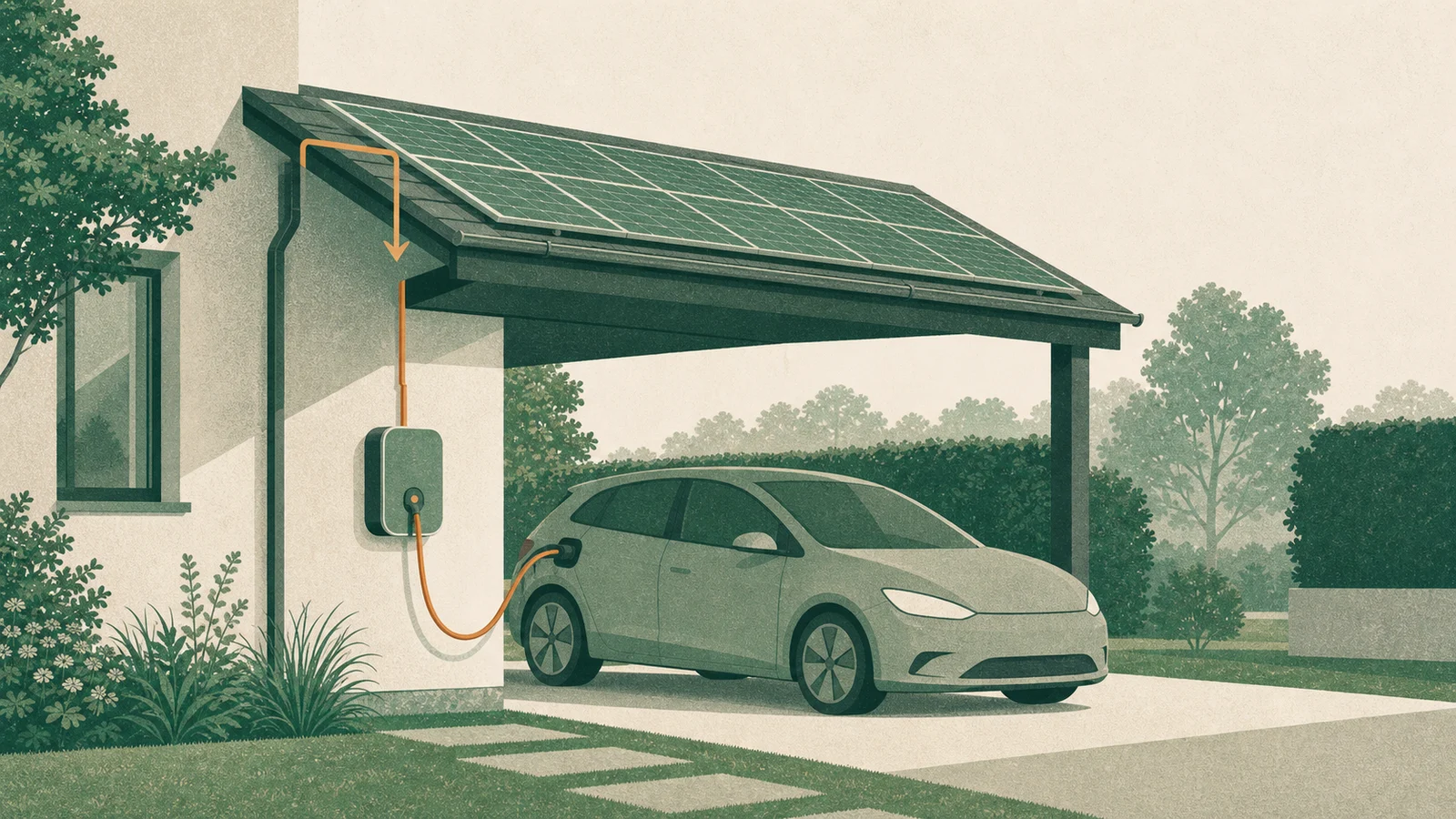
If you drive an electric car in Austria in 2026, you charge it, for the most part, where it spends most of its time anyway: at home. It is convenient, considerably cheaper than the public charging point — and it raises a series of very practical questions. What does a wallbox actually cost, installation included? Are there still subsidies? How much do I save compared with charging on the road? And above all: am I even allowed to put the box up if I rent, or if the garage belongs to a building with multiple owners?
This piece takes stock of where things stand in early summer 2026 — no sales pitch, but with the figures and legal foundations you should know before the electrician arrives.
What a wallbox costs, installation included
A permanently installed wallbox is not a socket but a registered device on your household grid connection. For the hardware alone, an 11 kW unit typically runs between roughly €500 and €1,500 according to Austrian suppliers — depending on manufacturer, app connectivity and load management. On top of that comes installation by a licensed electrician, which usually takes three to six hours and, at hourly rates of around €60 to €120, adds roughly €200 to €800 to the bill.
All told, industry sources put a clean private installation at somewhere between about €1,000 and €2,500. Important caveat: that applies to the straightforward case — a garage attached to the house, the meter cabinet nearby, enough space in the distribution board.
Things get more expensive through line items that tend to slip through the cracks in the initial consultation. An outdated or full meter cabinet that needs replacing can, according to installers, cost €500 to €1,500. An upgrade of your grid connection capacity, longer cable runs to a detached garage or groundworks for a carport push the price up further. Which is why the rule is: before ordering, get an on-site visit and a written quote in which precisely these points have been probed.
On power output, 11 kW is the pragmatic standard for most households. Overnight, it will comfortably top up any realistic day's driving. 22 kW sounds like more, but for the typical park-and-charge situation at home it is rarely necessary — and, as we explain below, it brings additional red tape and approval requirements.
Notification or approval?
In Austria, you cannot simply plug in a wallbox: it must be registered with your local grid operator. The rule of thumb, according to the grid operators: up to 12 kW, a notification suffices; above that threshold, you need an actual approval. In practice, that means an 11 kW box is notified and confirmed; a 22 kW installation must be formally cleared. In Lower Austria, for instance, charging equipment above 3.68 kVA is registered via the customer portal of Netz NÖ; in Vienna it goes through Wiener Netze, the city's grid operator.
At 22 kW, the grid operator can in theory refuse approval if the local network cannot carry the load — rare in practice; usually a throttling to 11 kW is proposed instead. The good news: the installer normally handles the registration as part of the job. But you should have it stated in the quote that this is included.
Subsidies in 2026: currently a waiting game
Here is where many prospective buyers are stuck at the moment. The federal subsidy for private charging infrastructure — most recently run under the name eRide through the Umweltförderung environmental funding scheme — hit its budget ceiling early in 2026. According to several sources, the pot was already exhausted around 18 March 2026, and no new registrations have been possible since.
For a sense of scale: in previous years, single-family homes received around €400, individual charging points in multi-unit buildings up to about €800 per point, and wallboxes in shared installations with load management up to €1,500 — each tied to conditions such as installation by a certified professional and operation on one hundred per cent green electricity.
Whether and when the pot will be topped up remains open as of June 2026. The ministry responsible for mobility, under federal minister Peter Hanke, recently said it was working on further expanding EV charging infrastructure; several measures were presented in May 2026. Since the funds were topped up more than once in previous years, a revival of the private subsidy is plausible — but as of June 2026 no specific amount has been fixed. If you intend to invest anyway, check the status directly on umweltfoerderung.at before placing an order, and do not bank on any particular sum. Beyond the federal scheme, there are in some cases provincial and municipal subsidies that can run independently of the federal pot.
Charging at home is significantly cheaper than on the road
The economic core of the whole exercise is the price gap on electricity. The average household electricity price in Austria in 2026 sits roughly around 30 cents per kilowatt-hour, and depending on tariff and province more like 30 to 35 cents. That puts a home charge at the equivalent of about four to seven euros per 100 kilometres.
Publicly, the arithmetic looks different: AC charging points frequently charge 40 to 60 cents per kilowatt-hour, and the fast HPC chargers up to around one euro. On the road, in other words, you quickly pay two to three times as much. Over an annual mileage of 15,000 kilometres, comparison calculations put the saving at roughly €500 to €1,000 if you charge primarily at home rather than at the expensive public point. If you want to dig into the exact tariff differences, you will find them in our cost comparison of public transport versus the car; more generally, it is worth a look at the development of electricity prices in Austria in 2026, because the home tariff carries the whole calculation.
That gap is also why the home wallbox usually pays for itself over the years despite the upfront cost — provided you drive regularly and not just a few thousand kilometres a year.
The real lever is not the box but the electricity price: if you charge at home for 30 cents instead of 70 at the public point, you have often recouped the extra outlay for the installation within two or three years.
Cheaper still: charging from your own solar array
If you have a roof and a photovoltaic system, you can amplify the savings considerably. In so-called surplus charging, the solar power that would otherwise flow into the grid for a few cents goes straight into the car. A smart wallbox adjusts the charging power dynamically to the available solar output, switches to single-phase charging when needed and starts from as little as around 1.4 kW.
The effect on self-consumption is substantial. According to industry figures, the self-consumption rate of a PV system on its own is about 30 per cent; with an EV connected it rises to around 55 to 65 per cent, and with a home battery on top, up to 85 per cent. In purely economic terms, surplus charging at 15,000 kilometres a year can save a further €700 to €1,000 or so in electricity costs — because you are using your own solar power in place of expensive grid electricity.
Whether a battery storage system pays off on top of that is a calculation of its own, heavily dependent on system size and consumption profile. We have unpacked it in a separate piece: Is a home solar battery worth it in 2026? And note that a wallbox up to 12 kW requires no approval in this configuration either — it merely has to be notified to the grid operator.
Renting and owning: the legal position
For many people, the hardest part is not the technology but the question of whether they may install the box at a shared parking space at all. Precision pays off here, because a hasty DIY job can be expensive to undo.
For owner-occupied flats, the 2022 amendment to Austria's condominium law (WEG) introduced a so-called "right to plug". Simplified, it means flat owners have, in principle, the right to their own charging facility at their parking space. The Supreme Court of Justice (OGH) had already, in an earlier decision (5 Ob 173/19f), classified single-phase charging at around 3.7 kW as a privileged measure under the WEG. For more extensive installations — three-phase at 22 kW, say — that privileged status does not, according to the OGH, apply automatically; here, additional proof of a substantial interest may be required. The other owners must be informed of the project and have a two-month window to object; if no one objects within the deadline, consent is deemed granted. Anyone who proceeds without proper notification risks a mandatory removal — the specialist law firms warn about this in no uncertain terms.
As for renting: structural interventions require, in principle, the landlord's consent, and a permanently mounted wallbox is such an intervention. For flats fully covered by Austria's Tenancy Act (Mietrechtsgesetz), a practically relevant easement applies: if the landlord does not respond to a written, specific request within two months, consent is deemed granted. The letter should therefore be precise — location, power output, the certified firm carrying out the work, and restoration on moving out.
In both cases, put everything in writing and, when in doubt, get brief initial legal advice before committing any money.
Conclusion
Charging an EV at home in Austria in 2026 is technically straightforward and economically well ahead of the public charging point — especially in combination with your own solar array. The two real stumbling blocks are subsidies and the law: the federal pot is currently empty and its replenishment uncertain, and in rented and owner-occupied properties alike, properly notifying the other parties determines whether the box may actually stay on the wall. If you clarify both in advance, check the installer's quote for hidden costs and verify the current subsidy status, the investment is easy to plan. For the bigger picture — why home charging is so central to the mobility transition — see our piece on EVs and the mobility transition.